
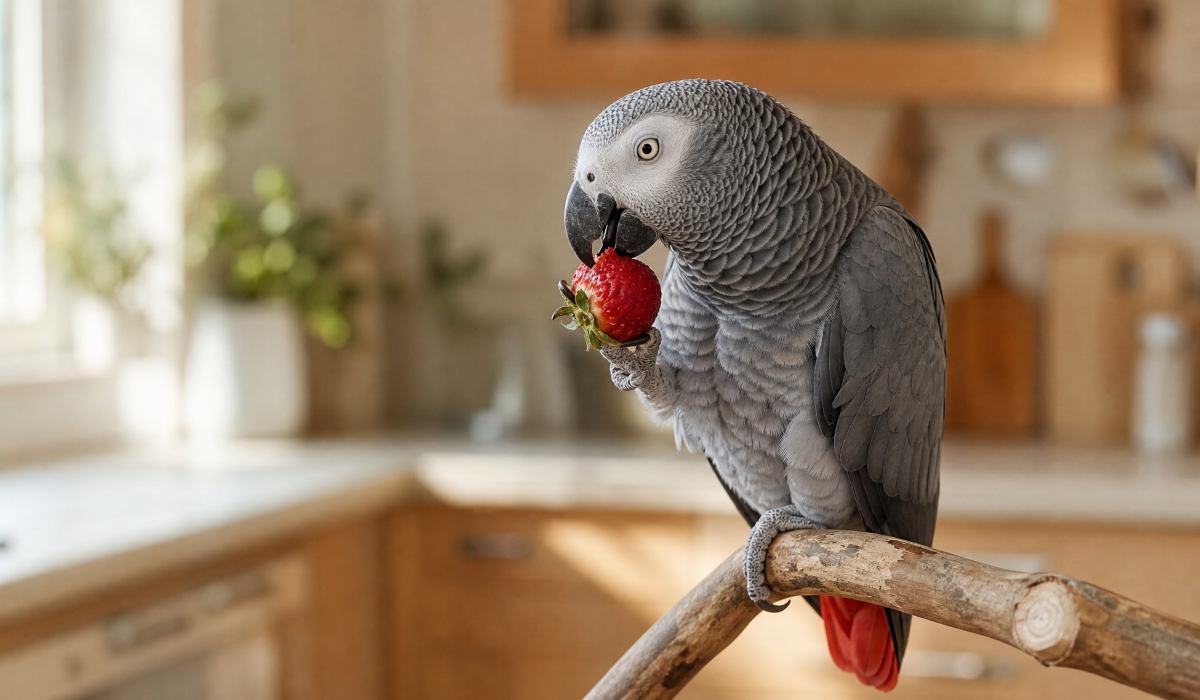
Short answer: yes, and berries are better for parrots than almost any other fruit.
Serve them two or three times a week — about 3 g for a budgie, 6 g for a cockatiel, 12 g for an African Grey and 20 g for a large macaw.
Nearly every article on this subject warns you to feed berries sparingly because of the sugar. That advice is backwards.
Raspberries carry less than a third of the sugar of a grape. They also hold more fiber than any other fruit you can buy.
The real reasons to be careful are different, and almost nobody mentions them.
Key facts at a glance
| Question | Answer |
|---|---|
| Are strawberries safe for parrots? | Yes |
| Are berries high in sugar? | No. Only tomato carries less |
| Which berry has the least sugar? | Raspberry, at 4.42 g per 100 g |
| Which berry has the most? | Blueberry, at 9.96 g — more than double a raspberry |
| Which berry has the most fiber? | Raspberry, at 6.5 g — the highest of any common fruit |
| Is the vitamin C useful? | No. Parrots make their own vitamin C |
| Do I need organic? | For strawberries, blackberries and blueberries, yes. Raspberries are the exception |
| Are the seeds safe? | Yes, all of them |
| Are strawberry tops safe? | Yes, leaves and all |
| Portion for a budgie | About 3 g — a quarter of a strawberry, or one raspberry |
| Portion for an African Grey | About 12 g — two strawberries or a small handful of raspberries |
| The real risk | Mold. Berries spoil faster than any other fruit |
Are berries high in sugar for parrots?
No. Of everything in the fruit bowl, only tomato carries less sugar than a berry.
Here is where they sit against the fruits everyone recommends freely.
| Fruit | Sugar per 100 g |
|---|---|
| Grape | 15.5 g |
| Banana | 12.2 g |
| Apple | 10.4 g |
| Blueberry | 9.96 g |
| Strawberry | 4.9 g |
| Blackberry | 4.88 g |
| Raspberry | 4.42 g |
| Tomato | 2.6 g |
A raspberry carries less than a third of the sugar of a grape. A strawberry carries less than half the sugar of a banana.
Yet the standard advice is to ration berries because of the sugar. Grapes and bananas get handed over without much thought.
If you are rationing fruit by sugar content, berries should be the fruit you feed most often, not least.
Which berry is actually best?
They are not interchangeable, and the differences are larger than most people expect.

| Per 100 g | Strawberry | Raspberry | Blackberry | Blueberry |
|---|---|---|---|---|
| Calories | 32 | 53 | 43 | 57 |
| Sugar | 4.9 g | 4.42 g | 4.88 g | 9.96 g |
| Fiber | 2.0 g | 6.5 g | 5.3 g | 2.4 g |
| Vitamin C | 58.8 mg | 26.2 mg | 21 mg | 9.7 mg |
| Vitamin A | 12 IU | 33 IU | 214 IU | 54 IU |
| Calcium | 16 mg | 25 mg | 29 mg | 6 mg |
| Phosphorus | 24 mg | 29 mg | 22 mg | 12 mg |
| Calcium to phosphorus | 1 : 1.5 | 1 : 1.2 | 1.3 : 1 | 1 : 2 |
Three differences are worth knowing about.
Which berry has the most fiber?
Raspberry, and it holds more than any other common fruit. At 6.5 g per 100 g, a raspberry carries seven times the fiber of a grape and nearly three times that of an apple. Blackberry is close behind at 5.3 g.
Fiber is part of what makes fruit worth feeding rather than simply sweet, and most fruit has very little of it.
Which berry is best for African Greys?
Blackberry, because of the calcium.
Bird diets aim for roughly two parts calcium to one part phosphorus. Almost every fruit runs the other way. Banana is 1:4.4. Grape is 1:2. Apple is 1:1.8.
Blackberry runs 1.3 to 1 in favor of calcium — the only common fruit that does.
It will not replace dark leafy greens or broccoli, which carry far more calcium. But of all the fruits you might offer a Grey, blackberry is the one that works with the calcium in the diet. Every other fruit works against it.
Are blueberries the worst of the four?
Yes, though not by much. Blueberry carries more than double the sugar of a raspberry, less than half the fiber and a sixth of the vitamin C. Its calcium is the lowest of the four.
Blueberries are not a problem. They are simply the least useful of the four, and they are usually the ones people buy.
Do parrots need the vitamin C in strawberries?
No. Parrots make their own vitamin C, and this is the single most repeated error in articles about berries and birds.
A strawberry carries 58.8 mg of vitamin C per 100 g, which is more than an orange. Practically every article on this subject lists that as a reason to feed them.
It does nothing for your bird.
Most birds make their own vitamin C from glucose, in the liver or the kidney. That is set out in avian nutrition guidance published by Lafeber, written by Dr. Christal Pollock, a board-certified avian veterinarian.
The same guidance notes plainly that signs of vitamin C deficiency have not been documented in pet birds.
Humans lost the enzyme that makes vitamin C. Parrots did not.
The honest caveat. A small number of bird species are exceptions, mostly passerines such as the red-vented bulbul. One source lists a conure among them, though the species naming there is unclear.
There are also situations where a dietary source does become useful. Birds with liver disease, birds under severe stress, and young chicks growing fast. Those are veterinary judgments, not reasons to feed fruit.
What this means in practice: feed berries for the fiber, the low sugar and the fact that birds enjoy them. Not for the vitamin C. And if you are trying to correct a deficiency, berries are the wrong tool. Vitamin A is what parrots actually run short of. For that, feed tomato or carrot.
Do berries need to be organic for parrots?
Three of the four common berries sit on the Dirty Dozen. Raspberry is the exception.
The Environmental Working Group’s 2026 Shopper’s Guide ranks produce by pesticide residue. It is built from USDA testing of 54,344 samples, all washed before measuring, so what they record is what survives normal preparation. Berries feature heavily:
| Rank | Produce |
|---|---|
| 1 | Spinach |
| 2 | Kale and collard greens |
| 3 | Strawberries |
| 4 | Grapes |
| 5 | Nectarines |
| 6 | Peaches |
| 7 | Cherries |
| 8 | Apples |
| 9 | Blackberries |
| 10 | Pears |
| 11 | Potatoes |
| 12 | Blueberries |
Raspberries do not appear on the list at all.
The other side, fairly stated. More than 99% of USDA-tested produce falls below EPA legal residue limits, and farming industry groups dispute EWG’s ranking method. EWG itself says the benefits of eating produce outweigh the residue risk.
Why it still matters more for a bird. An African Grey weighs about 400 g. An adult weighs 175 times that. Eat the same berry and the bird takes in a far larger dose for its size. Legal residue limits are set for people.
What to do:
- Buy organic strawberries if the budget allows. Of the four, this is the one worth paying for
- For conventional berries, soak 15 minutes in one part white vinegar to three parts water, then rinse under running water
- Do not soak berries until you are about to use them. Wet berries mold within hours
- Raspberries are the safest conventional option
What is the real risk with berries?
Mold, not sugar. Berries spoil faster than any other fruit, and moldy fruit is genuinely dangerous to a small bird.

This is the part almost nobody covers, and it is the only real hazard in the whole subject. A strawberry left in a warm bowl can grow visible gray mold in a day. The fungus spreads through the fruit before you can see it on the surface.
Mold matters far more for a bird than for you. Mycotoxins from common food molds are dangerous to parrots. A bird weighing a few hundred grams gets a large dose from a small amount.
This is the same reason moldy bread is a real hazard rather than just unpleasant.
You will find a rumor on parrot forums that strawberries “harbor a fungus that can be deadly.” The rumor is aimed at the wrong thing. Strawberries do not carry anything unusual. They simply spoil faster than most fruit, so the window between fresh and dangerous is shorter.
Practical handling:
- Serve berries and remove what is not eaten within two hours, sooner in warm weather
- Store unwashed in the fridge. Washing before storage accelerates spoilage
- Discard the whole container if one berry is furry. Mold spreads through a container
- Frozen berries are a good option. Freeze fresh ones yourself rather than leaving them to spoil
- Never serve a berry you would not eat yourself
What about the strawberry allergy claim?
There is no documented strawberry allergy in parrots.
You may find posts claiming strawberries are risky for birds because they contain a protein called Fra a 1.
Fra a 1 is real, and it is a genuine allergen in humans. It belongs to a family of proteins that cross-react with birch pollen. That is why some people who react to birch also react to strawberries and apples.
Bird immune systems do not work the same way. Birds are not sensitized by birch pollen the way people are. And there is no published case of a parrot with a strawberry allergy.
If your individual bird reacts badly to a particular food, stop feeding it and speak to an avian vet. That is true of any food and is not a reason to avoid berries.
How many berries can a parrot eat?
About 3 g for a budgie, 6 g for a cockatiel, 12 g for an African Grey and 20 g for a large macaw, two or three times a week.
Fruit belongs in 5–10% of total food intake, and our complete guide to what parrots eat sets out the full pellet, vegetable and fruit ratio.
| Bird size | Example species | Berries per serving | How often |
|---|---|---|---|
| Small | Budgie, parrotlet, lovebird | About 3 g — a quarter of a strawberry, or one raspberry | 2–3 times a week |
| Medium | Cockatiel, conure, Quaker, Senegal | About 6 g — half a strawberry, or two raspberries | 2–3 times a week |
| Large | African Grey, Amazon, eclectus | About 12 g — two small strawberries, or a small handful of raspberries | 2–3 times a week |
| Extra large | Blue and gold macaw, umbrella cockatoo | About 20 g — three or four strawberries | 2–3 times a week |
Strawberries, raspberries and blackberries carry a third to a half of the sugar of most fruit. That puts them at the generous end of the fruit budget rather than the cautious end. Blueberries sit closer to an apple, so treat them the way you would treat one.
If you feed fruit three times a week, berries are a sensible choice for two of them.
How do you prepare berries for a parrot?
- Wash properly. Fifteen minutes in vinegar water for conventional berries, then rinse
- Leave the seeds. Strawberry, raspberry and blackberry seeds are all safe. There is nothing to remove
- Leave the strawberry tops on if the fruit is organic. The green leaves are safe and many parrots enjoy shredding them
- Cut to size. Quarter strawberries for small birds. A whole one is a choking risk for a budgie and usually gets dropped by a macaw
- Serve raspberries and blackberries whole. They are already the right size for most birds
- Do not mash them. Whole fruit takes longer to get through, and a bird working at its food is a bird with something to do
Making them last
A bird gets through berries in seconds. A few ways to slow that down:
- Freeze them. Frozen berries take far longer to work through, and they are welcome in hot weather
- Push a strawberry onto a stainless steel food skewer
- Scatter raspberries through a foraging tray rather than putting them in a bowl
- Stir a few into cooked whole grains. Berries are useful for making a plain grain interesting to a fussy bird
None of this turns a berry into a real foraging job. A berry is soft and it gives way at once. If your bird needs something to work at properly, nuts in the shell do that job and berries never will.
Which berry products should parrots avoid?
Dried berries. Drying removes the water and concentrates the sugar several times over. Many commercial dried cranberries and blueberries are also sweetened, which makes them worse again.
Berry yogurt. Sugar, dairy and very little berry. Parrots do not digest lactose well.
Jam, preserves and pie filling. Mostly sugar.
Berry juice and smoothies. The fiber is gone, which is the one thing berries are genuinely good for.
Anything sugar-free. Sugar-free is worse, not better. Xylitol is toxic to birds and appears in some sugar-free dried fruit and baked goods.
Any berry you cannot identify. Garden and wild berries include species that are genuinely toxic. Feed only berries sold for people to eat.
This is a different category from the fruit in your kitchen, in the same way avocado and chocolate sit apart from apples.
When should you keep berries off the menu?
- Any berry showing mold, or from a container where one berry has gone furry
- Overweight birds, though berries are the fruit least likely to cause this
- Birds diagnosed with fatty liver disease, unless your avian vet says otherwise
- Any bird that stops eating vegetables once fruit appears. Berries are sweet and require no work, which makes them one of the more likely fruits to trigger this
- Berries washed in advance and then stored. Wash them right before serving, never before putting them away
One thing worth noting: berry juice stains. Blackberries and raspberries will mark perches, cage covers and your furniture. That is not a health issue, but it does surprise people the first time.
Frequently asked questions
Can parrots eat strawberries? Yes. Strawberries are safe for parrots, seeds and green tops included. Serve about 3 g for a budgie, 6 g for a cockatiel, 12 g for an African Grey and 20 g for a large macaw, two or three times a week.
Are berries too high in sugar for parrots? No, and this is the most common error in articles on the subject. Raspberries carry 4.42 g of sugar per 100 g against a grape’s 15.5 g and a banana’s 12.2 g. Only tomato carries less. Berries should be fed more often than most fruit, not less.
Which berry is best for parrots? Raspberries and blackberries, for different reasons. Raspberry has the most fiber of any common fruit at 6.5 g per 100 g. Blackberry is the only fruit whose calcium-to-phosphorus ratio favors calcium, which matters for African Greys. Blueberry is the weakest of the four, with double the sugar of a raspberry.
Do parrots need the vitamin C in strawberries? No. Most birds synthesize their own vitamin C in the liver or kidney, and signs of vitamin C deficiency have not been documented in pet birds. The vitamin C content is a real number, but it is not a reason to feed berries to a parrot.
Do berries need to be organic for parrots? Strawberries, blackberries and blueberries all appear on EWG’s 2026 Dirty Dozen, at positions three, nine and twelve. Raspberries do not appear at all. Buy organic strawberries if you can. For conventional berries, soak fifteen minutes in one part vinegar to three parts water, then rinse.
Can parrots eat strawberry tops and leaves? Yes, if the fruit is organic. Strawberry leaves are not toxic and many parrots enjoy shredding them. Skip the tops on conventional fruit, since residue concentrates on the surface.
Can parrots eat berry seeds? Yes. Strawberry, raspberry, blackberry and blueberry seeds are all safe and there is no need to remove any of them.
Can parrots eat frozen berries? Yes, and frozen is a good option. It slows the bird down, it suits hot weather and it avoids the spoilage problem entirely. Thaw slightly or serve frozen, whichever your bird prefers.
Are strawberries an allergy risk for parrots? There is no documented strawberry allergy in parrots. The claim comes from a protein called Fra a 1, which is a genuine allergen in some people who also react to birch pollen. Bird immune systems do not work the same way and no case has been published.
Can parrots eat dried berries or cranberries? Best avoided. Drying concentrates the sugar several times over, and most commercial dried berries are sweetened on top of that.
Can baby parrots eat berries? Unweaned chicks should have an appropriate hand-rearing formula and nothing else. Once weaned, small amounts fit within the normal fruit allowance.
What if my parrot ate a moldy berry? Watch it closely. Mycotoxins from food molds are dangerous to birds, and a small amount goes a long way in an animal weighing a few hundred grams. Call an avian vet if your bird becomes lethargic, stops eating, vomits or shows any breathing difficulty.
The practical summary
Berries are among the best fruits you can give a parrot, and the standard advice has it backwards.
Strawberry, raspberry and blackberry carry a third to a half of the sugar of a grape, banana or apple. Raspberry holds more fiber than any other common fruit, which is where it beats even tomato. Blackberry is the only fruit whose calcium ratio works in your bird’s favor.
Feed them for that, not for the vitamin C, which your parrot makes for itself.
The one thing to take seriously is mold. Berries spoil faster than anything else in the fruit bowl, and moldy fruit is genuinely dangerous to a small animal. Serve fresh, remove what is not eaten, and throw out the container the moment one berry turns.
Sources and notes
- Vitamin C synthesis in birds: Lafeber, “Avian Nutrition Basics” by Dr. Christal Pollock, DVM, DABVP (Avian Practice), linked above
- Berry nutrient values: USDA FoodData Central, strawberries, raspberries, blackberries and blueberries, all raw
- Pesticide residue ranking: Environmental Working Group, 2026 Shopper’s Guide to Pesticides in Produce, based on USDA Pesticide Data Program testing of 54,344 samples
- Fra a 1 and strawberry allergy: published human allergy literature on Bet v 1 homologues
- Portion guidance comes from the 5–10% fruit share widely used in avian nutrition, applied to what a bird of each size eats in a day.
This article is for general information and does not replace veterinary advice. If your parrot is unwell, or has eaten moldy fruit, contact an avian veterinarian.