
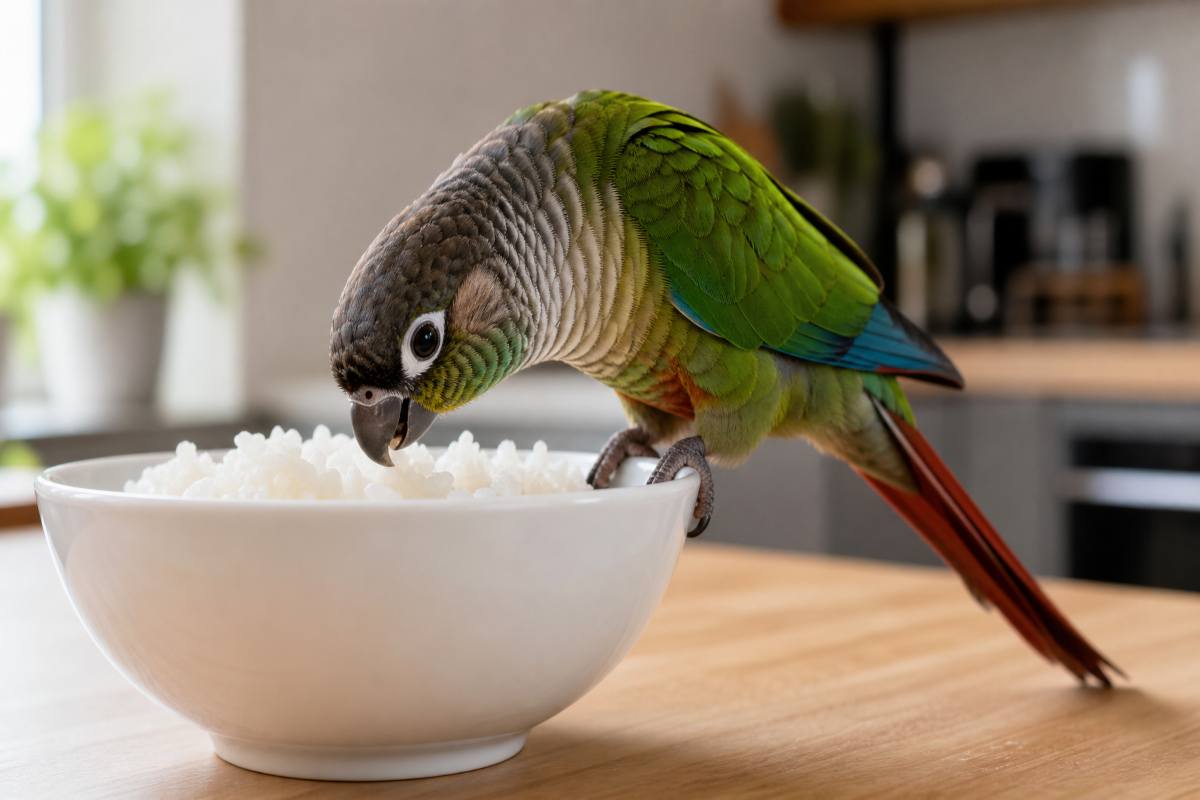
Yes, parrots can eat rice, cooked or uncooked, as long as it is plain. The old story that uncooked rice swells inside a bird and kills it is false. Keep the portion small, add nothing to it, and take the bowl out after two hours. About one teaspoon, two or three times a week, suits a bird the size of an African Grey.
Almost every article on this topic tells you the swelling myth is false. That part is right.
What they leave out is that rice does have two real problems, and neither one is the myth. The first comes from the soil rice grows in. The second happens in the bowl after you serve it.
Both are easy to fix, and neither is a reason to stop feeding rice.
Key facts at a glance
| Question | Answer |
|---|---|
| Can parrots eat rice? | Yes, plain and unseasoned |
| Can parrots eat uncooked rice? | Yes. It will not swell or harm them |
| Cooked or uncooked, which is better? | Cooked is easier to digest |
| Is brown rice the healthier pick? | Better for fiber, worse for arsenic |
| Which rice is safest? | White basmati from California, India or Pakistan |
| Does rice have vitamin A or calcium? | Almost none of either |
| Can rice be a main food? | No. Treat only, served with vegetables |
| Portion for a 400 g African Grey | 1 teaspoon, 2 to 3 times a week |
| How long can it sit in the cage? | 2 hours. 1 hour in a warm room |
| What actually makes rice risky | Salt, oil, soy sauce, seasoning, and leftovers |
Can parrots eat rice?
Yes. Plain rice is safe in both cooked and raw form. It gives your bird energy, a little protein and some B vitamins. What it does not give is vitamin A, vitamin D or calcium. Those three absences are the reason rice belongs in the treat portion of the diet rather than replacing pellets or vegetables.
Best Friends Animal Society lists cooked whole grains including brown, wild and forbidden rice among the fresh foods worth giving a parrot, alongside vegetables and cooked beans.
Avian vets, meaning vets who specialize in birds, put formulated pellets at roughly 50 to 70 percent of a parrot’s diet. Fresh food makes up the rest. Rice sits inside that fresh-food share rather than on top of it.
Our full guide to what parrots eat shows the whole picture of what belongs in the bowl.
Will uncooked rice swell up and kill my parrot?
No. Uncooked rice cannot swell inside a bird. Rice only puffs up once it reaches about 158°F (70°C). A parrot’s body runs at 104 to 107°F (40 to 42°C), which is nowhere near hot enough. The crop also empties every two to four hours, so nothing sits there long enough to matter.
You have probably heard this one. A bird eats dry rice. The rice soaks up all the water in the bird’s stomach, swells to many times its size, and the bird bursts. It is the reason couples stopped throwing rice at weddings.
The earliest trace of the story is 1985. A Connecticut state representative named Mae Schmidle put forward a bill to ban throwing rice at weddings. An Ann Landers newspaper column later repeated the warning to millions of readers, and it stuck.
One quick piece of bird anatomy first, since the crop comes up several times below. The crop is a stretchy pouch in a bird’s throat. Food lands there first, gets softened, and passes down to the stomach in stages. It is not a sealed container, and nothing in it stays dry for long.
With that in mind, here are four reasons the story never made sense.
- Rice needs heat you cannot get inside a bird. Dry grains stay hard until they reach about 158°F (70°C). Your parrot’s body sits at 104 to 107°F (40 to 42°C). Boiling water is 212°F (100°C). A bird’s crop is not a saucepan.
- Birdseed absorbs water faster than rice does. The seed already in your bird’s bowl swells more, and quicker, when it gets wet. If the theory worked, seed would be the bigger worry.
- The crop empties every two to four hours. Food starts getting wet the second it arrives. It never sits dry and then expands all at once.
- Wild parrots eat rice constantly. Rose-ringed parakeets (Psittacula krameri) raid rice fields across India and West Africa, and farmers there treat them as a serious pest. They strip the grain straight off the growing plant. Bobolinks were nicknamed rice birds for the same habit. None of them come to any harm.
This is the same faulty logic behind the claim that bread swells and blocks a parrot’s crop. Both sound believable. Both fall apart when you look at what actually happens inside a bird.
Is cooked or uncooked rice better for parrots?
Cooked rice is easier for a parrot to digest and gives it more usable energy. Several popular articles claim raw rice is more nutritious, which is not correct. Raw and cooked rice hold the same nutrients per gram. The difference is that a bird can only get at those nutrients properly once the rice is cooked.
The raw-is-better claim turns up even on vet-reviewed pages, so it is worth taking apart.
In a raw grain, the starch is packed into hard little bundles. A bird’s digestive enzymes struggle to break those open, so a lot of the starch passes straight through. Food scientists call this resistant starch.
Boiling softens those bundles and opens them up. The starch becomes easy to digest.
So the truth is the opposite of the usual advice. Cooked rice gives your bird more calories per gram than raw rice, not fewer.
If you have an overweight parrot, that means feeding a smaller portion. It does not mean switching to raw.

| What changes | Raw rice | Cooked rice |
|---|
| Nutrients per gram | Same | Same | | How easily it digests | Poorly | Easily | | Usable energy | Less | More | | Texture | Hard, needs cracking | Soft | | Good for small birds? | Yes, beaks are built for hard seed | Yes | | Good for chicks? | No | Only if your vet says so | | Safe to leave in the bowl? | Yes | No, 2 hour limit |
Neither one is wrong. A budgie cracking a dry grain is doing exactly what its beak was made for. A macaw eating a spoon of cooked rice is getting more out of the same weight of food.
Pick based on your bird, not on a nutrition claim that does not hold up.
What nutrients does rice give a parrot?
Rice gives a parrot carbohydrate for energy, a little protein and fiber, B vitamins including thiamine, niacin and riboflavin, plus magnesium and potassium. Brown rice adds manganese and selenium. Rice contains no useful vitamin A, no vitamin D and almost no calcium, which are the three things pet parrots most often run short of.
| Nutrient | In rice? | Why it matters for a parrot |
|---|---|---|
| Carbohydrate | Plenty | Energy. Too much causes weight gain |
| Protein | A little | Feather and muscle building |
| Fiber | Some, more in brown | Gut function |
| B vitamins | Yes | Nerves, metabolism, feather quality |
| Magnesium, potassium | Yes | Growth and normal body function |
| Manganese, selenium | Brown rice only | Bone and immune support |
| Vitamin A | None | The most common deficiency in pet parrots |
| Vitamin D | None | Needed to absorb calcium |
| Calcium | Almost none | Weak bones and egg binding without it |
Those last three rows are the ones that matter. Vitamin A deficiency, calcium deficiency and bone disease are what avian vets treat most often in pet parrots, and rice does nothing for any of them.
That is the whole reason rice stays a treat. It fills a bird up without feeding it.
Does rice contain arsenic, and does it matter for a parrot?
Yes. Rice pulls roughly ten times more arsenic out of the ground than other grains, because it grows in flooded fields. The arsenic collects in the outer bran layer. That means brown rice carries about 80 percent more of the harmful type of arsenic than white rice, which flips the usual advice to always pick brown.
This is the part almost no parrot article covers, and it changes what you should buy.
Rice is grown in paddies under standing water. That water changes the soil chemistry so the plant soaks up far more arsenic than wheat, oats or barley growing in dry ground. The arsenic travels up the roots into the grain.
It settles mostly in the bran, the brown outer coat. Milling removes that coat to make white rice, and it takes most of the arsenic with it.
Arsenic comes in two forms. The organic form passes through the body and does very little. The inorganic form is the one that builds up and causes harm, and that is the form rice carries.
Consumer Reports testing found brown rice holds around 80 percent more inorganic arsenic than white rice of the same type.
Every parrot blog tells you to choose brown rice because it has more fiber. That advice is right about the fiber and silent about everything else.
Why this matters more for a bird than for you
Your bird is tiny. A budgie weighs about 30 grams. You weigh roughly 2,000 times as much, so the same speck of anything harmful goes much further in a small body than in a large one.
Your bird also lives a long time. Arsenic is not a one-meal problem. It builds up slowly over years. A cockatiel can reach 20 years and a macaw 50 or more, eating from the same bowl that whole time.
Here is what keeps all of this in proportion. Rice is a treat, not a staple, and a teaspoon two or three times a week is a tiny amount. There are no published reports of a pet parrot being poisoned by arsenic from normal rice feeding, and none of this is a reason to stop.
It is a reason to buy the right rice and cook it the right way. Both cost you nothing.
Two changes that cut the arsenic
- Buy lower-arsenic rice. White basmati grown in California, India or Pakistan usually has the least, along with sushi rice grown in the United States. Rice labeled as grown in Arkansas, Louisiana or Texas usually has the most.
- Cook it like pasta. The US Food and Drug Administration found that boiling rice in plenty of water and pouring the water away removes 40 to 60 percent of the inorganic arsenic. Use six to ten parts water to one part rice, then drain. Consumer Reports tested a similar method, part-boiling the rice and then draining it, and measured a 50 to 58 percent drop.
Draining does wash away some B vitamins along with the arsenic. Rice is a treat rather than a main meal, so that is a trade worth making.
Which type of rice is safest for parrots?
White basmati grown in California, India or Pakistan is the best everyday choice. It is low in arsenic, cheap and easy to find. Wild rice is nutritionally the best of all, because it is a different plant and does not collect arsenic the same way. It does cost more, and not every bird likes the chewy texture. Brown rice is fine now and then for the extra fiber.
| Type | Fiber and minerals | Arsenic level | Verdict |
|---|---|---|---|
| White basmati (California, India, Pakistan) | Low | Lowest | Best everyday pick |
| Wild rice (not really rice) | High | Low | Best nutrition, if your bird takes to it |
| US sushi rice | Low | Low | Good choice |
| Plain white long grain | Low | Medium | Fine, drain-cook it |
| Jasmine | Low | Medium | Fine, drain-cook it |
| Brown basmati (California, India, Pakistan) | High | Medium | Best of the brown options |
| Black or forbidden rice | High | Medium | Good for variety |
| Brown rice (standard) | Highest | High | Rotate in, do not default to it |
| Sticky or glutinous rice | Low | Medium | Safe, but clings to face feathers |
| Instant or minute rice | Lowest | Low | Safe, not much use |
| Fried rice, pilaf, risotto, any flavored rice | n/a | n/a | Never |
One note on wild rice, since it sits at the top of that table. Despite the name it is not rice at all. It is the seed of a different water grass, which is exactly why the arsenic problem does not follow it. Buy a small bag first. Some birds take to the chewy texture straight away and some ignore it completely.
How much rice can a parrot eat?
A rough guide by body weight: about ⅛ teaspoon of cooked rice for a budgie, ¼ teaspoon for a cockatiel, ½ teaspoon for a Quaker or Senegal, 1 teaspoon for an African Grey or Amazon, and up to 2 teaspoons for a large macaw. Two or three times a week. Rice comes out of the treat allowance, not on top of it.

| Bird | Typical weight | Cooked rice portion | How often |
|---|---|---|---|
| Budgie, parrotlet | 25 to 45 g | A few grains, about ⅛ tsp | 2 x per week |
| Cockatiel, lovebird | 80 to 110 g | ¼ tsp | 2 to 3 x per week |
| Green cheek conure, caique | 60 to 170 g | ¼ to ½ tsp | 2 to 3 x per week |
| Senegal, Pionus, Quaker | 120 to 300 g | ½ tsp | 2 to 3 x per week |
| African Grey, Amazon | 400 to 550 g | 1 tsp | 2 to 3 x per week |
| Umbrella or Moluccan cockatoo | 550 to 900 g | 1 to 1½ tsp | 2 to 3 x per week |
| Blue and gold or green wing macaw | 900 to 1,300 g | 1½ to 2 tsp | 2 to 3 x per week |
These are starting points. The right amount for your bird depends on its weight, how active it is, and what else it eats that day.
Use a gram scale rather than judging by eye. The same rule applies to every treat food, which is why apple portions need measuring even though apples are perfectly safe.
Rice also shares the treat budget with everything else. If your bird has already had grapes that day, the rice comes out of the same allowance.
How do you cook rice for a parrot?
Rinse the rice, boil it in six to ten parts water like pasta, then drain the water away. Add nothing at all. Let it cool to room temperature before serving, measure the portion instead of filling the bowl, and take it out within two hours.
- Rinse the dry rice under cold water until the water runs clear.
- Boil it in plenty of water. Six to ten parts water to one part rice.
- Drain the water off and throw it away. This is the step that removes most of the arsenic. Do not use the usual method where the rice soaks up every drop of water.
- Add nothing. No salt, no butter, no oil, no bouillon cube, no soy sauce, no herbs, no spice.
- Let it cool to room temperature. Hot food can burn a crop.
- Measure the portion using the table above.
- Take it out of the cage within two hours. The next section explains why that time limit matters more than most owners expect.
Raw rice needs no preparation at all. Drop a few dry grains in the bowl, or hide them in a foraging toy. Small birds manage it better than you might expect, because cracking hard seed is exactly what their beaks are built for.
How long can cooked rice stay in a parrot’s cage?
Two hours at most, and one hour in a warm room or in summer. A germ called Bacillus cereus multiplies in cooked rice once it sits at room temperature. Boiling does not kill its spores, and reheating does not destroy the poison it makes. The same warm damp bowl also grows yeast and mold, which cause sour crop and aspergillosis in birds.
This is the one genuine hazard on the whole page, and almost nobody writing about parrots and rice mentions it.
Bacillus cereus is a germ that lives naturally in soil and on rice. It survives boiling by curling up into tough seed-like spores. When cooked rice cools slowly and then sits out, those spores wake up, multiply, and produce a poison that heat cannot destroy. Reheating the rice kills the germ but leaves the poison behind. In people this is the illness known as fried rice syndrome.
Parrot owners run into this more than most people, simply because of how birds are fed. Food goes in the bowl in the morning and often sits there all day. A bird room kept at a comfortable 75 to 80°F (24 to 27°C) for your bird is just as comfortable for bacteria.
That same warm, damp, starchy bowl is also where yeast and mold grow. Both cause real problems in birds. Candida yeast causes sour crop. Aspergillus mold causes aspergillosis, a lung infection that is hard to treat and often kills.
All of it points to one simple rule.
The two hour rule: cooked rice leaves the cage within two hours of being served. In a warm room, or in summer, make it one hour.
For any leftovers, spread them thin in a shallow container so they cool fast, then refrigerate within an hour. Use them within three to four days. Reheat once only, until steaming, and never reheat the same rice twice.
When in doubt, throw it out. The poison has no smell and no taste, and rice that has gone bad looks exactly like rice that has not.
Cook a small fresh batch for your bird instead of spooning some out of last night’s takeout container.
What must never be added to a parrot’s rice?
Plain rice is safe. Almost everything people put on rice is not. Salt, soy sauce, butter, oil, onion, garlic, bouillon cubes, sugar, milk and any fried or seasoned rice should never reach your bird. Chocolate and avocado in a rice dish are genuine emergencies.
| Never add | Why |
|---|---|
| Salt | A small bird’s kidneys cannot cope with much of it |
| Soy sauce | One tablespoon holds close to 900 mg of sodium |
| Butter, oil, ghee, coconut oil | Fat a parrot does not need, and a known cause of liver disease |
| Onion and garlic, fresh or powdered | Both damage red blood cells in birds |
| Chocolate in rice pudding or dessert | Theobromine is toxic to birds |
| Avocado in a rice bowl or guacamole | Toxic to parrots with no safe amount |
| Milk and cream | Birds cannot digest lactose. Rice pudding is not bird food |
| Sugar and sweetened rice dishes | Empty calories, no benefit |
| Bouillon or stock cubes | Salt, onion powder and garlic powder all in one |
| Fried rice of any kind | Oil, salt, soy sauce and usually onion |
| Anything moldy | Mold spreads through food long before you can see it on the surface |
If your bird has eaten a little seasoned or fried rice, it is unlikely to cause a crisis. Give fresh water, watch for heavy drinking and very wet droppings over the next day, and call an avian vet if either appears. If the dish had chocolate, avocado, onion or garlic in it, call straight away rather than waiting for symptoms.
What can you mix with rice for a parrot?
Mix rice into a vegetable base rather than serving it alone. Cooked sweet potato, squash, carrot and dark leafy greens fill the exact gaps rice leaves, which are vitamin A and calcium. Cooked lentils or chickpeas add protein. This mix is what parrot keepers call chop.
Chop is a batch of grains, beans and finely chopped vegetables made once a week and frozen in daily portions. It is the easiest way to get variety into a bird.
| Add this | What it fixes |
|---|---|
| Cooked sweet potato, squash, carrot | Vitamin A, which rice has none of |
| Kale, chard, dandelion greens | Calcium and vitamin A, the two biggest gaps |
| Cooked lentils, chickpeas, mung beans | Protein |
| Chopped red bell pepper | Vitamin A, and most parrots love it |
| A little tomato | Color and flavor, which makes the mix more tempting |
| A little chopped banana | Softness and sweetness for a fussy bird |
| A few crushed almonds or walnuts | Healthy fat, and something to pick out. Measure these |
| Sprouted seed | More vitamins than the dry seed it came from |
Go easy on the fruit. Fruit, seeds and nuts added together should be no more than 10 to 20 percent of everything your bird eats.
Sticky rice varieties are safe but cling to face feathers, which then need cleaning off a bird that will not sit still. Long grain gives you less trouble.
When should you not feed rice to a parrot?
Skip rice, or cut the portion right back, for chicks still being hand-fed, overweight birds, birds with kidney or liver disease, and birds that already refuse their pellets. Small species need genuinely tiny amounts. In hot weather, cut the two hour bowl limit to one hour.
- Chicks still being hand-fed: hand-rearing formula only, nothing else until they are fully weaned
- Small birds: a 30 g budgie is so light that salt, calories and contaminants all count double. Keep portions genuinely tiny
- Overweight birds: cooked rice is easily digested energy. Cut the portion rather than switching to raw
- Birds refusing pellets: rice is soft, mild and easy, exactly the food a fussy bird will hold out for
- Birds with kidney disease: salt is the concern here, so plain preparation is not optional
- Birds with fatty liver disease: ask your vet before adding any starchy food
- Warm weather: the two hour rule drops to one hour
Frequently asked questions
Can parrots eat rice?
Yes. Plain rice is safe for parrots, cooked or uncooked. Serve it unseasoned with no salt, oil or sauce, keep the portion to treat size, and take it out of the cage within two hours.
Will uncooked rice swell up and kill my bird?
No. Rice only swells at around 158°F (70°C), and a parrot’s body temperature is 104 to 107°F (40 to 42°C). The crop empties every two to four hours, birdseed absorbs water faster than rice does, and wild parakeets feed in rice fields without harm. The myth traces back to a 1985 Connecticut bill and an Ann Landers column.
Is cooked or uncooked rice better for parrots?
Cooked is easier to digest. In raw rice the starch is locked in hard bundles that a bird’s gut cannot fully break down. Boiling opens them up. Raw rice is not more nutritious, despite what several popular articles say. It holds the same nutrients, the bird just gets at fewer of them.
Can parrots eat brown rice?
Yes, and it has more fiber, manganese and selenium than white. It also carries around 80 percent more inorganic arsenic, because arsenic collects in the bran layer that milling removes from white rice. Rotate brown rice in rather than making it the default, and choose brown basmati from California, India or Pakistan if you can.
Which rice is safest for parrots?
White basmati grown in California, India or Pakistan, or sushi rice grown in the United States. Wild rice is also excellent, since it is a different plant and does not build up arsenic the same way. Boiling any rice in plenty of water and draining it removes 40 to 60 percent of the inorganic arsenic.
How much rice can I give my parrot?
About ⅛ teaspoon for a budgie, ¼ teaspoon for a cockatiel, 1 teaspoon for an African Grey and up to 2 teaspoons for a large macaw, two or three times a week. Rice comes out of the treat allowance rather than being added on top of it.
Can baby parrots eat rice?
No. Chicks that are still being hand-fed need a proper hand-rearing formula and nothing else. Starchy food feeds yeast, and yeast overgrowth is a leading cause of crop problems in young birds.
Can parrots eat fried rice?
No. Fried rice has oil, salt and usually soy sauce, onion and garlic in it. Onion and garlic damage red blood cells in birds, and the salt alone rules it out.
Is rice water good for parrots?
No, and if you are cooking rice the low-arsenic way you should be pouring that water away rather than saving it. Plain fresh drinking water, changed daily, is what your bird needs.
Can parrots eat rice cakes or puffed rice cereal?
A crumb of a plain rice cake will not harm a bird, but it is air and starch with nothing useful attached. Puffed cereals are usually sweetened and salted. Cooked whole grain does far more with the same treat allowance.
How long can cooked rice stay in the cage?
Two hours, or one hour in a warm room. Bacillus cereus is a germ whose spores survive boiling. Once cooked rice sits at room temperature it produces a poison that reheating cannot destroy. The same warm damp bowl also grows yeast and mold, which cause sour crop and a lung infection called aspergillosis.
My parrot loves rice and now ignores its pellets. What do I do?
Cut the rice back slowly rather than removing it suddenly, since birds go downhill fast when they stop eating. Put pellets and vegetables next to the rice so the alternatives become familiar first. Weigh your bird on a gram scale through the change, and call an avian vet if it loses weight.
Can wild birds eat rice from my feeder?
Yes. Doves, grackles, sparrows, finches and blackbirds all eat rice happily, cooked or uncooked. It gives energy but little else, so it should sit alongside a proper seed mix rather than replacing it.
If you are unsure about the right portion for your own bird, an avian vet can weigh it and work out amounts from its actual body condition. That beats any general chart, including the one on this page.
The short version
Rice is safe. The exploding-stomach story has been wrong for forty years.
The two things that actually matter are quieter.
The first is arsenic. Rice pulls it out of flooded paddy soil and it collects in the bran, which makes the brown rice everyone recommends the higher-arsenic option. Boiling rice in plenty of water and draining it removes most of it.
The second is leftovers. Cooked rice sitting in a warm cage grows bacteria, yeast and mold. That is a real risk, not a theoretical one.
So: buy white basmati or wild rice. Boil it like pasta and drain it. Add nothing. Serve a measured spoon on a bed of vegetables. Take the bowl out after two hours.
Do that and rice earns a small, useful place in your bird’s week. It will never carry vitamin A, vitamin D or calcium, so it can never carry the diet itself.
Sources and notes
- Parrot diet composition and recommended fresh foods: Best Friends Animal Society, The Best Parrot Diet (linked above); Veterinary Partner (VIN), Diets for Healthy Parrots
- Rice nutrient values: USDA FoodData Central
- Arsenic in rice, and brown versus white comparison: Consumer Reports arsenic in rice testing; Dartmouth College Arsenic and You program; peer-reviewed research comparing arsenic content in brown and white rice in the United States
- Arsenic reduction by cooking method: US Food and Drug Administration research on excess-water cooking; Consumer Reports parboil and drain testing
- Starch structure in raw versus cooked rice: published food science research on resistant starch
- Bacillus cereus in cooked rice, temperature limits and storage: USDA National Institute of Food and Agriculture, Preventing Foodborne Illness; university extension food safety guidance
- Rose-ringed parakeet feeding in rice crops: agricultural ornithology surveys from India and West Africa
- Origin of the wedding rice myth: 1985 Connecticut legislative proposal and later syndicated column coverage
This article is for general information and does not replace veterinary advice. If your parrot is unwell, has eaten rice containing chocolate, avocado, onion or garlic, or shows signs of crop problems, contact an avian veterinarian.