
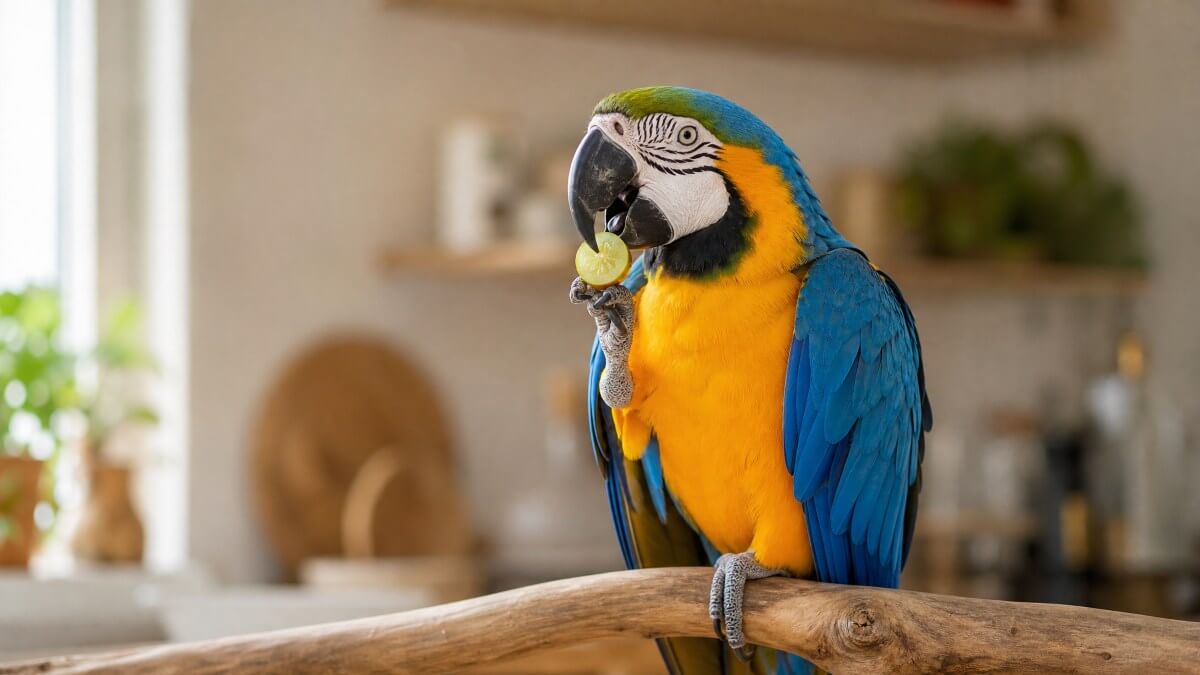
Short answer: yes. Grapes are not toxic to parrots. Serve them two or three times a week in a measured portion — about half a small grape for a budgie, one grape for a cockatiel, two for an African Grey, and three for a large macaw, counted inside the 5–10% fruit part of the diet.
Most people ask this question because of a dog. Grapes cause acute kidney failure in dogs, the warning is everywhere, and it is easy to assume it applies to every pet in the house. It does not, and the reason why is now reasonably well understood.
Key facts at a glance
| Question | Answer |
|---|---|
| Are grapes toxic to parrots? | No. The toxicity that affects dogs does not apply to birds |
| Why are grapes toxic to dogs? | Tartaric acid, identified by ASPCA toxicologists in 2021 |
| How often can parrots have them? | Two or three times a week, not daily |
| Portion for a budgie | Half a small grape, quartered |
| Portion for a cockatiel | One grape, halved |
| Portion for an African Grey | Two grapes, halved |
| Portion for a large macaw | Three grapes |
| Sugar content | 15.5 g per 100 g — higher than banana |
| Best nutrient | Vitamin K — 14.6 mcg per 100 g |
| Are raisins safe? | Technically yes. In practice, avoid them — 3.8 times the sugar |
| Do I need organic grapes? | Grapes rank fourth on the 2026 Dirty Dozen. Organic, or wash properly |
| Should I cut them? | Yes for small and medium birds |
The dog question, answered properly
Grape toxicity in dogs does not extend to parrots. No case reports describe grape-induced kidney failure in birds, and grapes do not appear on standard lists of foods toxic to parrots — unlike avocado, chocolate and onion, which appear on every one.
Here is what changed in our understanding, and why it matters for your bird.
For about twenty years, veterinarians knew grapes and raisins caused acute kidney injury in dogs but could not say why. Some dogs ate a whole bunch and were fine. Others went into kidney failure after two or three.
The breakthrough came from an unrelated case. A dog developed acute kidney injury after eating homemade playdough, which contains cream of tartar — a form of tartaric acid. The kidney damage looked identical to what vets saw in grape poisoning. Tamarind, also high in tartaric acid, produced the same picture.
In April 2021, a team from the ASPCA Animal Poison Control Center set out that observation in a letter to the Journal of the American Veterinary Medical Association. The title says a great deal about its scope: “Unique sensitivity of dogs to tartaric acid and implications for toxicity of grapes.” A fuller case series followed in 2022 in the Journal of Veterinary Emergency and Critical Care.
The ASPCA’s own summary of that work notes that tartaric acid concentration in grapes ranges from 0.35% to 2%, varying by variety, growing region and ripeness. That variation explains the thing that had puzzled vets for two decades: why the same handful of grapes kills one dog and does nothing to another.
Why this does not transfer to birds
The sensitivity described in that research is specific to dogs. The research team named it in their title.
There is also a straightforward biological reason to expect the difference. Soft, sweet, brightly colored fruits did not evolve to be eaten by mammals. They evolved to be eaten by birds, which swallow the fruit, digest the flesh, and deposit the seeds somewhere else. That is the entire purpose of a grape from the vine’s point of view. In evolutionary terms, a grape is a package built for a bird.
What this means in practice: the reason to limit grapes for your parrot is sugar, not poison. Those are very different problems, and they call for very different responses.
What is actually in a grape
All values are from USDA FoodData Central, raw red or green grapes, per 100 grams — roughly 15 to 18 medium grapes.
| Nutrient | Per 100 g | What it means for a parrot |
|---|---|---|
| Calories | 69 | Low, because grapes are 81% water |
| Sugars | 15.5 g | Higher than banana. This surprises most owners |
| Total carbohydrate | 18.1 g | Almost all of it sugar |
| Fiber | 0.9 g | Very low — among the lowest of any common fruit |
| Vitamin K | 14.6 mcg | What grapes are genuinely good for |
| Vitamin C | 3.2 mg | Modest |
| Potassium | 191 mg | Moderate |
| Vitamin B6 | 0.086 mg | Low — about a quarter of banana’s |
| Vitamin A | negligible | Grapes are not a vitamin A source either |
| Calcium | 10 mg | Low |
| Phosphorus | 20 mg | Gives a calcium ratio of roughly 1:2 |
| Iron | 0.36 mg | Low |
Grapes contain more sugar than bananas
This one fact changes how most owners feed them.
Bananas feel heavy and sweet, so people ration them carefully. Grapes feel light and refreshing, so people hand out four or five without thinking.
Per 100 grams, banana contains 12.2 g of sugar. Grape contains 15.5 g. That is about 27% more.
Grapes feel lighter because they are 81% water and lower in calories — 69 per 100 g against banana’s 89. Fewer calories, more sugar. Both are true at once, and only one of them is obvious from eating one.
Vitamin K is the real benefit
At 14.6 micrograms per 100 g, grapes are a reasonable source of vitamin K, which birds need for blood clotting. Few soft fruits offer a meaningful amount.
That is worth something, but it is worth being clear about how much. Vitamin K deficiency is not a common problem in parrots on a decent diet. Grapes are a pleasant treat with a small nutritional bonus attached. Nothing in a grape addresses the deficiencies parrots actually develop.
The calcium ratio, and the fiber problem
Grapes contain 10 mg of calcium against 20 mg of phosphorus — a ratio of about 1:2. Bird diets aim for roughly 2:1 the other way, so grapes are inverted, though far less sharply than banana at 1:4.4.
The fiber is more notable. At 0.9 g per 100 g, grape is one of the lowest-fiber fruits you can buy. An apple has nearly three times as much. Fiber is part of what makes fruit useful in a diet rather than simply sweet, and grapes have very little of it.
For an African Grey, the calcium point is the one to hold onto. Greys are the species most prone to low blood calcium, and our African Grey care guide covers what they need day to day.
How much, and how often
Fruit belongs in 5–10% of total food intake. Grapes compete for that space with everything else in the bowl — our complete guide to what parrots eat sets out the full pellet, vegetable and fruit ratio.
| Bird size | Example species | Grapes per serving | How often |
|---|---|---|---|
| Small | Budgie, parrotlet, lovebird | Half a small grape, quartered | 2–3 times a week |
| Medium | Cockatiel, conure, Quaker, Senegal | One grape, halved | 2–3 times a week |
| Large | African Grey, Amazon, eclectus | Two grapes, halved | 2–3 times a week |
| Extra large | Blue and gold macaw, umbrella cockatoo | Three grapes | 2–3 times a week |
These come from applying the 5–10% fruit guideline to typical daily intake by body size. Treat them as starting points. An overweight Amazon, a breeding hen and a bird recovering from illness each need a different answer, and that is a conversation for an avian vet.
The advice you find elsewhere — “half a grape every other day” — is offered without asking which bird you have. A budgie weighs 30 grams. A hyacinth macaw weighs over a kilogram. One portion cannot be right for both.
Cut them, at least for smaller birds

A whole grape is a choking risk for a small parrot, and a large bird will often take one bite and drop the rest.
- Small birds — quarter them
- Medium birds — halve them
- Large birds — halve them, or leave whole if your bird works methodically
- Seeded grapes — the seeds are not toxic and many parrots eat them. Remove them for small birds, since they are hard and offer little
The pesticide question
Every few months a claim circulates in parrot forums that grapes carry enough pesticide to kill a bird. It deserves a proper answer, because the claim is an exaggeration but the concern underneath it is real.
What is true: grapes rank fourth on the Environmental Working Group’s 2026 Dirty Dozen, behind spinach, leafy greens and strawberries. That list is built from USDA Pesticide Data Program testing of more than 54,000 samples across 47 fruits and vegetables. Importantly, USDA washes and peels samples before testing — so the residues measured are what remains after normal preparation. Grapes rank high because the skin is thin, edible, and receives repeated fungicide applications.
What is also true: more than 99% of USDA-tested produce falls below EPA legal residue limits, and EWG’s ranking method is disputed by agricultural industry groups who argue it discourages people from eating fruit and vegetables. EWG itself says the benefits of eating produce outweigh the residue risk.
Why it still matters more for a bird than for you: a 400-gram African Grey eating the skin of one grape takes in a far larger dose per kilogram of body weight than an adult eating a whole bunch. Dose scales with body size, and legal limits are calculated for people.
The practical position:
- Buy organic grapes if the price difference is manageable. Grapes are one of the few items where it genuinely changes the residue picture
- If you buy conventional, soak for 15 minutes in one part white vinegar to three parts water, then rinse under running water. A quick rinse alone removes very little
- Do not peel them. The skin holds most of the antioxidants and all of the texture value
For contrast, bananas sit on EWG’s Clean Fifteen — the produce with the lowest residues, thanks to a thick peel nobody eats. That is a reasonable argument for leaning on bananas when you cannot get organic grapes.
Raisins: the part that actually causes problems
Raisins turn up in a great many commercial parrot treat mixes, which is unfortunate, because drying a grape changes it considerably.

| Form | Calories per 100 g | Sugar per 100 g |
|---|---|---|
| Fresh grapes | 69 | 15.5 g |
| Raisins | 299 | 59.2 g |
Drying removes roughly 80% of the water and concentrates everything left behind. Calories rise 4.3 times. Sugar rises 3.8 times.
At 59.2 g of sugar per 100 g, raisins sit in the same range as dates, and higher per unit weight than most chocolate bars.
This is the same trap as fried banana chips, arriving from the opposite direction. Banana chips become dangerous because oil and sugar are added. Raisins become dangerous because water is taken away. Either way, a food that reads as a wholesome fruit treat turns into a sugar concentrate — and raisins carry a reputation for being healthy that almost nobody questions.
If you feed raisins at all: treat one raisin as roughly four grapes’ worth of sugar and portion accordingly. For most birds that means one raisin occasionally, and never as a routine training reward.
Golden raisins carry one further consideration. They are treated with sulfur dioxide as a preservative during processing. There is no established avian toxicity concern, but if you are choosing between the two, dark sun-dried raisins involve fewer additions.
Grape products to avoid entirely
Wine and any alcoholic grape product. Alcohol is toxic to birds. Their livers are not equipped for it, and the amount that affects a 400-gram animal is very small.
Grape juice. Sugar water with the fiber removed. It offers a parrot nothing that a fresh grape does not offer better.
Grape jam, jelly and grape-flavored products. Added sugar stacked on top of concentrated fruit sugar.
Sugar-free dried fruit. Sugar-free is worse, not better. Xylitol is toxic to birds and appears in some sugar-free dried products.
When to keep grapes off the menu
- Overweight birds, until the weight is under control. Grapes are close to pure sugar
- Birds diagnosed with fatty liver disease, unless your avian vet says otherwise
- Diabetic birds. Uncommon in parrots, but it happens, and it changes the whole calculation
- Any bird that stops eating vegetables once fruit appears. Grapes are among the most likely fruits to cause this, because they are sweet, easy to eat and take no work. If your bird holds out for them, grapes come out of the rotation until vegetables are being eaten reliably
Frequently asked questions
The questions parrot owners ask most about feeding grapes.
Can parrots eat grapes?
Yes. Grapes are not toxic to parrots. Serve half a small grape for a budgie, one for a cockatiel, two for an African Grey and three for a large macaw, two or three times a week, within the 5–10% fruit portion of the diet.
Are grapes toxic to birds the way they are to dogs?
No. Grape toxicity in dogs is attributed to tartaric acid, identified by ASPCA toxicologists in 2021, and the research describes the sensitivity as unique to dogs. No comparable toxicity has been documented in parrots, and grapes do not appear on standard lists of foods toxic to birds.
Do grapes have more sugar than bananas?
Yes. Grapes contain 15.5 g of sugar per 100 g against banana’s 12.2 g — roughly 27% more. Grapes feel lighter because they are 81% water and lower in calories, but the sugar concentration is higher.
Can parrots eat raisins?
Technically yes, but it is better to avoid them. Drying concentrates sugar 3.8 times, from 15.5 g per 100 g to 59.2 g. One raisin carries roughly the sugar of four fresh grapes. If you use them at all, portion accordingly.
Do I need to buy organic grapes for my parrot?
It is worth it if you can afford it. Grapes rank fourth on EWG’s 2026 Dirty Dozen, and USDA washes samples before testing, so those residues persist after normal rinsing. If you buy conventional, soak for 15 minutes in one part vinegar to three parts water before rinsing.
Can parrots eat grape seeds?
Yes. Grape seeds are not toxic and many parrots eat them without any problem. Remove them for small birds, since they are hard and offer little.
Should I peel grapes for my parrot?
No. The skin carries most of the antioxidants and much of the texture value. Wash it thoroughly instead.
Can parrots eat green and red grapes?
Both are safe. Red and black grapes contain more resveratrol, which sits almost entirely in the skin. At the portion sizes involved the difference is small, and most birds simply have a preference.
Can baby parrots eat grapes?
Unweaned chicks should have a proper hand-rearing formula and nothing else. Once weaned, small amounts fit inside the normal fruit allocation. Growing birds need more calcium, which is another reason to keep fruit modest and greens generous.
Can parrots drink grape juice?
No. Grape juice is concentrated sugar with the fiber removed, and wine or any alcoholic grape product is toxic to birds.
Still unsure about a specific food or portion for your bird? An avian veterinarian can weigh your parrot and set portions from its actual body condition, which is always more accurate than a general guideline.
The practical summary
Grapes are safe for parrots. The dog warning does not apply, and the reason it does not apply is now reasonably well understood.
What does apply is sugar. Grapes carry more of it than bananas, and their light, watery texture makes it easy to hand out four or five without thinking about it. Two or three times a week, cut to size, is the right pattern.
Buy organic if you can. Wash properly if you cannot. And keep raisins out of your bird’s treat mix — of everything on this page, they are the only part likely to do real harm.
Sources and notes
- Tartaric acid and canine grape toxicity: ASPCApro, “Toxic Component in Grapes and Raisins Identified” (linked above), summarising Wegenast et al., Journal of the American Veterinary Medical Association 258(7), 2021, and Wegenast et al., Journal of Veterinary Emergency and Critical Care 32(6), 2022
- Nutrient values: USDA FoodData Central, grapes (red or green, raw) and raisins (seedless)
- Pesticide residue ranking: Environmental Working Group, 2026 Shopper’s Guide to Pesticides in Produce, based on USDA Pesticide Data Program testing
- Portion guidance is derived from the 5–10% fruit proportion widely used in avian nutrition, applied to typical daily intake by body size
This article is for general information and does not replace veterinary advice. If your parrot is unwell, overweight, or has a diagnosed condition, speak to an avian veterinarian before changing its diet.