

Short answer: yes. Ripe tomato flesh is safe for parrots. Serve it two or three times a week — about 3 g for a budgie, 6 g for a cockatiel, 12 g for an African Grey and 20 g for a large macaw.
Never feed the leaves, the stems or the green vine. That part is genuinely dangerous, and it is a completely different question from the fruit.
Almost every article on this subject warns that tomatoes are too acidic for birds. Measured pH data does not support that.
In fact, the same sites that warn about tomatoes recommend apples and grapes freely. Both are more acidic.
Key facts at a glance
| Question | Answer |
|---|---|
| Is ripe tomato flesh safe? | Yes |
| Are the leaves and stems safe? | No. Never feed any green part of the plant |
| Are tomatoes too acidic for parrots? | No. Apples, grapes and strawberries are more acidic |
| Is it solanine or tomatine? | Mainly tomatine, which is far less toxic |
| Green tomato tomatine | Up to 500 mg per kg |
| Ripe tomato tomatine | Under 5 mg per kg |
| Vitamin A per 100 g | 833 IU — about fifteen times an apple’s |
| Sugar per 100 g | 2.6 g — the lowest of any common fruit |
| Portion for a budgie | About 3 g |
| Portion for an African Grey | About 12 g |
| Should I remove the seeds? | No. Ripe tomato seeds are fine |
| What about ketchup and sun-dried tomatoes? | No. Salt and sugar |
Are tomatoes too acidic for parrots?
No. Tomatoes are less acidic than several fruits that parrot sites recommend without hesitation.
The claim appears on nearly every page covering this question. Tomatoes are described as highly acidic, capable of damaging a bird’s digestive tract and causing ulcers.
Here is measured pH data. Lower numbers mean more acidic.
| Food | pH |
|---|---|
| Granny Smith apple | 3.5 |
| Strawberry | 3.5 |
| Red grape | 3.7 |
| McIntosh apple | 3.7 |
| Golden Delicious apple | 3.9 |
| Tomato | 4.0 – 4.1 |
| Gala apple | 4.1 |
| Honeycrisp apple | 4.2 |
| Navel orange | 4.3 |
| Banana | 4.5 – 5.2 |
The pH scale is logarithmic, so a half-point gap is bigger than it looks. A Granny Smith apple at 3.5 holds roughly three times the acid of a tomato at 4.0.
Seedless grapes run from pH 2.9 to 3.8. Strawberries sit at 3.5.
Apples, grapes and strawberries all appear on parrot feeding lists as good choices. Tomatoes get a warning about ulcers.
Where the confusion comes from: tomatoes taste sharp, and in human nutrition they sit on reflux lists. But reflux is about a valve at the top of the human stomach. Birds do not have that anatomy.
Taste is not a measure of pH. Neither is reputation.
What is actually true: a bird that eats a lot of any acidic fruit at once may have loose droppings for a day. That is just as true of grapes, oranges and strawberries.
It is a reason to measure portions. It is not a reason to single out tomatoes.
Is it solanine or tomatine?
Mainly tomatine, and the difference matters.
Almost every parrot article on this subject says tomato plants contain solanine. Solanine is the compound that makes green potatoes dangerous, and it has a serious reputation.
Tomatoes contain mostly tomatine. The two come from the same plant family and belong to the same class of compound. But they are not the same thing. They do not behave the same way.
Published research describes tomatine as far less toxic than solanine. Animal studies have found tomatine taken by mouth to be low in toxicity, or non-toxic, next to similar compounds.
Tomatine also binds cholesterol in the gut. Researchers have studied it for anti-inflammatory and antimicrobial activity.
This does not make tomato leaves safe. They are still off the menu, and the next section explains why. But it does mean the alarming word most articles reach for is the wrong one. It also explains something odd. Green potato poisoning is well documented. Tomato poisoning cases are very hard to find.
Can parrots eat green tomatoes?
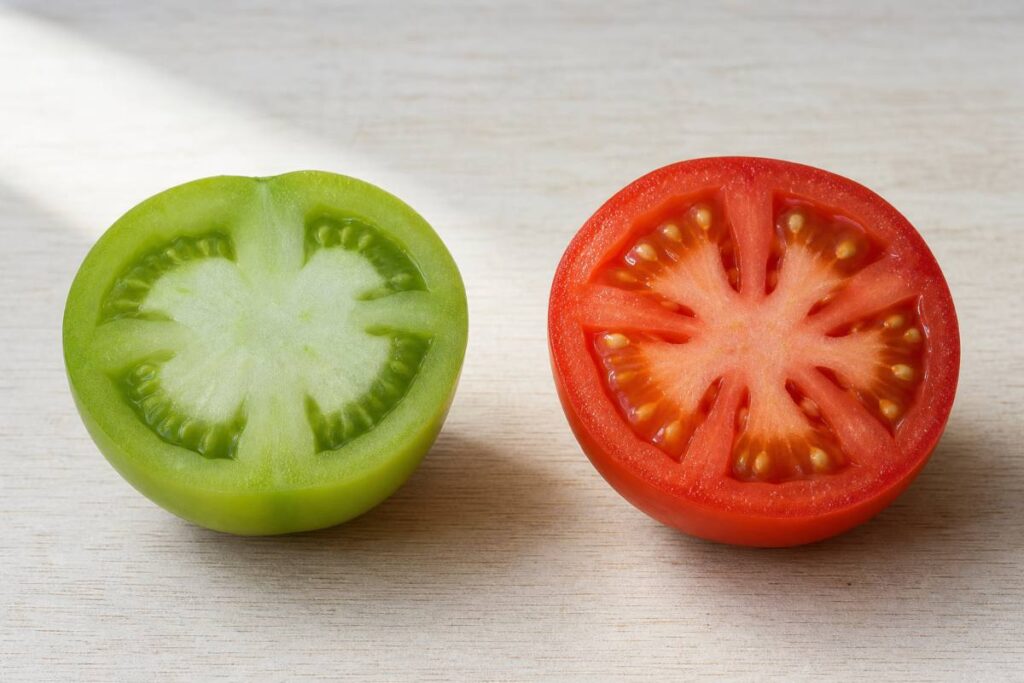
No, not unripe ones. Ripening drops the tomatine content by roughly a hundredfold.
| Green, unripe | Fully ripe | |
|---|---|---|
| Tomatine | Up to 500 mg per kg | Under 5 mg per kg |
| Vitamin A | 642 IU per 100 g | 833 IU per 100 g |
| Lycopene | None | 2,573 mcg per 100 g |
| Vitamin C | 23.4 mg per 100 g | 13.7 mg per 100 g |
As a tomato ripens, tomatine is converted into a different compound called esculeoside A. That conversion is driven by ethylene, the same ripening hormone that softens the fruit and turns it red.
So ripeness is not a rough guide to safety. Ripeness is what makes the fruit safe. A ripe tomato has already done the chemistry.
What this means in practice:
- Fully ripe, deep red — the only version to feed
- Orange or pink, still firm — wait
- Green and hard — do not feed. A single bite will not kill a bird, but there is no reason to offer it
- Green ripe varieties such as Green Zebra — these are ripe despite the color, and they are fine. Judge by softness and by the variety, not by color alone
Supermarket tomatoes are often picked green and ripened with ethylene in transit. Once they are fully red they are safe. Vine-ripened fruit is still the better choice where you have one, mostly for flavor and quality.
Are tomato leaves and stems poisonous to parrots?
Yes. This is the genuinely dangerous part, and it covers every part of the plant except the ripe fruit.
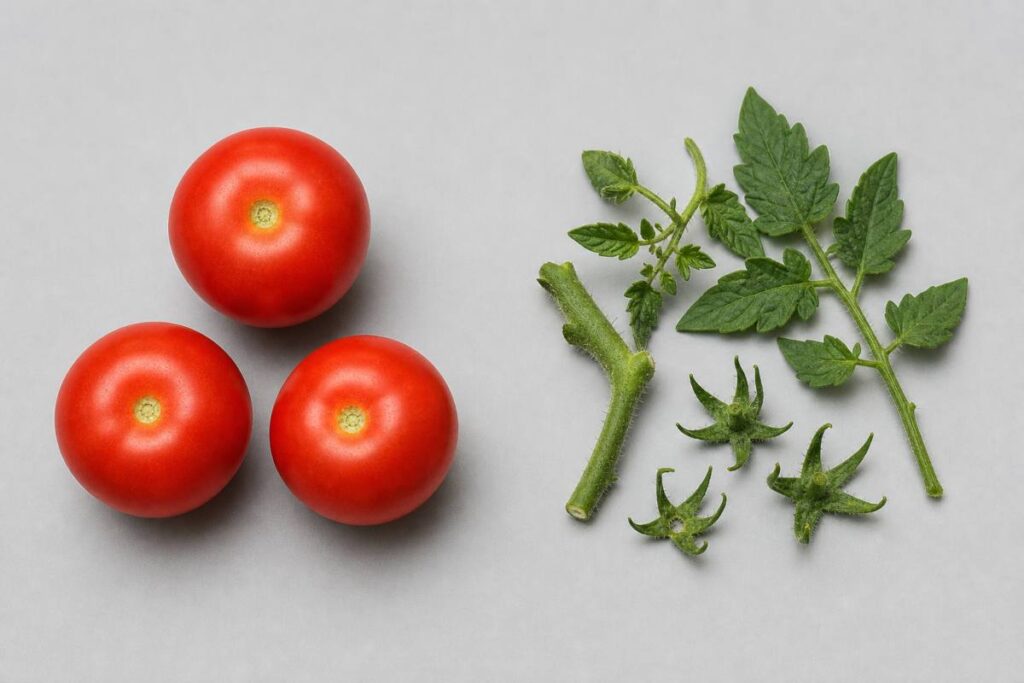
Leaves, stems, vines, flowers and the green cap all carry far more tomatine than the fruit ever does. Feed none of it.
Signs of tomatine poisoning include weakness, lethargy, loss of appetite, tremors and diarrhea. If your parrot has eaten any green part of a tomato plant, call an avian vet right away. Do not wait for symptoms.
The real risks are not in the kitchen:
- Tomatoes sold on the vine. Remove and discard the vine and the green cap before the fruit goes anywhere near your bird
- A tomato plant on a windowsill or patio. A free-flying parrot will investigate it. Keep birds out of the room, or keep the plant out of the house
- A vegetable garden with a bird on a harness. Tomato foliage smells strong and most animals avoid it, but a curious parrot is not most animals
This is the same category as avocado and chocolate — genuinely toxic, no safe preparation, no safe amount. The ripe fruit is not in that category at all.
What is actually in a tomato?
All values from USDA data for raw red ripe tomato, per 100 grams — roughly one small tomato.
| Nutrient | Per 100 g | What it means for a parrot |
|---|---|---|
| Calories | 18 | Very low. Tomatoes are 94.5% water |
| Sugars | 2.6 g | The lowest of any common fruit |
| Fiber | 1.2 g | Modest |
| Vitamin A | 833 IU (42 mcg RAE) | The reason to feed tomato at all |
| Beta-carotene | 449 mcg | Converts to vitamin A in the body |
| Lycopene | 2,573 mcg | Antioxidant, only in the ripe red fruit |
| Vitamin C | 13.7 mg | Good |
| Potassium | 237 mg | Good |
| Calcium | 10 mg | Low |
| Phosphorus | 24 mg | Calcium ratio of roughly 1:2.4 |
| Iron | 0.27 mg | Low |
Do tomatoes have vitamin A?
No article on this subject mentions this, and it turns the whole question around.
Vitamin A deficiency is one of the most frequently diagnosed nutrition problems in pet birds, according to the Merck Veterinary Manual. In seed-fed parrots it builds quietly over years. It damages the lining of the mouth, sinuses and airways. You see it as white patches in the mouth, nasal discharge, poor feather quality and repeated chest infections.
Now compare the fruits parrot owners are told to feed:
| Fruit | Vitamin A per 100 g |
|---|---|
| Tomato | 833 IU (42 mcg) |
| Apple | 54 IU (3 mcg) |
| Banana | 64 IU (3 mcg) |
| Grape | 66 IU (3 mcg) |
A tomato carries about fifteen times the vitamin A of an apple and about a quarter of the sugar.
The fruits everyone recommends deliver almost nothing against the deficiency parrots actually develop. The one everyone warns about is the one that helps.
That does not make tomato a superfood. It will not fix a deficiency on its own, and cooked sweet potato and red bell pepper carry far more.
But it does mean the caution around tomatoes points the wrong way.
How much tomato can a parrot eat?
About 3 g for a budgie, 6 g for a cockatiel, 12 g for an African Grey and 20 g for a large macaw, two or three times a week.
Fruit belongs in 5–10% of total food intake, and our complete guide to what parrots eat sets out the full pellet, vegetable and fruit ratio.
| Bird size | Example species | Tomato per serving | How often |
|---|---|---|---|
| Small | Budgie, parrotlet, lovebird | About 3 g — a thin wedge | 2–3 times a week |
| Medium | Cockatiel, conure, Quaker, Senegal | About 6 g — one small wedge | 2–3 times a week |
| Large | African Grey, Amazon, eclectus | About 12 g — half a small tomato | 2–3 times a week |
| Extra large | Blue and gold macaw, umbrella cockatoo | About 20 g — one small tomato | 2–3 times a week |
Tomato carries 2.6 g of sugar per 100 g against a grape’s 15.5 g. That puts it at the generous end of the fruit budget, not the cautious end.
If you rotate fruit through the week, tomato can take more of those slots than most.
How do you prepare a tomato for a parrot?
- Remove the green cap and any vine before anything else. This is the only step that matters for safety
- Wash it. Tomatoes are not on EWG’s 2026 Dirty Dozen, but a rinse costs nothing
- Leave the skin on. It holds much of the lycopene
- Leave the seeds in. Ripe tomato seeds carry no meaningful tomatine and many parrots eat them without any issue
- Cut to size. Wedges for large birds, thin slivers for small ones
- Cherry tomatoes — halve or quarter them. A whole one is a choking risk for a small bird and usually gets dropped by a large one
Is cooked tomato better than raw?
Heating breaks down cell walls and makes lycopene more available. Cooked plain tomato — no salt, no oil, no garlic, no onion — is a perfectly good option, and some parrots prefer the softer texture.
Cooking does not reduce tomatine in any useful way, so it does not make green tomatoes safe. Ripe is still the rule.
Which tomato products should parrots avoid?
Ketchup. Sugar and salt. Commercial ketchup is roughly a quarter sugar by weight.
Tomato sauce and pasta sauce. Almost always salted, and usually with garlic and onion, both of which damage red blood cells in birds.
Tomato juice and vegetable juice blends. Salted, and the fiber is gone.
Sun-dried tomatoes. Drying concentrates everything, and salt can reach 6% by weight. Many are also treated with sulfur dioxide.
This is the same trap as raisins and bread. A food that reads as wholesome, carrying a sodium load that is large for a small bird.
Canned tomatoes. Check the label. No-salt-added versions exist and are acceptable in small amounts, but most canned tomatoes are salted.
Canned tomato soup. Salt, cream, sugar. Not food for a bird.
Green tomato pickles, chutney and relish. Green tomato plus vinegar plus salt plus sugar. Every part of that is wrong.
When should you keep tomatoes off the menu?
- Any bird that has shown loose droppings after tomato before. Some individuals do react. Drop it and feed red bell pepper instead, which delivers more vitamin A anyway
- Birds being treated for low blood calcium. Tomato’s calcium-to-phosphorus ratio runs the wrong way, so it should not replace dark leafy greens
- Overweight birds — though tomato is one of the least problematic fruits here
- Any bird with access to a tomato plant. The plant is the risk, not the fruit
Frequently asked questions
The questions parrot owners ask most about tomatoes.
Can parrots eat tomatoes?
Yes. Ripe tomato flesh is safe for parrots. Serve about 3 g for a budgie, 6 g for a cockatiel, 12 g for an African Grey and 20 g for a large macaw, two or three times a week. Never feed the leaves, stems or vine.
Are tomatoes too acidic for parrots?
No. Measured pH data puts tomatoes at about 4.0 to 4.1. That makes them less acidic than Granny Smith apples at 3.5, red grapes at 3.7 and strawberries at 3.5. All three are routinely recommended for parrots. The acidity warning is widely repeated, but the numbers do not support it.
Are tomato leaves poisonous to parrots?
Yes. Leaves, stems, vines, flowers and the green cap all carry tomatine at far higher concentrations than the fruit. If your bird has eaten any green part of a tomato plant, call an avian vet immediately.
Do tomatoes contain solanine?
Mostly not. Tomatoes contain mainly tomatine, a related but different glycoalkaloid that published research describes as significantly less toxic than solanine. Solanine is the compound associated with green potatoes.
Can parrots eat green tomatoes?
No. An unripe green tomato can carry up to 500 mg of tomatine per kilogram, against under 5 mg per kilogram in a fully ripe one. Green ripe varieties such as Green Zebra are different and are fine, since they are ripe despite the color.
My parrot ate a piece of green tomato. What now?
A single bite of green tomato flesh is very unlikely to cause a problem. Watch your bird as normal and offer fresh water. If it has eaten a large amount of green tomato, or any leaves, stems or vine, call an avian vet.
Can parrots eat tomato seeds?
Yes. Ripe tomato seeds carry no meaningful tomatine and many parrots eat them without any problem. There is no need to remove them.
Do tomatoes have vitamin A for parrots?
Yes, and this is the main reason to feed them. Raw red tomato carries 833 IU of vitamin A per 100 grams against an apple’s 54 IU. Vitamin A deficiency is one of the most common nutrition problems in pet birds, and most of the fruits people recommend supply almost none of it.
Can parrots eat cherry tomatoes?
Yes, when ripe. Halve or quarter them first. A whole cherry tomato is a choking risk for a small bird and usually gets dropped uneaten by a large one.
Is cooked tomato safe for parrots?
Yes, if it is cooked plain with no salt, oil, garlic or onion. Cooking makes lycopene more available. It does not make green tomatoes safe.
Can parrots eat ketchup or pasta sauce?
No. Ketchup is roughly a quarter sugar by weight. Pasta sauces are salted and usually contain garlic and onion, both of which damage red blood cells in birds.
Can baby parrots eat tomatoes?
Unweaned chicks should have an appropriate hand-rearing formula and nothing else. Once weaned, small amounts fit within the normal fruit allowance.
Still unsure about a specific food or portion for your bird? An avian veterinarian can weigh your parrot and set portions from its actual body condition, which is always more accurate than a general guideline.
The practical summary
The warning attached to tomatoes is aimed at the wrong part of the plant.
The fruit is fine. It is less acidic than an apple and lower in sugar than any other common fruit. It also carries fifteen times the vitamin A of an apple, and vitamin A deficiency is the problem pet parrots most often develop.
The leaves, stems and vine are the real hazard, and that hazard is genuine. Remove the green cap, throw away the vine, and keep your bird away from the plant itself.
Ripe, red, no green attached, cut to size. That is the whole rule.
Sources and notes
- Vitamin A deficiency in pet birds: Merck Veterinary Manual, “Nutritional Diseases of Pet Birds” (linked above)
- Tomato nutrient values: USDA FoodData Central, tomatoes red ripe raw and tomatoes green raw
- Tomatine and esculeoside A content across ripening stages: published research on steroidal glycoalkaloids in Solanum lycopersicum
- Comparative toxicity of tomatine and solanine: peer-reviewed reviews of glycoalkaloid toxicology
- pH values: published food acidity measurements for raw fruit and vegetables
- Portion guidance comes from the 5–10% fruit share widely used in avian nutrition, applied to what a bird of each size eats in a day
This article is for general information and does not replace veterinary advice. If your parrot is unwell, or has eaten tomato leaves, stems or any green part of the plant, contact an avian veterinarian.