
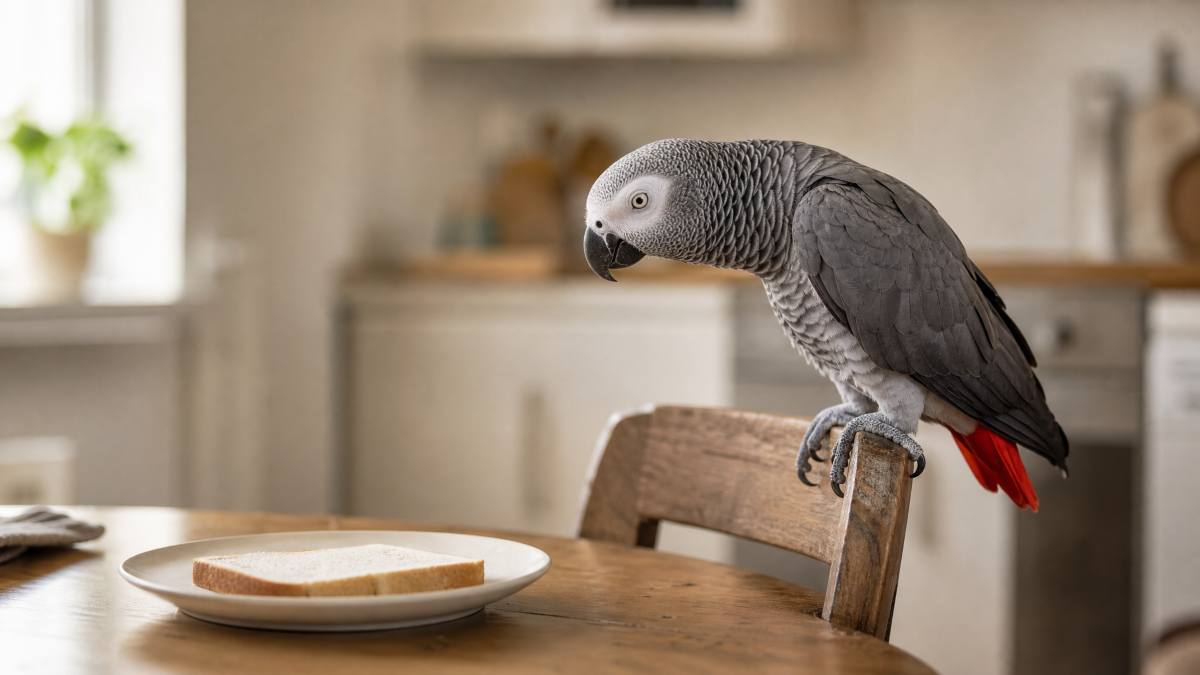
Short answer: a crumb will not hurt your bird, but bread should not be part of its diet.
Bread is not toxic to parrots. It is also not really food for a bird. It is starch, salt and empty calories in a form birds like far too much.
Most websites will tell you the danger is that bread swells in the crop and blocks it. That warning is everywhere, and it does not hold up.
The real problem is quieter and slower. It is also the reason a bird can eat bread for two years and look perfectly fine, right up until it does not.
Key facts at a glance
| Question | Answer |
|---|---|
| Is bread toxic to parrots? | No. It is not poisonous |
| Should parrots eat bread? | No. It has no place in the diet |
| Will bread swell and block the crop? | Almost certainly not. This claim is not supported by veterinary sources |
| What is the real risk? | Salt, empty calories and the food it crowds out |
| Sodium in one slice of white bread | 120–180 mg |
| What one slice means for a 400 g parrot | Roughly 10 times its daily sodium share |
| If my bird ate a crumb? | Nothing will happen. Do not panic |
| Is whole grain better? | Slightly. It is still bread |
| Is toast safe? | No better, and it adds acrylamide |
| Is any bread acceptable? | Homemade, salt-free, unsweetened, a crumb at a time |
| What is genuinely dangerous | Bread containing chocolate, onion, garlic, xylitol or mold |
Will bread swell up and block my parrot’s crop?
Almost certainly not. This is the most repeated claim about bread and birds, and it does not stand up.
The claim turns up on wildlife charity pages, forum threads and parrot blogs. Dry bread soaks up moisture, expands in the crop and blocks it. It sounds plausible. It is the same reasoning behind the old myth that uncooked rice makes birds explode.
Here is what actually happens in a bird’s crop.
The crop is a stretchy pouch in the esophagus. Its job is to hold food, moisten it and pass it down in stages.
Food starts getting wet the moment it arrives. Bread never gets a chance to sit dry and then swell all at once. And in a healthy bird the crop empties every two to four hours.
Now look at what actually causes crop impaction. University extension services, poultry vets and avian medicine texts all name the same things:
- Long blades of grass
- String, twine and synthetic fibers
- Bedding, wood chips and litter
- Feathers
- Plastic or metal objects
- Fruit skins such as banana and persimmon
- Yeast infection (candidiasis), especially in chicks
- Muscle problems that stop the crop emptying properly
Bread is not on any of those lists.
What does show up is something related but different: too much starchy food feeds yeast. Yeast overgrowth causes sour crop — a fermenting, infected crop that stops emptying properly. That is a genuine risk, and it is serious. But it is not the mechanical blockage everyone describes.
This is about quantity, not about grain itself. A spoon of cooked brown rice is nothing like bread every day.
Why this matters: if you think the danger is a sudden blockage, you will assume your bird is fine as long as nothing dramatic happens.
That is the wrong conclusion. The real harm builds over months, and it gives no warning until it is well advanced.
What does bread actually do to a parrot?
Three things. The third one is what kills birds.
1. Salt
Every article mentions salt. None of them tell you how much.
A slice of commercial white bread contains roughly 120–180 mg of sodium. Some varieties run higher. In the United States, bread is the single largest source of sodium in the whole food supply. Not because any one slice is extreme. Because people eat it constantly.

Now scale that to a bird.
An adult human weighs about 175 times what a 400 g African Grey weighs. The recommended daily sodium limit for an adult is around 2,300 mg. Scale that down by body weight and you get roughly 13 mg for the Grey.
One slice of bread carries ten times that.
That calculation is rough, and body weight is not a perfect way to scale nutrition between species. But it shows the scale of the problem, which is what matters here.
According to the Hagen Avicultural Research Institute, too much salt makes birds drink and urinate heavily. In larger amounts it can cause kidney failure, fluid buildup, tremors, neurological signs and heart failure.
Birds do need salt. They die without it. But the gap between what a small bird needs and what harms it is narrow.
Now consider a budgie. It weighs 30 grams — a thirteenth of an African Grey. Gram for gram, the same bread hits it thirteen times harder.
2. Empty calories
A slice of white bread is about 70 calories, and roughly three quarters of that is carbohydrate. There is almost nothing else in it. No useful vitamin A. No calcium worth counting. Barely any fiber.
Parrots do not count calories. They eat by volume and by preference. A bird that fills up on bread has less room, and less appetite, for the food that would keep it alive.
3. It crowds out real food
This is the one that does the real damage, and it happens slowly enough that owners rarely link the two.
A bird eating bread regularly eats fewer pellets and fewer vegetables. Over months that produces exactly the problems avian vets see most: vitamin A deficiency, calcium deficiency, obesity and fatty liver disease.
It is the same reason fruit portions have to be measured even when the fruit is perfectly safe. Anything a bird prefers can crowd out what it needs.
None of this happens overnight. A bird can eat bread for two years and look fine. The first visible sign is often a bird that is already seriously ill.
Our complete guide to what parrots eat sets out what should be in the bowl instead.
Is whole grain bread better than white?
Slightly better. Still not good.
| White bread | Whole wheat bread | |
|---|---|---|
| Fiber | Very low | Moderate |
| Sodium | 120–180 mg per slice | Similar, sometimes higher |
| Empty calories | Yes | Mostly yes |
| Additives | Often preservatives, dough conditioners | Fewer, but present |
Whole grain has more fiber and more of the grain intact. That is a genuine improvement over white bread.
But it is still bread. Still the salt. Still crowding out real food. Choosing whole grain over white is picking the better of two things that do not belong in the bowl.
If your bird likes bread for the grain, feed it cooked whole grains instead. Brown rice, oats, quinoa, barley or buckwheat, cooked plain with no salt. Same appeal, with actual nutrition attached.
Is toast safe for parrots?
No, and toasting adds a problem that plain bread does not have.
Toasting starchy food produces acrylamide, a compound that forms when starch is heated above about 250°F (120°C). The FDA considers acrylamide a concern in the human diet. Darker toast contains more of it than lighter toast.
Nobody has studied acrylamide in parrots, so there is no safe limit to point to. What is known is that dose scales with body weight, and a parrot weighs a fraction of what you do.
Toast has a second problem. It is dry and crumbly, and a bird tearing at it can breathe in crumbs. Parrots have no teeth, so they swallow pieces whole.
The burnt edges are the worst part of the slice. If bread is going anywhere near your bird, it should not be toasted.
What if my parrot already ate bread?
Nothing is going to happen. A crumb or a small piece is not an emergency.
Bread is not toxic. There is nothing to give your bird and nothing you need to do quickly. Watch it as normal, offer fresh water and go back to its usual diet.
If a small bird has eaten a large piece rather than a crumb, watch for heavy drinking and very wet droppings over the next day. Call a vet if either shows up.
The exceptions are about what was in the bread, not the bread itself:
- Anything containing chocolate — theobromine is toxic to birds. Call an avian vet. Our guide to chocolate explains why
- Anything containing onion or garlic — both damage red blood cells in birds
- Anything sugar-free — xylitol is toxic to birds and appears in some sugar-free baked goods
- Anything with avocado — guacamole toast is not a hypothetical. Avocado is toxic to parrots with no safe amount
- Anything moldy — mycotoxins from bread mold are dangerous to birds, and mold grows through a loaf before you can see it on the crust
If any of those apply, call an avian vet rather than waiting for symptoms.
Is there any bread that is acceptable?
Homemade, salt-free, unsweetened and only a crumb at a time.
If you bake it yourself you control everything in it. Leave out the salt. Leave out the sugar. Use whole grain flour, and check anything else before it goes in.
Even then, keep it in perspective. Treat it the way you would a single sunflower seed — a reward, not a food.
Sprouted grain bread is the best of the shop-bought options. Fewer additives, more nutrition. But check the sodium on the label, because plenty of brands are no better than standard bread.
Never feed:
- Garlic bread
- Sweetened breads, banana bread and other cakes
- Anything with raisins or dried fruit baked in
- Anything with nuts, unless you know they are plain and unsalted
- Anything from a bakery whose ingredients you cannot check
What should I feed instead of bread?
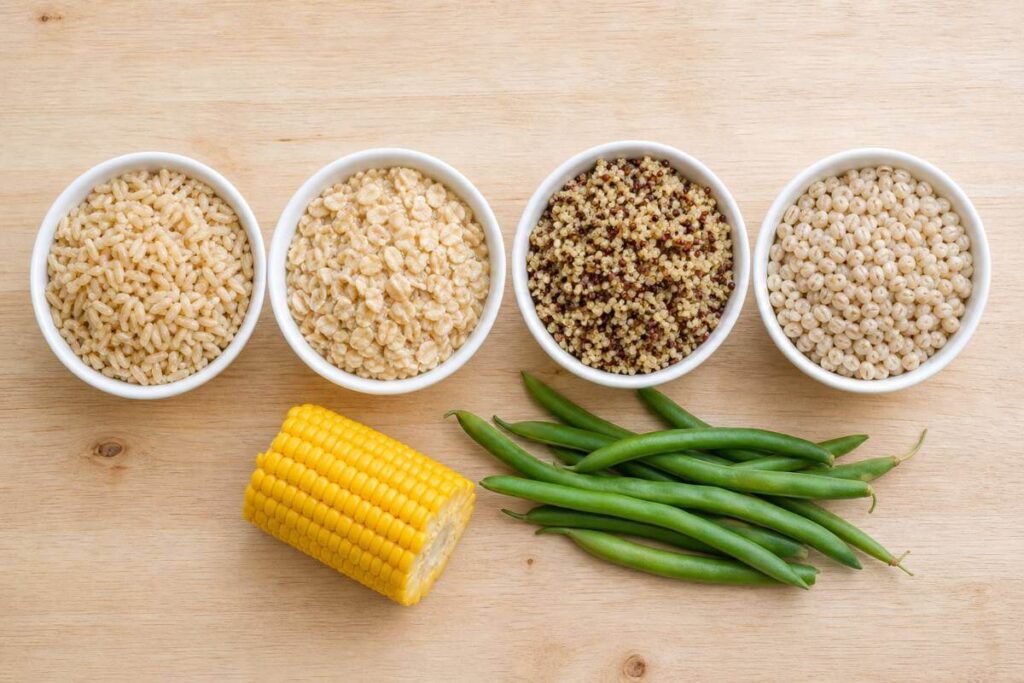
Parrots like bread for a few simple reasons: it is soft, it is mild and it tears. Every one of those can be met by food that also does something useful.
| If your bird likes bread for… | Feed this instead |
|---|---|
| The soft, chewy texture | Cooked sweet potato, cooked squash |
| The grain taste | Cooked brown rice, oats, quinoa, barley |
| Something to tear apart | Corn on the cob, a whole green bean, leafy greens |
| Sharing your food at mealtimes | Steamed vegetables from your plate, unseasoned |
| A training reward | A single pine nut or sunflower seed |
| Something to work at | Almonds or walnuts in the shell, in the right portion |
Cooked whole grains are the direct swap. Same appeal to the bird, and they carry the protein, fiber and B vitamins that bread has had stripped out.
When is bread a bigger problem than usual?
- Small birds. An amount of salt a macaw would barely notice is a real dose for a 30 g budgie
- Overweight birds. Bread is dense in calories and empty of everything else
- Birds with kidney disease. Sodium load is a direct concern
- Birds with diagnosed fatty liver disease. Empty calories are the last thing they need
- Birds already refusing vegetables. Bread makes fussy eating worse. A bird that has tasted it will hold out for it
- Hand-reared chicks. Nothing but an appropriate formula until fully weaned
Frequently asked questions
The questions parrot owners ask most about bread.
Can parrots eat bread?
They can eat it without being poisoned, but they should not. Bread gives a parrot next to no nutrition, carries a lot of salt for a small bird and crowds out the pellets and vegetables that keep it healthy.
Will bread swell up and block my parrot’s crop?
Almost certainly not. Veterinary sources list grass, string, bedding, feathers, fruit skins and yeast infection as causes of crop impaction — not bread. Too much starchy food does feed yeast, and yeast overgrowth causes sour crop. But the blockage claim itself is widely repeated and not supported.
What if my parrot ate a piece of bread?
Nothing will happen. Bread is not toxic. Watch your bird normally and return to its usual diet. The exception is bread containing chocolate, onion, garlic, avocado, xylitol or mold — those need an avian vet.
Is whole grain bread better for parrots than white?
Slightly. Whole grain has more fiber and more intact grain. It still carries the same sodium, and it still crowds out real food. Cooked whole grains such as brown rice, oats or quinoa give the same appeal with real nutrition.
Can parrots eat toast?
No. Toasting produces acrylamide, which forms when starch is heated, and darker toast contains more of it. Toast is also dry and crumbly, which raises the risk of inhaled crumbs in a bird with no teeth.
How much sodium is in bread compared with what a parrot needs?
A slice of commercial white bread contains roughly 120–180 mg of sodium. Scale a human daily sodium limit down to the weight of a 400 g parrot and you get about 13 mg. One slice carries roughly ten times that, and a budgie weighs a thirteenth of a Grey.
Can baby parrots eat bread?
No. Unweaned chicks should have an appropriate hand-rearing formula and nothing else. Yeast infection is a leading cause of crop problems in chicks, and starchy food feeds yeast.
Is sourdough bread safe for parrots?
It is not meaningfully better. Sourdough fermentation breaks down some phytate, a compound that blocks mineral absorption. That is a small benefit, but the sodium and the empty calories remain. Homemade salt-free bread is the only version worth considering, and only as a rare crumb.
Can parrots eat bread crumbs?
A few crumbs will not harm a bird. The problem is that crumbs turn into a habit, and a bird that expects bread at mealtimes starts refusing the food it needs.
What about tortillas, cornbread and crackers?
Treat them the same way. They are all refined starch with added salt, and crackers are usually the saltiest of the three. Plain corn tortillas are the least bad option because they are simpler, but none of them belong in a parrot’s diet. Plain cooked corn or a piece of corn on the cob does the same job and actually feeds the bird.
My parrot only wants bread. How do I stop?
Do not take it away all at once. Birds can go downhill quickly when they stop eating. Cut the portion back gradually. Put cooked whole grains next to it, so the new food is familiar before the bread disappears. Weigh your bird on a gram scale through the change. If it loses weight, stop and call an avian vet.
Why do people feed bread to birds if it is bad for them?
Because birds take it eagerly, and that looks like enjoyment. The same is true of ducks in a park. But enthusiasm is not nutrition. Bread tastes good, needs no work and goes down easily. That is exactly why birds choose it over food that would do them good.
Still unsure about a specific food or portion for your bird? An avian veterinarian can weigh your parrot and set portions from its actual body condition, which is always more accurate than a general guideline.
The practical summary
Bread will not poison your parrot and it will not block its crop. Both of those miss what actually happens.
What bread does is take up space. Space in the crop, space in the day’s calories and space in a bird’s appetite for anything else.
Over months that becomes vitamin A deficiency, weak bones, an overweight bird and a fatty liver. None of it announces itself until it is well advanced.
If your bird has had bread, nothing needs to happen today. Stop offering it and put cooked whole grains in its place.
If your bird now refuses everything else, make the change gradually rather than all at once, and weigh it through the switch. Birds go downhill fast when they stop eating.
Sources and notes
- Salt requirements and sodium toxicity in birds: Hagen Avicultural Research Institute, “Importance of Salt in Bird Food” (linked above)
- Crop impaction causes: University of Maryland Extension, Common Crop Issues in Backyard Chickens; poultry and avian veterinary references
- Bread nutrient values and sodium content: USDA FoodData Central
- Acrylamide formation in heated starch: US Food and Drug Administration guidance
This article is for general information and does not replace veterinary advice. If your parrot is unwell, has eaten bread containing chocolate, onion, garlic, avocado or xylitol, or shows signs of crop problems, contact an avian veterinarian.