

If your bird has just eaten chocolate, do this now
1. Note the time.
Text it to yourself if that is fastest. It decides which treatments are still possible.
2. Call your avian vet.
If you cannot reach one, either of these is staffed 24 hours a day, every day of the year. A consultation fee applies.
- ASPCA Animal Poison Control — (888) 426-4435
- Pet Poison Helpline — (855) 764-7661
Do not try to make your bird vomit. It risks aspiration pneumonia.
There is a window of roughly one to three hours in which a vet can still remove the chocolate before the body absorbs it. Go now rather than waiting for symptoms. The full emergency steps are further down this page.
The answer is no. Most pages will tell you that much, and then stop. Almost none of them show you the evidence.
That gap matters, because the advice out there is not unanimous. Some pages still tell owners that a moderate amount of dark chocolate is fine now and then. It is not, and a bird can die from being on the wrong side of that guess.
Here is what the veterinary literature says. A 2025 review of avian toxicoses in Frontiers in Veterinary Science examined the reported cases of chocolate poisoning in birds. Every documented case ended in the bird’s death, with one exception.
One survivor. Every other bird in the record died.
This guide covers three things: what chocolate does inside a bird, the doses that have actually killed one, and the narrow window in which a vet can still remove it.
Quick answer
No. Parrots cannot eat chocolate in any amount or any form.
Chocolate contains theobromine and caffeine, both methylxanthines. Birds absorb them rapidly. And because a bird is small and burns energy fast, a quantity that would barely register in a person becomes a serious dose in a parrot.
If your bird has eaten chocolate, call an avian vet immediately. There is a window of roughly one to three hours in which a vet can flush the crop and physically remove the chocolate before it is absorbed. After that, the treatment options narrow sharply.
Do not try to make your bird vomit. Veterinary guidance is explicit that inducing vomiting in a poisoned bird is not recommended, because of the high risk of aspiration pneumonia.
Key facts at a glance
- The toxins: theobromine and caffeine
- What they do: overstimulate the heart and nervous system
- Why birds suffer most: small body, fast metabolism, rapid absorption
- The record: every reported case in birds died, except one mynah
- A fatal dose: 20 grams of dark chocolate killed an adult kea
- Treatment window: one to three hours
- Never: induce vomiting
- Worst forms: cocoa powder, baking chocolate, cacao nibs, dark chocolate
- Emergency: ASPCA (888) 426-4435 or Pet Poison Helpline (855) 764-7661, both 24 hours
My parrot just ate chocolate. What do I do?
If this is why you are here, read this section first and the rest later.
- Note the time. Text it to yourself if that is fastest. The exact minute matters more than anything else you will do, because the treatment options depend on it.
- Call for help right now. Not in an hour. Any of these three, whichever you reach first. Who to callNumberHoursYour own avian vetYour clinic’s numberCheck their after-hours lineASPCA Animal Poison Control Center(888) 426-443524/7, every day of the yearPet Poison Helpline(855) 764-766124/7, every day of the year Both hotlines charge a consultation fee, and both are staffed by veterinary toxicology specialists who will talk your own vet through the case if needed. If your regular vet does not see birds, ask the emergency clinic for the nearest avian practitioner, or search the Association of Avian Veterinarians directory.
- Do not make your bird vomit. This is not a mild precaution. Veterinary guidance states that inducing vomiting in a poisoned bird is not recommended because of the high risk of aspiration pneumonia. Birds have a crop and a very different airway from a mammal’s, and forcing anything up can kill a bird faster than the chocolate will.
- Have these five things to hand. Poison control and your vet will ask for every one of them, so gather what you can while the phone is ringing.
- Species and weight of the bird, as accurately as you can
- What kind of chocolate, with the cocoa percentage from the wrapper
- Roughly how much was eaten. Weigh what is left and subtract
- What time it happened
- Any signs you have already seen, and anything you have already given the bird
- Keep the bird warm, quiet, and undisturbed. No handling, no other pets, dim light. A poisoned bird burning energy on stress does worse.
- Go now, even if the bird looks fine. Signs often begin within a few hours, but the reason to move fast is not the signs. It is the window.
How long do you have to get to a vet?
Veterinary guidance for avian poisoning gives a specific window: roughly one to three hours after ingestion. Inside it, a vet can perform a delicate crop lavage. The bird is anesthetized, ventilated through a tracheal tube, and the crop is gently flushed with warm water or saline.
In plain terms: for a short period after your bird eats chocolate, a vet can physically wash it back out before the body absorbs it.
That is not a home procedure. It requires general anesthesia and airway control, and it can only be done by someone qualified. But it does mean that calling the vet at minute twenty and calling at hour six are two very different situations.
Activated charcoal, at 1 to 3 g/kg of body weight, may also be used to bind toxin that has already moved past the crop.
If you take nothing else from this article: the clock starts when the chocolate goes in.
What if it happened hours ago?
Go anyway. This is the question people hesitate over, and hesitating is the wrong call.
Past the lavage window, the vet still has real options. Activated charcoal binds toxin that is still in the gut. Fluid therapy helps the body clear it. Oxygen supports a struggling heart. Antiarrhythmic drugs steady the rhythm, and sedatives control tremors and seizures before they exhaust the bird.
None of that is nothing. The one bird in the literature that survived chocolate poisoning, a common mynah, recovered on medication and supportive care over four days.
Missing the window makes the situation worse. It does not make it hopeless.
How do I know if my bird ate chocolate?
Sometimes you see it happen. Often you do not, and you are working backwards from a mess on the table.
Look for these:
- A chewed or shredded wrapper, especially foil
- Brown smearing on the beak, face, or chest feathers
- Brown staining on the feet, from standing in it
- A visibly smaller piece than you remember leaving
- Crumbs scattered near where the bird was perched
Chocolate melts on contact with a warm beak, so it marks a bird more obviously than most foods. Check under the chin and around the nostrils, where owners often miss it.
If you have more than one bird out, assume all of them were involved until you can rule each one out. Birds share food and follow each other to it.
If you find evidence but cannot tell how much was eaten, weigh what is left and subtract it from the original weight on the packaging. That number is exactly what the vet will ask for.
Why can’t parrots eat chocolate?
Chocolate is made from cocoa. Cocoa contains a group of compounds called methylxanthines, and three of them matter here: theobromine, caffeine, and theophylline.
Methylxanthines do two things at once inside a bird.
They act as adenosine receptor antagonists. Adenosine is the brake pedal of the nervous system. It is the chemical that makes you feel tired and settles the heart rate.
Block it, and the brakes come off. The result is nervous system stimulation, a racing heart, irregular rhythms, raised blood pressure, and increased urine output.
They also inhibit phosphodiesterase, which drives up a signaling molecule called cyclic AMP inside cells. That amplifies the whole stimulant effect.
So a poisoned bird is not sick to its stomach. It is being driven hard by a chemical accelerator it cannot switch off.
Why is chocolate worse for birds than for people?
Three reasons, and they stack.
Rapid absorption. Methylxanthines move into the bloodstream quickly in birds.
Small body size. A crumb that a 150 pound adult would never even notice is a real dose in a 90 gram cockatiel.
High metabolic rate. A bird’s heart already beats several hundred times a minute at rest. A stimulant pushes a system that is running close to its limit anyway.
Put those three together and the veterinary guidance is blunt. In birds, even small amounts can cause hyperactivity, tremors, seizures, and sudden death.
How much chocolate is dangerous for a bird?
Most advice on this stops at “even a small amount is dangerous.” That is true. It is also not much help when your bird has just eaten something and you need to know how worried to be.
So here is a real number.
In 2007, the New Zealand Veterinary Journal published the case of a wild kea, a large alpine parrot, that died after raiding chocolate.
The postmortem found 20 grams of dark chocolate in the crop. The estimated dose was 250 mg/kg theobromine, plus 20 mg/kg caffeine and 3 mg/kg theophylline.
Tissue examination showed acute degenerative damage to the liver, kidney, and brain.
Now scale that to the birds people actually keep.
A kea weighs about 900 grams, so 250 mg/kg means it took in roughly 225 mg of theobromine. From 20 grams of chocolate, that is about 11 mg of theobromine in every gram. Apply the same 250 mg/kg to a smaller bird and the numbers get uncomfortable fast.
| Bird | Typical weight | Dark chocolate delivering the kea-equivalent dose |
|---|---|---|
| Budgerigar | 35 g | under 1 g (about two chocolate chips) |
| Green-cheek conure | 70 g | about 1.6 g |
| Cockatiel | 90 g | about 2 g |
| Quaker parrot | 100 g | about 2.2 g |
| African Grey | 450 g | about 10 g |
| Amazon | 500 g | about 11 g |
| Blue and gold macaw | 1,000 g | about 22 g |
For scale, one square of a standard dark chocolate bar weighs about 8 grams. A single Hershey’s Kiss is around 4.5 grams. One chocolate chip is roughly half a gram.
So a single square of dark chocolate carries roughly ten times the kea-equivalent dose for a budgerigar, and about four times the dose for a cockatiel.
Two honest caveats. That 250 mg/kg figure is one documented fatal case, not an established lethal threshold, and the kea also took in caffeine and theophylline alongside it. Individual sensitivity varies between birds, and doses well below a fatal one can still cause tremors, seizures, and lasting organ damage.
The table is not a safety guide. It is there to show the scale of the problem. A bird can reach a documented fatal dose from an amount of chocolate a person would not notice dropping.
Which chocolate is worst for birds?
The rule is simple. Theobromine comes from cocoa solids, so the more cocoa a product contains, the more toxin it carries.
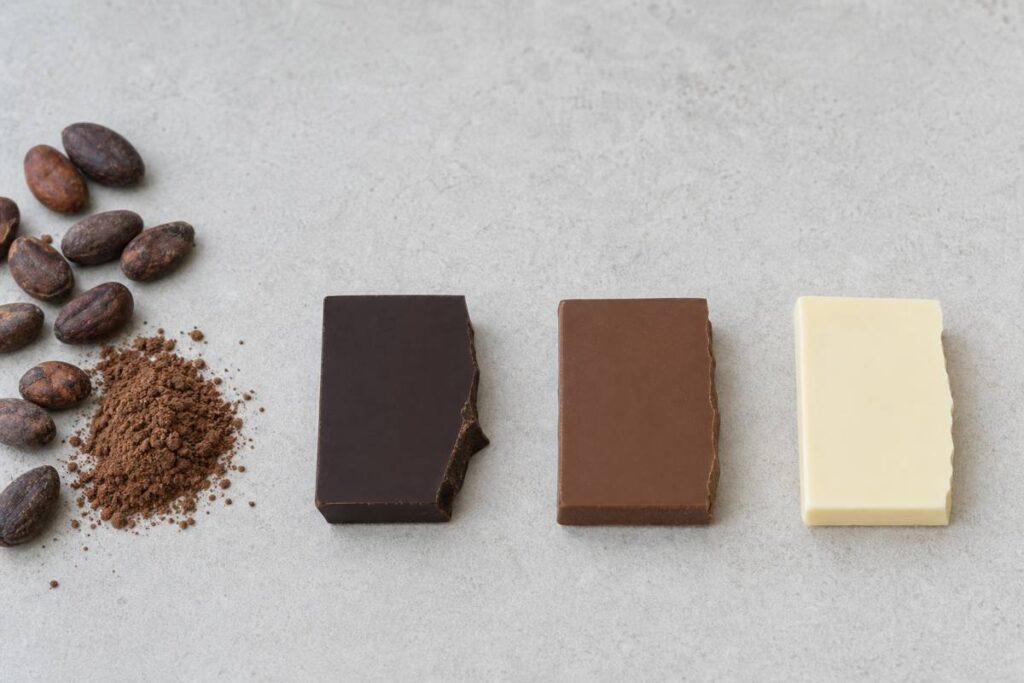
| Type | Approximate theobromine | Risk |
|---|---|---|
| Cocoa powder, cacao nibs, baking chocolate | Highest of all | Extreme |
| Dark chocolate (70% and above) | 130 to 450 mg per ounce | Very high |
| Milk chocolate | around 64 mg per ounce | High for a small bird |
| White chocolate | Trace amounts | Low toxin, but high sugar and fat |
Look at the gap between milk and dark. Dark chocolate can carry several times the theobromine of milk chocolate by weight. That is why an identical crumb is a different emergency depending on which bar it fell from.
Baking chocolate and cocoa powder deserve particular attention. They are the most concentrated forms in most kitchens, and during baking they sit in open bags and jars rather than in wrappers.
Is white chocolate safe for parrots?
No, though this one deserves a proper explanation rather than a flat no.
White chocolate is made from cocoa butter, not cocoa solids, so it contains only trace theobromine. On the methylxanthine question alone, it is the least dangerous form.
That does not make it food for a bird. White chocolate is sugar and fat, close to nothing else. Parrots are prone to obesity and fatty liver disease. A lump of sweetened fat is a poor thing to put into a small body with a fast metabolism.
It also almost never turns up alone. It comes in mixed boxes, on cookies, in cakes, alongside the forms that do carry theobromine.
So the honest answer is that white chocolate is less likely to cause acute poisoning and is still not something to give a parrot.
What are the symptoms of chocolate poisoning in birds?
Signs usually begin within a few hours, though they can be delayed. They tend to arrive in two stages.
Early signs
- Restlessness and hyperactivity, unable to settle
- Increased thirst and urination
- Vomiting or regurgitation
- Diarrhea, or loose dark droppings
Serious signs. Get to a vet immediately.
- Racing or irregular heartbeat
- Rapid breathing
- Muscle tremors
- Loss of coordination
- Seizures
- Collapse
One warning about the early picture. An agitated, hyperactive bird is easy to misread as an excited one. A parrot that suddenly cannot settle after being near chocolate is showing you a symptom, not a mood.
Diagnosis in practice is based on history and clinical signs. Laboratory confirmation is rarely performed, so what you tell the vet about what was eaten and when is effectively the diagnostic test.
When is my bird out of danger?
There is no official all-clear time, so use this as a working guide.
First one to three hours. The treatment window. This is when a vet can still remove chocolate from the crop.
3 to 12 hours. The period when signs most commonly appear. Watch closely and do not leave the bird alone.
12 to 24 hours. Delayed signs are still possible. Keep watching, especially for breathing changes and tremors.
After 24 hours with a bird that is eating, drinking, behaving normally, and producing normal droppings, the acute risk has largely passed.
A bird that ate a large amount and was treated may still need follow-up, because methylxanthines can damage the liver and kidneys. Your vet will tell you whether recheck bloodwork is worth doing.
Can a bird survive chocolate poisoning?
Yes, and one bird in the literature did. But the record around that survivor is sobering.
The 2025 Frontiers in Veterinary Science review of avian toxicoses states that the few reported cases of chocolate toxicosis in birds resulted in death, with one exception.
That exception is worth knowing about, because it is the closest thing to good news on this page.
A common mynah presented with tremors and convulsions after eating chocolate. It was treated with a diphenhydramine elixir to control the tremors. The convulsions stopped the day after treatment began, the tremors eased, and the bird recovered completely in four days.
That single case tells you two things. Recovery is possible, and it happened because the bird got veterinary treatment.
Supportive care for chocolate toxicosis includes fluid therapy, oxygen, antiarrhythmic drugs for the heart, and sedatives such as benzodiazepines to control seizures. There is no antidote in the sense of a reversal agent. But unlike some poisonings, there is a real toolkit, and it works when it is used in time.
This is a meaningful difference from avocado poisoning, where the damage is to heart muscle and there is nothing to remove and nothing to reverse. With chocolate, the first hours genuinely matter.
What else contains theobromine or caffeine?
Chocolate bars are the obvious hazard. These are the ones that catch people off guard.
In the baking cupboard
- Cocoa powder, drinking chocolate, cacao nibs, baking chocolate
In sweets and desserts
- Chocolate cookies, cake, brownies, muffins, doughnuts
- Chocolate cereal, cereal bars, ice cream
In drinks
- Coffee, espresso grounds, coffee beans
- Tea, including green tea
- Cola and energy drinks
- Anything coffee-flavored
In the garden
- Cocoa mulch, made from cocoa shell and high in theobromine
That last one matters if your bird has any outdoor time, or if you have an aviary near a flower bed.
Coffee deserves a specific mention because of how people drink it. A mug left on a side table at bird height, with a parrot out of its cage, is one of the most common exposures there is.
What can parrots eat instead of chocolate?
Nothing about chocolate is nutritionally necessary, so there is no gap to fill. There is only the habit of sharing what you are eating, and plenty of safe ways to do that.
Good options include apple with the seeds removed, banana, berries, mango, papaya, melon, carrot, sweet potato, peas, bell pepper, and leafy greens. Small amounts of unsalted nuts work well as high-value treats for larger parrots.

If what you actually want is something chocolate-like, the answer is carob. Carob comes from the pod of the carob tree. It looks and tastes broadly similar to chocolate, and it contains no theobromine and no caffeine. It is sold in bird treats for exactly this reason.
Carob is still sugary, so keep it occasional rather than daily. But it is the one genuine substitute, and it answers what most people are really asking when they wonder about chocolate.
For the full picture of how fresh food fits alongside pellets and seed, see our guide to what parrots eat.
Five things that prevent almost every case
- Cage the bird before chocolate comes out, not after. Baking, holidays, movie nights, visitors with handbags
- Keep coffee mugs covered or in another room while the bird is out
- Store chocolate in a closed cabinet, not a bowl on the counter. Parrots open containers
- Tell visitors and children the rule before they arrive. “He just wanted a taste” is how most cases start
- Check the garden if your bird has outdoor time. Cocoa mulch is high in theobromine
Underneath all five is one rule. Decide the bird does not get human snacks at all, and the question never comes up mid-mouthful. Every accidental poisoning starts as a small exception.
Frequently asked questions
Can parrots eat chocolate in small amounts?
No. There is no established safe amount for any parrot. A documented fatal case in a kea involved an estimated 250 mg/kg of theobromine. Scaled to body weight, that corresponds to under a gram of dark chocolate for a budgerigar.
How much chocolate is toxic to a parrot?
Less than most people expect. Using the kea case as a reference, a budgerigar reaches an equivalent dose from under one gram of dark chocolate, roughly two chocolate chips. A cockatiel reaches it from about two grams. A single square of a dark chocolate bar weighs around eight grams.
What should I do if my parrot ate chocolate?
Note the time, call an avian vet immediately, and do not induce vomiting. Within roughly one to three hours of ingestion, a vet can perform a crop lavage and physically remove the chocolate before it is absorbed. Bring the packaging so the vet can see the cocoa percentage.
Can I make my bird vomit after it eats chocolate?
No. Veterinary guidance advises against inducing vomiting in poisoned birds because of the high risk of aspiration pneumonia. Crop lavage is done by a vet under general anesthesia with the airway protected.
Is white chocolate safe for parrots?
It contains only trace theobromine, so it is far less likely to cause acute poisoning. It is still sugar and fat with no nutritional value for a bird, and it usually appears alongside forms that do contain theobromine.
How long does it take for chocolate to affect a bird?
Signs typically begin within a few hours of ingestion, though they can be delayed. The important clock is not the symptoms but the treatment window, which is roughly one to three hours for crop lavage.
Can a parrot recover from chocolate poisoning?
Yes, but reported cases in birds have mostly ended in death. The one documented recovery was a common mynah treated with a diphenhydramine elixir, which recovered fully in four days. Prompt veterinary treatment is what makes the difference.
Is coffee as dangerous as chocolate for parrots?
Both contain methylxanthines and both are dangerous. Coffee delivers caffeine rather than theobromine, but the mechanism and the effects are the same, and an unattended mug at bird height is a very common exposure.
Can parrots eat carob instead of chocolate?
Yes. Carob comes from the carob tree pod, contains no theobromine and no caffeine, and is sold in bird treats as a chocolate substitute. It is still sugary, so offer it occasionally rather than daily.
My parrot ate chocolate hours ago. Is it too late to do anything?
No. Past the crop lavage window, a vet can still use activated charcoal, fluid therapy, oxygen, antiarrhythmic drugs, and sedatives. The one documented survival in a bird recovered on medication and supportive care. Go anyway.
Who do I call if my parrot ate chocolate?
Call your avian vet first. If you cannot reach one, the ASPCA Animal Poison Control Center is on (888) 426-4435 and the Pet Poison Helpline is on (855) 764-7661. Both run 24 hours a day, every day of the year, and both charge a consultation fee. Have the bird’s weight, the chocolate type and amount, and the time of ingestion ready before you dial.
When is my bird safe after eating chocolate?
Signs most often appear between 3 and 12 hours, and delayed signs are possible up to 24 hours. A bird that is eating, drinking, behaving normally, and passing normal droppings after 24 hours has largely passed the acute risk. Ask your vet about follow-up bloodwork if a large amount was eaten.
Bottom line
So, can parrots eat chocolate? No, and the record is unusually clear on this one. In the reported veterinary cases of chocolate toxicosis in birds, all but a single mynah died.
The reason is simple enough. Theobromine and caffeine take the brakes off the heart and nervous system, birds absorb them fast, and a bird is small enough that a crumb counts as a dose.
If it has already happened, the single most useful thing you can do is move quickly. There is a window of roughly one to three hours in which a vet can wash the chocolate back out before the body takes it up. That window closes whether or not your bird looks unwell.
Keep chocolate off surfaces the bird can reach. Keep coffee mugs covered or out of the room. And treat the whole category as off limits rather than something to portion carefully, because there is no safe portion.
Sources consulted
- Vetere A, Di Ianni F, Gavezzoli M, Cococcetta C. Avian toxicoses: a review. Frontiers in Veterinary Science, Volume 12, 11 August 2025. Section 11, Methylxanthines
- Gartrell BD, Reid C. Death by chocolate: a fatal problem for an inquisitive wild parrot. New Zealand Veterinary Journal, 2007
- Mokaram SG. Treatment of chocolate toxicosis in a Mynah bird (a case report). Proceedings of the 4th International Veterinary Poultry Congress, Tehran, 2014
- Cole G, Murray M. Suspected chocolate toxicosis in an African Grey parrot (Psittacus erithacus). Proceedings of the Annual Conference of the Association of Avian Veterinarians, Monterey, 2005
- Lightfoot TL, Yeager JM. Pet bird toxicity and related environmental concerns. Veterinary Clinics of North America: Exotic Animal Practice, 2008
- Wismer T. Advancements in diagnosis and management of toxicologic problems. In: Speer B, ed. Current Therapy in Avian Medicine and Surgery, Elsevier, 2016
Disclaimer: This guide is educational and does not replace veterinary advice. If your bird has eaten chocolate, or shows agitation, tremors, rapid breathing, or any sudden change in behavior, contact a qualified avian veterinarian immediately.