

Short answer: yes. Apple flesh and skin are both safe for parrots. Serve apple two or three times a week in a measured portion — about 3 g for a budgie, 6 g for a cockatiel, 12 g for an African Grey and 20 g for a large macaw. Keep all fruit to 5–10% of what your bird eats.
Remove the core and seeds first. Every article on this subject says so, usually with the word “fatal” attached and no explanation.
That explanation is worth having, because the usual one misses the most important part.
Key facts at a glance
| Question | Answer |
|---|---|
| Is apple flesh safe for parrots? | Yes |
| Is apple skin safe? | Yes — and you should not peel it |
| Are apple seeds dangerous? | Yes — and for a reason most articles miss |
| Why do seeds matter more for birds than people? | Parrots crack seeds open. People swallow them whole |
| How often can parrots have apple? | Two or three times a week |
| Portion for a budgie | About 3 g — a thin sliver |
| Portion for a cockatiel | About 6 g — one small slice |
| Portion for an African Grey | About 12 g — two thin slices |
| Portion for a large macaw | About 20 g — a small wedge |
| Sugar content | 10.4 g per 100 g — lower than banana or grape |
| Fiber content | 2.4 g per 100 g with skin, 1.3 g without |
| Vitamin A content | 3 mcg per 100 g — almost none, despite common claims |
| Pesticide ranking | Eighth on EWG’s 2026 Dirty Dozen |
Are apple seeds poisonous to parrots?
Yes, apple seeds are dangerous to parrots — but for a reason that is different from the one you will read elsewhere.
Apple seeds contain a compound called amygdalin. On its own it is harmless. But when it meets certain enzymes in the gut, it breaks down and releases hydrogen cyanide.
That much appears in every article about apples and parrots. Here is the part that gets left out.
A whole seed passes straight through
An apple seed only releases cyanide if its shell is broken.
The seed has a hard outer shell that stomach acid cannot break down. Swallow a seed whole and it travels through the gut and out the other end unchanged. The amygdalin inside never meets the enzymes that would turn it into cyanide.
The shell has to be crushed, ground or properly chewed for anything to happen at all.
This is why human health advice about apple seeds is so relaxed. A person eating an apple sometimes swallows a seed by accident. It passes through. Nothing is released.
Parrots crack seeds open
Parrots do not swallow seeds whole, which is exactly why apple seeds matter more for birds than for people.
A parrot’s beak is built to crack seeds open and crush them. That is not a side effect of its shape — it is the whole point of it.
Give a parrot an apple core and it will find the seeds, hold each one in place, and split it open. That is what the beak is for, and seeds are food worth the effort.
So the one thing that keeps apple seeds harmless for people is the one thing your bird will not do.
This is the real reason to remove the core, and it is a better reason than “cyanide is fatal.” What matters is not whether seeds exist. It is whether your parrot gets the chance to crack them.
How many apple seeds are dangerous for a parrot?
Nobody knows. Any site giving you a precise number is guessing, and here is why.
The source data does not agree. Published studies put the amygdalin content of apple seeds anywhere between 1 and 4 mg per gram — a fourfold gap on its own. Reported seed weights vary by more than ten times between sources. Any figure built on those numbers is only as good as the numbers behind it.
Nobody has measured this in birds. Lethal cyanide doses are documented for humans and several mammals. No equivalent research exists for parrots. Assuming a bird reacts the same way a human does, just scaled down by weight, is a guess. It is not a finding.
Size changes everything. A budgie weighs about 30 grams. An adult human weighs around 70,000 grams. A poison measured by body weight behaves very differently at that size.
Here is what is certain. Nobody has worked out a safe number of crushed apple seeds for a parrot. The possible harm is serious. And cutting out a core takes about five seconds. There is nothing to gain from finding out where the limit is.
What if my parrot already ate an apple seed?
One seed swallowed whole is very unlikely to cause a problem. If several have been cracked open, call an avian vet now.
Cyanide poisoning shows itself quickly. Watch for fast or labored breathing, weakness, unsteadiness and collapse. This is a call to make immediately, not something to watch and wait on.
Seeds are a preparation problem, not a toxic food
Apple is a safe food with one part that needs removing. It is not in the same category as the foods that are genuinely toxic.
Avocado and chocolate are toxic to parrots. No amount of preparation makes them safe and no portion is acceptable. They should not be in the house.
Apple is different. It needs one part taken out, in the same way you would not hand a bird a whole peach with the stone still in it. Cut around the core and the problem is gone.
What is actually in an apple
All values from USDA FoodData Central, raw apple with skin, per 100 grams — roughly half a medium apple.
| Nutrient | Per 100 g | What it means for a parrot |
|---|---|---|
| Calories | 52 | Low. Apples are 86% water |
| Sugars | 10.4 g | Lower than banana (12.2 g) or grape (15.5 g) |
| Total carbohydrate | 13.8 g | Mostly sugar, with useful fiber |
| Fiber | 2.4 g | The best thing in an apple, and it is in the skin |
| Vitamin C | 4.6 mg | Modest |
| Potassium | 107 mg | Moderate |
| Vitamin A | 3 mcg | Almost none, despite what several parrot sites claim |
| Vitamin B6 | 0.041 mg | Low — about a ninth of banana’s |
| Calcium | 6 mg | Low |
| Phosphorus | 11 mg | Calcium ratio of roughly 1:1.8 |
| Iron | 0.12 mg | Low, which suits species prone to iron storage disease |
Do apples contain vitamin A for parrots?
No. Apple contains 3 micrograms of vitamin A per 100 grams, which is almost nothing.
The same weight of cooked sweet potato contains around 960 micrograms — more than 300 times as much.
At least one popular parrot site says apples contain vitamin A that “promotes your bird’s eyesight.” That is the same error that circulates about bananas, and it matters for the same reason.
Vitamin A deficiency is one of the most frequently diagnosed nutrition problems in pet birds, according to the Merck Veterinary Manual. In seed-fed parrots it builds up quietly over years. It damages the lining of the mouth, sinuses and airways. You see it as white patches inside the mouth, nasal discharge and sneezing, poor feather quality and repeated chest infections.
Feeding apple to fix a vitamin A problem does nothing at all.
For vitamin A, feed: cooked sweet potato, red and orange bell pepper, carrot, butternut squash, kale, collard greens.
Fiber is the real benefit
Apple has more than twice the fiber of a grape, about 15% less sugar than a banana and about a third less than a grape.
At 2.4 g per 100 g, most of that fiber is pectin, a soft fiber that feeds gut bacteria. Apple is one of the better fruit sources of it.
Decent fiber, lower sugar, plenty of water. That combination makes apple a good default fruit — the one to reach for most often. It is not exciting nutritionally, but it causes the fewest problems.
Should you peel apples for a parrot?
No. Peeling throws away about 46% of the fiber and leaves the sugar behind.
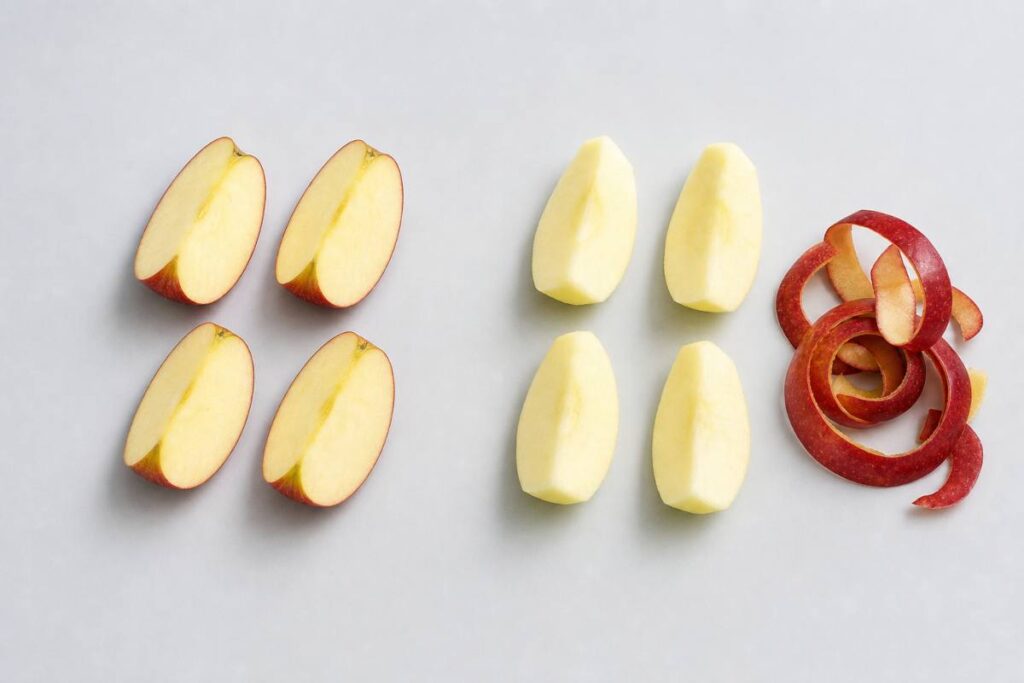
| With skin | Without skin | |
|---|---|---|
| Fiber | 2.4 g | 1.3 g |
| Vitamin C | 4.6 mg | 4.0 mg |
| Sugar | 10.4 g | 11.1 g |
Several popular parrot sites tell you to peel apples first. The worry is pesticide residue. That is a reasonable worry, but peeling costs more than it saves.
Fiber is the one thing apple is genuinely good for, and half of it gets thrown away. Peeling also removes most of the polyphenols, which sit in the skin and just under it. A peeled apple is a sweeter, less useful food than a whole one.
It removes the texture too. Parrots work at apple skin. A peeled slice is gone in seconds. A wedge with the skin on can keep a bird busy for several minutes. For an animal that gets bored easily, that is worth a lot.
Wash it properly instead. Soak for 15 minutes in one part white vinegar to three parts water, then rinse under running water. A quick rinse on its own removes very little.
How much apple can a parrot eat?
About 3 g for a budgie, 6 g for a cockatiel, 12 g for an African Grey and 20 g for a large macaw, two or three times a week.
Fruit should make up 5–10% of what your bird eats, and apple competes for that space with every other fruit. Our complete guide to what parrots eat sets out the full pellet, vegetable and fruit ratio.
| Bird size | Example species | Apple per serving | How often |
|---|---|---|---|
| Small | Budgie, parrotlet, lovebird | About 3 g — a thin sliver | 2–3 times a week |
| Medium | Cockatiel, conure, Quaker, Senegal | About 6 g — one small slice | 2–3 times a week |
| Large | African Grey, Amazon, eclectus | About 12 g — two thin slices | 2–3 times a week |
| Extra large | Blue and gold macaw, umbrella cockatoo | About 20 g — a small wedge | 2–3 times a week |
These come from applying the 5–10% fruit rule to what a bird of each size eats in a day. Treat them as starting points. An overweight Amazon, a breeding hen and a bird recovering from illness each need a different answer, and that is a conversation for an avian vet.
Because apple is lower in sugar than most fruit, you can be a little more generous with it. If you feed fruit three times a week, apple is a sensible choice for two of those.
How to cut it, by bird size
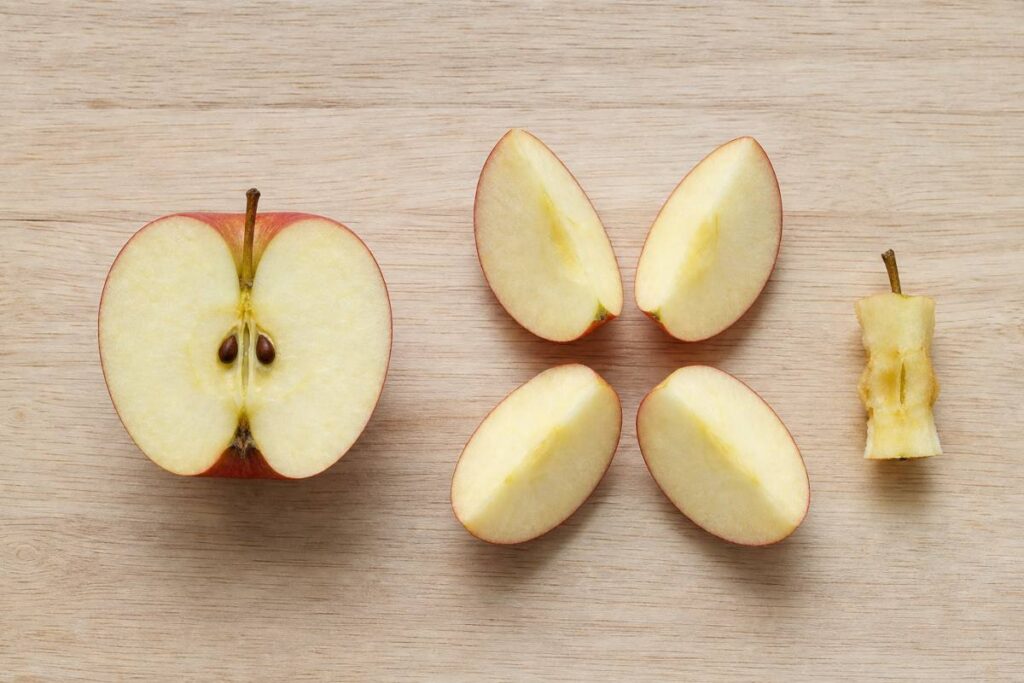
- Small birds — thin slivers, skin on, no core. Check for seed fragments
- Medium birds — small slices, skin on. Check for seeds
- Large birds — wedges cut well clear of the core. Skin on
- All birds — cut around the core, never through it, so no seed ends up loose in the bowl
Cutting through the core leaves seeds inside the slices. Cutting around it takes the same amount of time and removes the problem completely.
How to make it last longer
Apple is one of the easier fruits to turn into a job rather than a snack.
- Push wedges onto a stainless steel food skewer instead of dropping them in a bowl
- Freeze slices in warm weather. Frozen apple takes far longer to get through
- Wedge a slice between the cage bars so your bird has to work it free
- Always leave the skin on. It is the part that takes time to eat
Do apples need to be organic for parrots?
Organic is worth buying if you can afford it. If you cannot, a vinegar soak does most of the job.
Apples are a heavily sprayed crop. They rank eighth on the Environmental Working Group’s 2026 Dirty Dozen. The full 2026 list runs spinach, kale and collard greens, strawberries, grapes, nectarines, peaches, cherries, apples, blackberries, pears, potatoes, blueberries.
That ranking is worth getting right, because at least one widely read parrot site still puts apples fourth, behind strawberries, spinach and nectarines. That was true of an older version of the list. It is not the current ranking.
The list comes from USDA testing of 54,344 samples across 47 fruits and vegetables. Samples are washed and peeled before testing, so whatever residue shows up is what survives normal preparation at home.
The other side, fairly put: more than 99% of produce tested by USDA falls below EPA legal residue limits. Farming industry groups dispute EWG’s ranking method, arguing it discourages people from eating fruit and vegetables. EWG itself says the benefits of eating produce outweigh the residue risk.
Why it still matters more for a bird: an African Grey weighs about 400 g. An adult weighs 175 times that. Eat the same piece of skin and the bird takes in a far bigger dose for its size. Legal residue limits are set for people.
What to do:
- Buy organic apples if the price difference is manageable
- If you buy conventional, soak for 15 minutes in one part vinegar to three parts water, then rinse
- Do not peel. You lose the fiber for certain, and the benefit is uncertain
For comparison, grapes rank fourth on the same list — clearly worse than apples — while bananas sit on the Clean Fifteen, thanks to a thick peel nobody eats.
Apple products to avoid
Apple juice. Concentrated sugar with the fiber strained out. Everything apple is good for is in the part that gets thrown away.
Dried apple rings. Drying removes most of the water and concentrates the sugar several times over, the same trap as raisins and banana chips. Many are also treated with sulfites.
Apple sauce. Usually sweetened. Even the unsweetened kind has lost the fiber structure and the texture.
Apple pie, apple cake, anything baked. Refined flour, sugar and fat.
Anything sugar-free. Sugar-free is worse, not better. Xylitol is toxic to birds and turns up in some sugar-free dried fruit and baked goods.
Crab apples and ornamental varieties. The fruit itself is not toxic, but ornamental trees are often sprayed with pesticides that are not approved for food crops. Feed only fruit sold for people to eat.
When to keep apples off the menu
- Overweight birds, until the weight is under control
- Birds diagnosed with fatty liver disease, unless your avian vet says otherwise
- Diabetic birds. Uncommon in parrots, but it happens
- Any bird that stops eating vegetables once fruit appears. If your bird holds out for the sweet thing, fruit comes out of the rotation until vegetables are being eaten reliably
- Any apple with the core still in it. This is the one that is not negotiable
Frequently asked questions
The questions parrot owners ask most about feeding apples.
Can parrots eat apples?
Yes. Apple flesh and skin are both safe for parrots. Serve about 3 g for a budgie, 6 g for a cockatiel, 12 g for an African Grey and 20 g for a large macaw, two or three times a week, with the core and seeds removed.
Are apple seeds poisonous to parrots?
Apple seeds contain amygdalin, which releases hydrogen cyanide when the seed is cracked or chewed. A whole seed passes through the gut without releasing anything. That is what protects people, who usually swallow seeds by accident. It does not protect parrots, because a parrot cracks seeds open. Remove the core.
What if my parrot ate an apple seed?
One seed swallowed whole is very unlikely to cause a problem. If your bird has cracked and eaten several, call an avian vet immediately. Cyanide poisoning shows itself quickly — fast or labored breathing, weakness and collapse.
Should I peel apples for my parrot?
No. Peeling removes about 46% of the fiber and most of the polyphenols while leaving the sugar behind. Wash the apple instead — soak for 15 minutes in one part vinegar to three parts water, then rinse.
Do apples have vitamin A for parrots?
No. Apple contains 3 micrograms of vitamin A per 100 grams, which is almost nothing. This claim appears on several parrot websites and is not supported by USDA data. For vitamin A, feed cooked sweet potato, red bell pepper, carrot or dark leafy greens.
Are apples better than bananas or grapes for parrots?
Nutritionally, yes. Apple has 10.4 g of sugar per 100 g against banana’s 12.2 g and grape’s 15.5 g, and more fiber than either. It is a sensible default fruit.
Can parrots eat apple skin?
Yes, and they should. The skin holds most of the fiber and polyphenols, and it gives the texture that makes apple worth eating slowly. Wash it well.
Do I need organic apples for my parrot?
It is worth it if you can afford it. Apples rank eighth on EWG’s 2026 Dirty Dozen, and USDA washes samples before testing, so residues survive a normal rinse. If you buy conventional, soak in a vinegar solution first.
Can baby parrots eat apples?
Unweaned chicks should have a proper hand-rearing formula and nothing else. Once weaned, small amounts fit inside the normal fruit allowance. Growing birds need more calcium, which is another reason to keep fruit modest and greens generous.
Can parrots drink apple juice?
No. Apple juice is concentrated sugar with the fiber removed, which throws away the only advantage apple has over sweeter fruit.
Still unsure about a specific food or portion for your bird? An avian veterinarian can weigh your parrot and set portions from its actual body condition, which is always more accurate than a general guideline.
The practical summary
Apple is one of the better fruits for a parrot. Less sugar than banana or grape, more than twice the fiber of a grape, and enough texture to keep a bird busy for a few minutes rather than a few seconds.
Leave the skin on. Wash it properly. Buy organic if you can.
And cut around the core, never through it. Not because apple seeds are uniquely deadly, but because your bird will crack them open in a way a person never would — and there is no reason at all to find out what happens next.
Sources and notes
- Avian nutrition and vitamin A deficiency: Merck Veterinary Manual, “Nutritional Diseases of Pet Birds” (linked above)
- Nutrient values: USDA FoodData Central, apples raw with skin and apples raw without skin
- Pesticide residue ranking: Environmental Working Group, 2026 Shopper’s Guide to Pesticides in Produce, based on USDA Pesticide Data Program testing of 54,344 samples
- Amygdalin content in apple seeds: published cultivar studies reporting a range of 1 to 4 mg per gram of seed
- Portion guidance comes from the 5–10% fruit share widely used in avian nutrition, applied to what a bird of each size eats in a day
This article is for general information and does not replace veterinary advice. If your parrot is unwell, overweight, or has eaten crushed apple seeds, contact an avian veterinarian.