

Yes. Parrots, parakeets and budgies can all eat broccoli, kale and the rest of the brassica family. Serve them plain, raw or lightly cooked. They are among the best vegetables you can put in the bowl, and kale gives your bird calcium it can actually absorb, which is rare in a green.
There is one real exception. It has killed birds, and it applies to a specific group: birds on all-seed diets, budgies most of all.
That is not a reason to stop feeding brassicas. It is a reason to know which side of the line your bird is on.
Most pages on this topic skip it, or drop a vague warning about “goitrogens” and move on. Bird forums have argued about it for years with nobody producing evidence. The evidence does exist, and it is set out below.
Key facts at a glance
| Question | Answer |
|---|---|
| Can parrots eat broccoli? | Yes, raw or cooked, plain |
| Can parrots eat kale? | Yes, and it is one of the best greens available |
| Which parts can they eat? | Florets, stems and leaves. The leaves are the best part |
| Is there a real risk? | Yes, but only for birds on all-seed diets |
| Which birds are at risk? | Seed-fed birds, budgies especially |
| Does a pellet-fed bird need to worry? | Almost certainly not |
| Raw or cooked? | Raw for most birds, cooked for at-risk birds |
| How does kale compare to spinach? | A bird absorbs about eight times more calcium from kale |
| How often? | Rotate with non-brassica greens rather than daily |
| Never serve with | Salt, butter, oil, cheese sauce, seasoning |
Can parrots eat broccoli?
Yes. Broccoli is safe for parrots raw or lightly cooked, and it does real work in the diet rather than just filling the bird up. It supplies calcium, vitamin C, vitamin K, fiber, and beta carotene, which the bird’s body turns into vitamin A.
Low vitamin A is the most common diet problem avian vets see. Any vegetable that helps with it earns its place in the bowl.
Serve it plain. No salt, no butter, no cheese sauce, no seasoning of any kind.
Broccoli sits in the fresh vegetable share of the diet, which most avian vets put at 20 to 30 percent. That is a much bigger allowance than fruit or treats get. You do not have to ration vegetables the way you ration almonds and walnuts.
Can parrots eat kale?
Yes, and kale deserves more credit than it usually gets. It is one of the few plants whose calcium the bird can actually use. That matters. Low calcium is the second most common diet problem in pet parrots, after low vitamin A.
Most greens look good on a nutrition label and then deliver very little once the bird eats them. Kale is the exception. There is a section further down that explains exactly why.
Kale also carries more vitamin C per gram than most vegetables, plus vitamin K, beta carotene, and fiber. African Greys and cockatiels are the two species most prone to calcium problems, and they benefit from kale more than any other bird on the list.
Which brassicas are safe for parrots?
All of the common brassicas are safe. It is a large family, so the list below is split in two. The leafy ones and the head-and-stem ones do different jobs in the bowl.
The leafy ones, which are where the calcium is:
| Leafy brassica | Notes |
|---|---|
| Kale | Calcium the bird can actually absorb |
| Bok choy | Excellent calcium, and badly underused |
| Collard greens | Similar profile to kale |
| Turnip greens | Good calcium, mild flavor |
| Mustard greens | Peppery. Some birds love it, some walk away |
| Napa cabbage | Mild, good for a fussy bird |
| Arugula, watercress | Strong flavor, so small servings |
The heads, stems and roots, which are where the chewing value is:
| Head or stem brassica | Notes |
|---|---|
| Broccoli | Florets, stems and leaves all usable |
| Cabbage, green and red | Red has more antioxidants. A whole leaf makes good foraging |
| Cauliflower | Fewer nutrients than broccoli, still perfectly fine |
| Brussels sprouts | Halve them so the bird can get at the inside |
| Kohlrabi | Crunchy bulb, good for chewing |
| Romanesco | Same as cauliflower, and the shape interests some birds |
| Radish and radish greens | The greens are worth more than the root |
| Broccoli sprouts | Much stronger than grown broccoli. Small amounts only |
Broccoli sprouts are the one worth a second look. Sprouting concentrates the plant chemicals covered in the next section, so a sprout is far stronger than a grown floret. Fine in small amounts, not a good daily green.
Do broccoli and kale affect a parrot’s thyroid?
Brassicas make it harder for the thyroid gland to take up iodine. If a bird is already short on iodine, that can tip it into thyroid disease. This is well documented in veterinary literature, it has killed birds, and broccoli was named as a cause in a published outbreak.
Here is the chain of events, step by step.
- Your bird chews a piece of broccoli or kale. Brassicas hold compounds called glucosinolates, and chewing releases an enzyme that turns them into chemicals which compete with iodine.
- The thyroid gland needs iodine to make thyroxine, the hormone that runs the body. Those chemicals get to the iodine first.
- The gland comes up short and makes less thyroxine.
- The brain notices and tells the gland to work harder. The gland responds by growing more cells.
- That swelling is goiter. Vets call it thyroid hyperplasia.
In a bird, the thyroid sits in the neck, right beside the windpipe and the food pipe. A gland that swells there causes trouble fast.
The University of Florida College of Veterinary Medicine’s guide to avian goiter lists the foods that can trigger it: soybean, flax, rapeseed, kale, cabbage, broccoli and turnips.
What it looks like in a bird
The signs are easy to miss, because most of them look like something else.
- Clicking, wheezing or a squeaky noise on the in-breath
- Loss of voice, or a voice that has changed
- Vomiting, difficulty swallowing, and weight loss
- Breathing trouble that builds over weeks rather than days
- Holding the head up to keep the airway open
- Lethargy, and infections that keep coming back
- Poor feather and skin condition
- Convulsions or sudden death in severe cases
The gland can reach five times its normal size.
One honest note on how the damage is done. For a long time it was assumed the swollen gland simply presses on the windpipe and the food pipe.
The University of Florida guide says recent findings question that. Fluid building up in the crop, the gut and the lungs may be doing more of the damage than the physical squeeze.
The signs and the treatment are the same either way.
Any budgie making a clicking or wheezing sound on the in-breath should be seen by an avian vet, meaning a vet who specializes in birds. It gets treated as a respiratory infection more often than it should, because that is what it sounds like.
The good news is that goiter responds well and fast to iodine treatment. That response is one of the ways vets tell it apart from a thyroid tumor. Leave the dosing to them rather than buying a bottle yourself.
The case that settles the argument
Parrot forums have argued about this for years. The usual conclusion is that nobody has ever actually seen a parrot with a thyroid problem.
They have.
A veterinary team recorded an outbreak of goiter in a flock of 400 budgerigars in California. Forty-five birds fell ill and many died. The investigation found two causes: a lot of broccoli in the diet, and no mineral supplement at all.
The owner added iodine and took the broccoli away. The sick birds gained weight, the deaths stopped, and no more birds became ill.
That is one flock, and outbreaks on that scale are rare. But it takes the question out of the theoretical. This happened, and what caused it is on record.
Which parrots are actually at risk?
The risk comes from a combination, not from brassicas alone. A bird eating mostly pellets is getting added iodine and can eat brassicas freely. A bird on an all-seed diet is getting almost no iodine, and piling on brassicas takes away what little it has.
One note on names before the table. In the United States, parakeet and budgie usually mean the same bird, the budgerigar. That is the species most of this section concerns.
| Bird | Risk level | Why |
|---|---|---|
| Any parrot eating mostly good pellets | Very low | Pellets have iodine added. Feed brassicas freely |
| Budgerigar on an all-seed diet | Highest | Budgies have high iodine needs, and goiter is their most common thyroid disease |
| Cockatiel on an all-seed diet | Raised | Documented cases exist |
| Larger parrot on an all-seed diet | Moderate | Fewer cases reported, but the same thing is happening |
| Any bird eating brassicas as its only green | Raised | No variety means no way to dilute the effect |
| Bird already diagnosed with thyroid disease | Ask your vet | Do not make diet changes on your own here |
Look down the middle column. Every row that is not marked very low has either an all-seed diet or no variety behind it.
The brassicas are not the problem. The missing iodine is. Brassicas simply widen a gap that was already there.
If your bird eats pellets, this section does not apply to you and you can feed broccoli and kale without thinking about it.
If your bird eats only seed, the brassicas are the least of your worries. An all-seed diet also causes vitamin A deficiency, fatty liver disease and weak bones from low calcium. Any one of those three is more likely to shorten your bird’s life than a thyroid problem. Moving the bird onto pellets fixes all four at once.
Does cooking change anything?
Yes, and this is where the raw-versus-cooked advice on most sites goes wrong.
The enzyme that makes the thyroid-blocking chemicals is destroyed by heat. Cooking brassicas cuts their effect on the thyroid sharply. So for a bird that is genuinely at risk, cooked broccoli and kale are safer than raw.
Several popular articles say the opposite. The usual line is that raw is more nutritious because boiling destroys vitamin C. The vitamin C part is true. The conclusion drawn from it is too simple.
| What changes | Raw brassicas | Cooked brassicas |
|---|---|---|
| Vitamin C | Higher | Lower, especially if boiled |
| Effect on the thyroid | Full | Much weaker |
| Beta carotene availability | Lower | Higher |
| Texture and foraging value | Better, birds work at it | Softer, eaten faster |
| Right for a pellet-fed bird | First choice | Also fine |
| Right for a seed-fed or at-risk bird | Avoid | First choice |
Here is the part that changes the trade. Parrots make their own vitamin C. People do not. So losing some in the pot costs a bird far less than it would cost you.
The practical answer: if your bird is on pellets, serve brassicas raw and let it chew. If your bird is on seed, or is a budgie, or has ever wheezed, steam them lightly and rotate in non-brassica greens.
Why kale beats spinach for calcium
A bird absorbs about 41 percent of the calcium in kale. From spinach it absorbs about 5 percent. The two look similar on a nutrition label, and one of them is doing almost nothing for your bird.
Greens get lumped together as one category on every feeding chart. Inside that category the difference is enormous, and calcium is where it shows up most.
Spinach is high in a substance called oxalate. Oxalate locks onto calcium and forms a compound the gut cannot break apart. Most of the calcium in spinach leaves the bird the same way it went in.
Kale is a brassica, and brassicas are low in oxalate. Its calcium stays free and gets absorbed.
Research in the American Journal of Clinical Nutrition measured kale at about 41 percent absorption and milk at roughly 32 percent. Kale beat milk. Spinach, measured the same way, came in near 5 percent.
| Green | Oxalate level | Calcium the bird can use | Verdict |
|---|---|---|---|
| Kale | Low | About 41% | Best of the common greens |
| Bok choy | Very low | Very high | Excellent, and badly underused |
| Collard greens | Low | High | Excellent |
| Turnip greens | Low | About 27% | Good |
| Broccoli | Low | Good | Good, and easier to get birds to eat |
| Spinach | High | About 5% | Fine as variety, poor as a calcium source |
| Swiss chard | High | Low | Same story as spinach |
Why this matters more for a parrot than for you. Low calcium in birds causes muscle tremors, seizures, bone deformity and egg binding, and African Greys and cockatiels are the two species most prone to it.
A bird whose only green is spinach looks like it is getting calcium. It mostly is not.
Spinach is not bad and does not need removing. It just should not be the green you rely on.
Which part of the plant should you serve?
All of it. And the part most people throw away is the best part.
Broccoli leaves, the large dark ones growing off the main stalk, carry more beta carotene than the florets do. Supermarkets usually trim them off, but if you find broccoli with leaves attached, or you grow your own, give the bird the leaves.
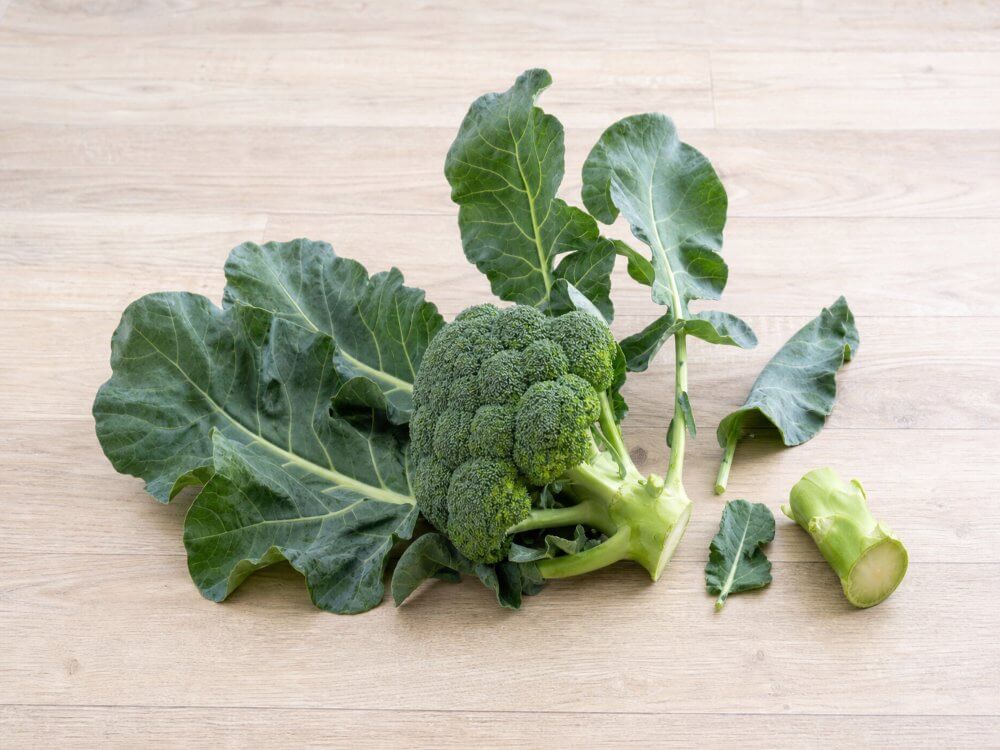
Broccoli stems are worth serving for a reason beyond nutrition. A thick stem takes a parrot real effort to get through, and that chewing time is the point. A bird that spends fifteen minutes working on a stem is a bird not screaming or plucking.
Kale stems are tough and stringy. Most birds strip the leaf and drop the rib, which is fine. You can also chop the rib finely into a mix if you would rather not waste it.
One plant family works the opposite way. With tomatoes, the ripe fruit is fine, while the leaves and stems contain solanine and should never be fed. With brassicas the leaves are the prize.
So the rule that green leaves are the dangerous part holds for the nightshade family and nowhere else. Do not apply it to other plants.
How much broccoli and kale can a parrot eat?
Brassicas are vegetables, not treats, so the portion rules are looser than they are for fruit or nuts. Vegetables should make up 20 to 30 percent of the daily diet. What you need to watch is variety, not amount.
The rule that matters: rotate. Serve brassicas two or three days a week and other greens on the other days, rather than making kale or broccoli the daily green.
You will find budgie forums saying a daily serving of broccoli is perfectly safe. For a budgie on good pellets, that is true. For a budgie on seed, it is the exact pattern that caused the outbreak described earlier. The advice is not wrong. It is just answering half the question.
| Bird | Typical weight | Chopped vegetable per day | Brassica share of that |
|---|---|---|---|
| Budgie, parrotlet | 25 to 45 g | 1 to 2 teaspoons | 2 days a week, cooked if seed-fed |
| Cockatiel, lovebird | 80 to 110 g | 1 tablespoon | 2 to 3 days a week |
| Conure, caique | 60 to 170 g | 1 to 2 tablespoons | 2 to 3 days a week |
| Senegal, Pionus, Quaker | 120 to 300 g | 2 to 3 tablespoons | 2 to 3 days a week |
| African Grey, Amazon | 400 to 550 g | ¼ cup | 3 days a week |
| Cockatoo | 550 to 900 g | ⅓ cup | 3 days a week |
| Macaw | 900 to 1,300 g | ½ cup | 3 days a week |
Good non-brassica greens to alternate with: dandelion greens, romaine, endive, escarole, parsley, cilantro, carrot tops and beet greens.
Fruit is a separate allowance and a much smaller one. Fruit, seeds and nuts together should be no more than 10 to 20 percent of the diet, which is why apple portions still need measuring even though vegetables do not.
How do you prepare brassicas for a parrot?
- Wash thoroughly. Brassicas hold pesticide residue in the floret heads and in the crinkles of kale leaves. Buy organic where you can, and soak and rinse where you cannot.
- Chop to a size your bird can handle. Small birds need small pieces. Large birds do better with big pieces they have to work at.
- Serve raw for a pellet-fed bird. Steam lightly for a seed-fed bird, a budgie, or any bird your vet has flagged.
- Add nothing at all. No salt, no butter, no oil, no cheese, no seasoning.
- Let cooked pieces cool to room temperature before serving.
- Remove leftovers within a few hours. Wet chopped vegetables grow bacteria and mold in a warm cage.
Mixing brassicas into a base makes them much harder for a fussy bird to refuse. Many owners make a big batch once a week, chopped vegetables mixed through a cooked grain, and freeze it in daily portions. Cooked rice works well as that base, along with quinoa, lentils or chickpeas.
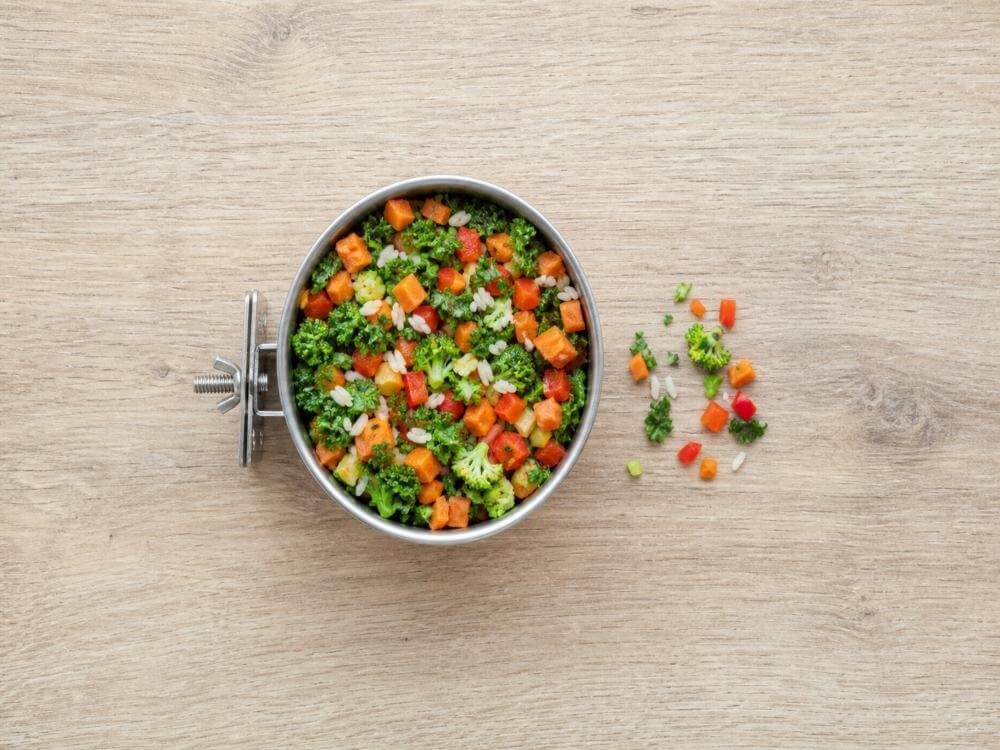
Compare that with bread, which fills a bird up without feeding it. A bowl of chopped kale, squash and bell pepper does the opposite, and that difference is the whole point of vegetables.
What should never go on them?
Plain is the whole rule. Everything people add to brassicas to make them tastier is a problem for a bird.
| Never add | Why |
|---|---|
| Salt | A small bird’s kidneys cannot cope with much of it |
| Butter, oil, olive oil | Fat a parrot does not need, and a known cause of liver disease |
| Cheese or cheese sauce | Birds cannot digest lactose, and the salt load is high |
| Onion and garlic, fresh or powdered | Both damage red blood cells in birds |
| Avocado in a salad or dressing | Toxic to parrots with no safe amount |
| Chocolate in any dish | Theobromine is toxic to birds |
| Bouillon or stock cubes | Salt, onion powder and garlic powder in one item |
| Vinegar or lemon dressing | Acidic, and no benefit |
| Anything from a restaurant plate | Assume salt and butter unless you cooked it yourself |
Raw or lightly steamed, and plain. That is the finished dish. There is no step after it.
When should you hold back on brassicas?
- Budgies on an all-seed diet: the highest-risk group. Cook the brassicas, rotate them, and start moving the bird onto pellets
- Any bird making clicking or wheezing sounds: stop the brassicas and see an avian vet before doing anything else
- Birds diagnosed with thyroid disease: follow your vet’s plan, not a chart on the internet
- Birds eating brassicas as their only vegetable: add variety before adding quantity
- Broccoli sprouts as a daily food: they are far stronger than the grown vegetable
- Chicks still being hand-fed: hand-rearing formula only, nothing else until they are weaned
Frequently asked questions
Can parrots eat broccoli?
Yes. Broccoli is safe for parrots raw or cooked, as long as it is plain. Florets, stems and leaves are all edible, and the leaves carry the most beta carotene, which the bird turns into vitamin A. Serve it as part of the fresh vegetable share of the diet, with nothing added.
Can parrots eat kale?
Yes, and it is one of the best greens you can offer. A bird absorbs about 41 percent of the calcium in kale, which is more than it absorbs from milk. Spinach, by comparison, gives up only about 5 percent. Rotate kale with other greens rather than serving it every single day.
Are goitrogens in broccoli dangerous for parrots?
Only when the bird is already short on iodine. Brassicas contain chemicals that compete with iodine, and the thyroid needs iodine to work.
A bird eating pellets gets added iodine and is not at real risk. A budgie on seed eating a lot of broccoli is. A published outbreak in a flock of 400 budgerigars in California showed exactly that.
Which birds are most at risk from brassicas?
Budgerigars on all-seed diets, by a clear margin. Goiter is the most common thyroid disease in budgies, and they have unusually high iodine requirements. Cockatiels on seed diets come next. Any bird eating a good pellet base can eat brassicas freely.
Should broccoli be raw or cooked for parrots?
Raw for a bird on pellets, cooked for a bird on seed. Heat destroys the plant enzyme that makes the thyroid-blocking chemicals, so cooked brassicas are gentler on the thyroid. Raw keeps more vitamin C, but parrots make their own vitamin C, so losing some costs a bird far less than it would cost you.
Can parrots eat broccoli stems and leaves?
Yes, and both are worth serving. The leaves carry more beta carotene than the florets. The stems take real chewing effort, which gives a bird something useful to do with its beak and its time.
Can parrots eat cabbage and cauliflower?
Yes, both are safe. Red cabbage carries more antioxidants than green. Cauliflower is lower in nutrients than broccoli but harmless. A whole cabbage leaf hung in the cage makes good foraging material.
Is kale better than spinach for parrots?
For calcium, yes, by a wide margin. A bird absorbs about 5 percent of the calcium in spinach, because a substance called oxalate locks onto it. From kale it absorbs about 41 percent.
Spinach is still fine as one green among several. It just should not be the one a bird relies on.
How often can a parrot eat kale?
Two or three days a week, alternating with non-brassica greens such as dandelion, romaine, endive, parsley or carrot tops. Daily kale is not dangerous for a pellet-fed bird, but variety is worth more than any single vegetable.
Can budgies eat broccoli?
Yes, in small amounts and ideally cooked, especially if the budgie is on a seed diet. Budgies are the species most prone to iodine-related thyroid disease, so keep brassicas to a couple of days a week and work on moving the bird onto pellets. One or two bite-sized pieces two or three times a week suits a budgie.
Can parakeets eat broccoli?
Yes. In the United States, parakeet usually means budgie, so the answer is the same. Broccoli is safe, best served in small pieces, and best cooked if the bird eats mostly seed. A budgie on quality pellets can have it raw without concern.
Can parrots eat broccoli every day?
If your bird eats a good pellet base, yes, though variety serves it better than any single vegetable. If your bird eats mostly seed, no. Daily brassicas on top of an iodine-poor seed diet is the exact pattern behind the documented budgerigar outbreak. Rotate with dandelion greens, romaine, endive, parsley or carrot tops instead.
Can parakeets eat kale?
Yes, and it is one of the best greens for them. Chop it small so a budgie can manage it. Rotate it with non-brassica greens rather than serving it daily, particularly if the bird is not yet on pellets.
Can parrots eat broccoli sprouts?
In small amounts, yes. Sprouting concentrates the plant chemicals far more than the grown vegetable does, so sprouts are not a good daily green. Treat them as an occasional extra.
Can parrots eat frozen broccoli?
Yes, and there is a detail worth knowing.
Commercial frozen vegetables are blanched in hot water before freezing. That brief heating already destroys most of the enzyme behind the thyroid problem. So frozen broccoli sits somewhere between raw and cooked, which makes it a convenient middle option for a seed-fed budgie.
Thaw it, serve it plain, and never use frozen vegetables that come with sauce or seasoning.
Can parrots eat Brussels sprouts and bok choy?
Yes to both. Halve the sprouts so the bird can get at the inside rather than rolling them around the cage. Bok choy is one of the best calcium sources in the whole brassica family and is far less used than it deserves to be.
Do I need to peel or deseed anything?
No. Brassicas have no toxic parts. Wash them well and serve. The only preparation that matters is removing anything you added, which is why plain is the rule.
My parrot refuses all vegetables. What now?
Chop brassicas finely and mix them into a cooked grain base so they cannot be picked out. Serve first thing in the morning, when appetite is highest.
Eat some in front of your bird. Parrots are social feeders and will investigate whatever you appear to be enjoying.
Most birds take weeks rather than days to accept a new food. That is normal, so do not give up after three tries.
If you are unsure whether your bird is at risk, an avian vet can look at its diet and its thyroid and answer that properly. That beats any chart, including this one.
The short version
Broccoli, kale and the rest of the brassicas are excellent food for parrots. Feed them.
Two things are worth carrying away.
First, the thyroid question, which is narrower than the internet suggests. Brassicas only cause trouble in a bird that is already short of iodine. That means seed-fed birds, and budgies above all.
A bird eating mostly pellets can have broccoli and kale without a second thought. A seed-fed budgie should get them cooked, a couple of days a week, while you move it onto pellets.
Second, kale. A bird absorbs around 41 percent of its calcium, against about 5 percent from spinach. For an African Grey or a cockatiel, that difference is worth building the week around.
The method itself is four steps. Wash it, chop it, add nothing, and take the bowl out after a few hours.
Sources and notes
- Goitrogenic feeds and avian thyroid hyperplasia: University of Florida IFAS Extension, Avian Goiter, linked above
- Goiter in budgerigars on all-seed diets: Merck and MSD Veterinary Manual, Nutritional Diseases of Pet Birds
- Documented outbreak: Loukopoulos et al., An outbreak of thyroid hyperplasia (goiter) with high mortality in budgerigars (Melopsittacus undulatus), Journal of Veterinary Diagnostic Investigation, 2015
- Calcium absorption from kale compared with milk: Heaney and Weaver, Calcium absorption from kale, American Journal of Clinical Nutrition
- Calcium absorption from spinach and the role of oxalate: published isotope-tracer studies in the same body of work
- Vegetable and fruit proportions in parrot diets: Veterinary Partner (VIN), Diets for Healthy Parrots
- Nutrient composition of brassicas: USDA FoodData Central
- Effect of heat on the enzyme that converts glucosinolates: published food science literature on myrosinase
This article is for general information and does not replace veterinary advice. If your bird is wheezing, clicking, regurgitating or losing weight, contact an avian veterinarian rather than adjusting its diet on your own.