

Yes, cooked eggs are safe for parrots, and so is the shell. A small serving once or twice a week suits most birds.
That is the answer every article on this topic gives you. It is also the easy half of the question.
The harder half is that plenty of avian vets tell their clients not to feed eggs at all, and they have a reason. Almost nobody writing about this mentions that the debate exists, let alone explains it. Once you know what the argument is actually about, the answer stops being a number and starts depending on your particular bird.
Key facts at a glance
| Question | Answer |
|---|---|
| Can parrots eat eggs? | Yes, cooked and plain |
| Can parrots eat raw eggs? | No. Cook them. See the avidin section |
| Can parrots eat eggshell? | Yes, but cook it with the egg rather than serving it raw |
| How often? | One or two small servings a week at most |
| Best cooking method? | Hard boiled or plain scrambled, nothing added |
| Are eggs controversial? | Yes. Avian vets genuinely disagree. See below |
| Who should skip eggs? | Sedentary, clipped, overweight or Amazon and Grey birds |
| Who benefits most? | Breeding pairs, and birds raising chicks |
| Protein absorbed, raw vs cooked | About 50 to 64 percent raw, about 94 percent cooked |
| Never serve with | Salt, butter, oil, cheese, onion, seasoning |
Can parrots eat eggs?
Yes. Cooked chicken egg gives a parrot complete protein, calcium in the shell, vitamin A, vitamin D, vitamin B12, iron, phosphorus and selenium. Eggs are also cheap and already sitting in most kitchens.
The important word is cooked. Raw egg is a different proposition, and the next section explains why.
Eggs sit in the treat share of the diet, not the base of it. Parrots are not built around animal protein. A base of formulated pellets, plenty of fresh vegetables and a little fruit is what most avian vets recommend, and eggs are an occasional addition on top of that.
Duck, goose and quail eggs are all fine too. Chicken is simply the one most people have.
Can parrots eat raw eggs?
No. Cook them. You will find articles suggesting raw egg is acceptable, or something to work up to once a bird is used to cooked egg. That advice has three problems, and turning on the stove solves all of them.

- Raw egg white blocks a vitamin. Egg white holds a protein called avidin, which locks onto biotin, or vitamin B7, and stops the body absorbing it. Each egg white carries roughly enough avidin to tie up the biotin in its own yolk. Biotin matters for feather quality, skin and energy, which are the first three things you notice in a bird. Cooking destroys avidin and the problem goes away.
- Raw egg gives less protein, not more. Cooking unravels the proteins and makes them easy to digest. Studies put protein absorption from cooked egg at around 94 percent, against roughly 50 to 64 percent from raw. So the whole reason to feed an egg works better cooked.
- Salmonella. Raw egg can carry it, both on the shell and inside the white. A bird is small, and a gut infection in a 90 gram cockatiel is a far bigger event than it is in a person.
There is a fourth reason, and it belongs to the debate in the next section. The one study anyone can point to on eggs and artery disease in birds fed chickens either raw egg or powdered egg. The raw group developed more arterial plaque.
That study used chickens rather than parrots, so it proves nothing about your bird directly. What it does say is that if you are going to hand a parrot an egg at all, raw is the version with the weakest evidence behind it.
Why do some vets say no to eggs?
Ask three avian vets about eggs and you may get three answers. This is the part of the topic most articles skip, and it is the part that actually decides what you should do.
The concern is atherosclerosis, which is fatty plaque building up inside arteries. Vets are diagnosing it in parrots more and more often, African Greys and Amazons especially, and eggs get named as a suspect because of their fat and cholesterol.
Here is the honest version, in four parts.
- There are no studies on parrots and eggs. None at all. Lafeber’s avian team says so plainly in their answer on feeding eggs to parrots. To claim eggs cause artery disease in parrots is speculation, because the research has not been done.
- Many vets advise against eggs anyway, out of caution rather than evidence. That is a fair position, and you should know it exists before you decide.
- The counter-argument is about exercise, not food. Dr Susan Orosz makes the point that parrots evolved to handle high fat and high protein precisely because they fly. Take the flying away and the same diet behaves differently in the same bird. On that view the problem is a bird that eats like a wild parrot and moves like an ornament.
- Cholesterol in food is not the settled villain it once was. In humans, the idea that eating cholesterol raises blood cholesterol has been revised. Whether that carries across to a parrot is unknown, which is exactly the point.
So the useful question is not whether eggs are safe for parrots. It is whether eggs are safe for your parrot.
Two birds of the same species can eat the same egg and not be running the same risk. One flies daily. The other sits on a perch.
So should your bird have eggs?
Work down this list. It will serve you better than any weekly number.
| Your bird | Verdict |
|---|---|
| Breeding pair, or feeding chicks | Yes. This is the clearest case for eggs |
| Flighted, active, healthy weight | Yes, once or twice a week in small amounts |
| Clipped or largely cage-bound | Limit sharply, or skip. The exercise argument does not apply |
| Overweight, or already on a fatty diet | Skip until the weight is sorted |
| African Grey or Amazon | Be conservative. These species are diagnosed with artery disease most often |
| Diagnosed with atherosclerosis or liver disease | Ask your vet. Do not decide from an article |
| Molting, or recovering from illness | Short-term protein boost can help. Ask your vet |
| Chick still being hand-fed | No. Hand-rearing formula only |
Lafeber’s own position is worth repeating, because it is more cautious than what most parrot blogs say. They do not recommend eggs for pet parrots in general, and reserve them for breeding pairs on a limited basis.
None of that is a reason to panic if your bird had scrambled egg this morning. It is a reason to keep eggs occasional rather than routine.
What do eggs actually give a parrot?
| Nutrient | In an egg? | Why it matters |
|---|---|---|
| Complete protein | High | Feather growth, muscle, tissue repair |
| Calcium | In the shell, not the egg | Bones, and egg-laying in hens |
| Vitamin A | Yes | The most common deficiency in pet parrots |
| Vitamin D | Yes | Needed to use calcium at all |
| Vitamin B12 | Yes | Hard to get from plants |
| Choline | Yes, in the yolk | Brain and liver function |
| Iron, phosphorus, selenium | Yes | General metabolic function |
| Fat and cholesterol | High | The reason for the whole debate above. Comparable to nuts |
| Fiber | None | Eggs contribute nothing here |
Two things are worth pulling out of that table.
The calcium is in the shell, not the egg itself. Feeding a peeled boiled egg gives your bird protein and almost no calcium. If calcium is what you are after, the shell is the part that carries it.
And the vitamin A is genuine. Low vitamin A is the single most common diet problem avian vets see. Eggs help with it, though a cooked carrot or a sweet potato does the same job with none of the fat argument attached.
Can parrots eat eggshell, and how do you prepare it?
Yes, and eggshell is one of the better calcium sources you can offer. Eggshell is roughly 95 percent calcium carbonate, the same compound that makes up a cuttlebone.
Most articles tell you to wash the shell and crush it. That skips the part that matters. Salmonella lives on the outside of the shell, and rinsing does not reliably remove it.
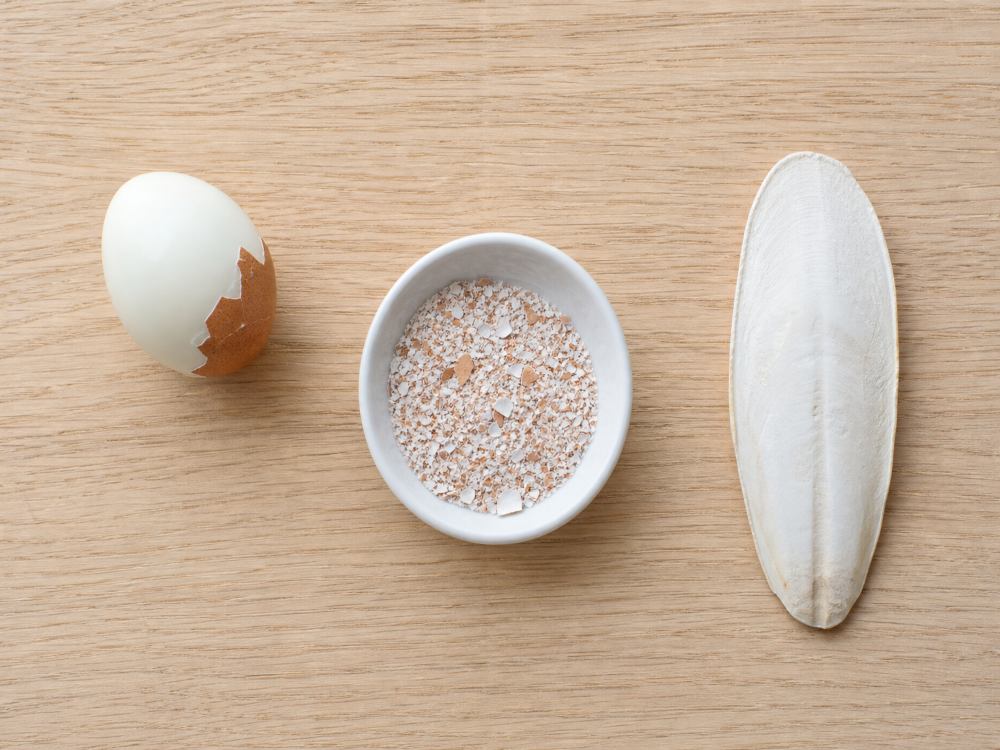
The method avian sources recommend is simpler than it sounds. Wash the shells, crush them, and cook them together with the egg. Boiling the whole egg with its shell on handles all of that in one step.
The reliable method:
- Wash the outside of the egg before you do anything with it.
- Hard boil the egg with the shell on for at least ten minutes.
- Let it cool, then crush the shell into small pieces or a coarse powder.
- Mix the crushed shell back through the chopped egg, or sprinkle it over food.
If you are saving shells separately, bake them at around 200°C, which is about 400°F, for ten to fifteen minutes before crushing. That kills anything on the surface and makes them brittle enough to grind.
Crush the pieces small. A sharp shard is a choking risk for a budgie in a way it is not for a macaw.
For a bird that mainly needs calcium rather than protein, kale is worth knowing about too. A bird absorbs around 41 percent of the calcium in kale, which is more than it absorbs from milk, and kale brings no fat argument with it.
How much egg can a parrot eat?
Small amounts, once or twice a week. Egg is dense food, and a portion that looks trivial to you is a real meal for a 90 gram bird.
| Bird | Typical weight | Portion of cooked egg | How often |
|---|---|---|---|
| Budgie, parrotlet | 25 to 45 g | ¼ teaspoon | Once a week |
| Cockatiel, lovebird | 80 to 110 g | ½ to 1 teaspoon | Once a week |
| Conure, caique | 60 to 170 g | 1 teaspoon | Once or twice a week |
| Senegal, Pionus, Quaker | 120 to 300 g | 1 to 2 teaspoons | Once or twice a week |
| African Grey, Amazon | 400 to 550 g | 1 tablespoon | Once a week, and see the species note above |
| Cockatoo | 550 to 900 g | 1 to 2 tablespoons | Once or twice a week |
| Macaw | 900 to 1,300 g | 2 tablespoons | Once or twice a week |
A whole egg is a meal for a person. For a cockatiel it is roughly the same proportion as several eggs would be for you.
Weigh your bird on a gram scale rather than judging by eye. The same discipline applies to every rich food, which is why apple portions need measuring even for a fruit with no controversy attached to it at all.
Egg also competes with everything else in the treat budget. If your bird has already had grapes or a piece of banana today, the egg comes out of the same allowance rather than being added on top.
What is the best way to cook eggs for a parrot?
Hard boiled is the simplest and the safest way. Plain scrambled works just as well, as long as nothing else goes in the pan.
| Method | Verdict |
|---|---|
| Hard boiled | Best. Cooks the shell at the same time |
| Plain scrambled, dry pan | Fine. No butter, no oil, no milk |
| Poached | Fine |
| Baked or egg muffin, plain | Fine, and convenient for freezing portions |
| Soft boiled or runny yolk | Avoid. Undercooked egg carries the raw risks |
| Fried | No. Oil the bird does not need |
| Omelette with fillings | No. Cheese, onion and salt are all problems |
| Raw, in any form | No |
Preparation steps:
- Wash the outside of the egg.
- Hard boil for at least ten minutes so both the egg and the shell are properly cooked.
- Cool it completely. Hot food can burn a crop.
- Chop it small, or mash it, and crush the shell back through it.
- Add nothing at all.
- Serve a measured portion in a shallow dish.
- Take it out within two hours. In a warm room, make it one hour.
That two-hour rule is not a formality. Cooked egg is moist and protein-rich, which makes it one of the fastest foods to grow bacteria in a warm cage. The same rule applies to cut fruit like watermelon.
Chopped egg mixes well into chop, the batch of chopped vegetables over a cooked grain that many owners freeze in daily portions. Cooked rice works well as the base.
What should never go with an egg?
Almost everything people cook eggs with is a problem for a bird.
| Never add | Why |
|---|---|
| Salt | A bird’s kidneys cannot handle a sodium load the way ours can |
| Butter, oil, ghee | Fat on top of a food that is already the fat argument |
| Milk or cream | Birds cannot digest lactose |
| Cheese | Lactose and salt together |
| Onion and garlic, in any form | Both damage red blood cells in birds |
| Tomato in a cooked omelette | The fruit is fine plain, but not in a seasoned dish |
| Avocado on the side | Toxic to parrots with no safe amount |
| Chocolate in any baked egg dish | Theobromine is toxic to birds |
| Pepper, herbs, spice | Unnecessary, and some are irritants |
| Non-stick pan on high heat | Overheated PTFE coatings release fumes that kill birds quickly |
That last row is worth reading twice. It is not about the egg at all. Overheated non-stick cookware is one of the most common causes of sudden death in pet birds, and scrambling eggs is exactly when it happens. Use stainless steel or cast iron if your bird is in or near the kitchen.
Do eggs help a molting parrot?
They can. Feathers are roughly 90 percent protein, and a full molt is genuinely demanding on a bird.
A small protein boost during a heavy molt is a reasonable use for egg, and it is one of the few times the benefit is easy to point at. Cooked lentils, chickpeas, quinoa and sprouted seed do the same job without the fat question, so egg is one option rather than the only one.
What egg cannot do is fix a bad diet. A bird molting badly on a seed diet needs the diet changed, not an egg added to the side of it. Seed is short on vitamin A, calcium and several other things at once, and an egg addresses one gap while leaving the rest open.
This is the same trap as bread, where owners add something the bird enjoys and the underlying problem carries on untouched.
Can budgies and parakeets eat eggs?
Yes, and the answer covers both, because in the United States parakeet almost always means budgie.
Size changes the portion more than it changes the rules. A budgie weighs about 30 grams, so a quarter teaspoon of chopped egg is a real serving for it, and once a week is enough.
- Chop the egg finely rather than offering chunks
- Crush the shell to a fine powder, since shards are a genuine risk at that size
- Mix it through the bird’s usual chopped vegetables so it is less strange
- Once a week, and skip it entirely if the budgie is overweight
Budgies are seed specialists in the wild, more so than most parrots, so egg is further from their natural diet than it is for a macaw. That is not a reason to avoid it, but it is a reason to keep the portion genuinely small.
Can parrots eat eggs every day?
No. Even the sources most relaxed about eggs cap it at twice a week, and several avian vets would say less than that.
Daily egg means daily fat and daily cholesterol in an animal whose exercise you have already reduced by keeping it in a cage. It also means a bird filling up on something with no fiber and no vegetable content, which pushes out the food it actually needs.
There is one exception. A breeding pair actively feeding chicks can have egg food more often, and that is the situation where avian sources genuinely recommend it. Once the chicks are weaned, it stops.
Frequently asked questions
Can parrots eat eggs?
Yes, cooked and plain. Eggs give complete protein, vitamin A, vitamin D and B12, and the shell adds calcium. Keep it small, once or twice a week, and add nothing to the pan.
Can parrots eat raw eggs?
No. Raw egg white contains avidin, which blocks the absorption of biotin, and cooking destroys it. Raw egg also carries Salmonella risk and gives less usable protein than cooked, roughly 50 to 64 percent absorbed against about 94 percent cooked.
Can parrots eat eggshell?
Yes. Eggshell is about 95 percent calcium carbonate, the same compound as a cuttlebone. Cook it with the egg rather than serving it raw, since Salmonella sits on the shell surface, and crush it small enough that there are no sharp shards.
How often can a parrot eat eggs?
Twice a week at the very most, and weekly is plenty for a smaller bird. Breeding pairs feeding chicks are the exception and can have egg food more often until the chicks are weaned.
Are eggs bad for parrots?
That depends on the bird, and the honest answer is that the science is unfinished. Some avian vets advise against eggs entirely because of concerns about artery disease. Others say the risk is about exercise rather than the egg. No study has been done on parrots and eggs, so anyone stating this confidently in either direction is going beyond the evidence.
Can budgies eat eggs?
Yes. About a quarter teaspoon of finely chopped cooked egg, once a week, suits a budgie. Crush the shell to a powder rather than leaving pieces, since shards are a real risk for a bird that size.
Can parakeets eat eggs?
Yes, and the guidance is identical. In the United States, parakeet usually means budgie, so a quarter teaspoon of finely chopped cooked egg once a week is the right portion. Every budgerigar is a parakeet, though not every parakeet is a budgerigar.
Can cockatiels eat eggs?
Yes. Half to one teaspoon of chopped cooked egg, once a week, suits a cockatiel. Cockatiels are prone to putting on weight in captivity, so keep the portion measured rather than offering a whole piece and letting the bird decide.
Can conures and lovebirds eat eggs?
Yes. A conure or caique does well with about a teaspoon, up to twice a week. A lovebird is smaller, so half to one teaspoon weekly is closer. Both are active birds, which puts them on the easier side of the exercise question.
Can African Greys and Amazons eat eggs?
Yes, but these two are the species to be most conservative with. Both are diagnosed with artery disease more often than other parrots. A tablespoon once a week is reasonable for a flighted, active bird at a healthy weight. If your Grey or Amazon is clipped, overweight or largely cage-bound, this is the case where skipping eggs makes the most sense.
Can macaws and cockatoos eat eggs?
Yes. A macaw can handle around two tablespoons and a cockatoo one to two, up to twice weekly. Larger birds also manage crushed eggshell more easily than small ones, since a shard that would worry you in a budgie’s bowl is nothing to a macaw’s beak.
Can parrots eat scrambled eggs?
Yes, if they are cooked in a dry pan with nothing added. No butter, no oil, no milk, no salt, no cheese. Use stainless steel or cast iron rather than non-stick, since overheated non-stick coatings release fumes that are lethal to birds.
Can parrots eat fried eggs?
No. Frying means oil, and often butter and salt as well. A parrot has no need for the added fat, particularly given the concerns about artery disease that surround eggs in the first place.
Do eggs help with feather growth and molting?
They can. Feathers are roughly 90 percent protein, and a heavy molt is demanding. A small serving of cooked egg during a molt is reasonable, though cooked lentils, chickpeas and sprouted seed provide protein without the fat question.
Can baby parrots eat eggs?
No. Chicks still being hand-fed need an appropriate hand-rearing formula and nothing else until they are fully weaned. Parents feeding chicks are different, and egg food for a breeding pair is a long-established practice.
Can parrots eat duck or quail eggs?
Yes. Duck, goose and quail eggs are all fine, prepared the same way as chicken eggs. Chicken is simply what most people have in the fridge.
How long can egg stay in the cage?
Two hours, or one hour in a warm room. Cooked egg is moist and protein-rich, which makes it one of the fastest foods to grow bacteria in a warm cage.
If you are unsure whether eggs suit your own bird, an avian vet can weigh it, look at its diet and its activity level, and answer that properly. That beats any general chart, including this one.
The short version
Cooked egg is safe for parrots, and the shell is a good calcium source. Keep the serving small and the frequency low.
Three things separate this from what you will read elsewhere.
Cook them. Raw egg white blocks biotin absorption, gives less usable protein, and carries Salmonella. The only study on eggs and artery disease in birds found the raw-fed group did worse.
Cook the shell too. Washing does not reliably remove Salmonella from the surface. Boil the egg whole, then crush the shell back through it.
And the frequency depends on your bird, not on a rule. There is a real disagreement among avian vets about eggs and artery disease, and no study on parrots to settle it. A flighted, active bird at a healthy weight is in a different position from a clipped, overweight African Grey. Breeding pairs are the one case where avian sources agree eggs are worth feeding.
Sources and notes
- No studies exist on eggs and atherosclerosis in parrots, the exercise argument from Dr Susan Orosz, the chicken study comparing raw and powdered egg, and the recommendation to reserve eggs for breeding pairs: Lafeber Pet Birds, Feeding eggs to parrots, linked above
- Avidin binding biotin in raw egg white, and its deactivation by cooking: published nutritional biochemistry literature
- Protein absorption of roughly 94 percent from cooked egg against 50 to 64 percent from raw: published gastrointestinal digestibility research
- Salmonella on eggshell surfaces and within egg white: published food safety literature
- Eggshell composition, approximately 95 percent calcium carbonate: USDA and published food composition data
- Nutrient composition of chicken eggs: USDA FoodData Central
- Diet proportions for pet parrots: Veterinary Partner (VIN), Diets for Healthy Parrots
This article is for general information and does not replace veterinary advice. If your parrot has been diagnosed with atherosclerosis, liver disease or is overweight, talk to an avian veterinarian before adding eggs to its diet.