

Search for the number of macaw species and you will find 17, 18, and 19 all stated with equal confidence.
None of them is wrong, exactly. They are counting different things.
Sixteen species are definitely alive today. The glaucous macaw has not been reliably seen since the 1960s, but it is still officially listed as Critically Endangered rather than Extinct, so counting it gives you 17.
Add the Cuban macaw, gone since the 1860s, and you reach 18. Add the Saint Croix macaw, known only from bones, and you reach 19.
This guide follows the standard 17-species count across six genera, and covers the extinct species separately.
It also covers why hundreds of macaws gather on the same riverbank cliffs every morning to eat dirt — a question that took a 16-year study and more than 20,000 hours of observation to answer properly.
The short answer
There are 17 recognized macaw species in six genera: Ara, Anodorhynchus, Cyanopsitta, Primolius, Orthopsittaca, and Diopsittaca.
They range from the hyacinth macaw at 100 cm, the largest flying parrot on Earth, down to the red-shouldered macaw at 30 cm, no bigger than a conure.
All are native to Mexico, Central America, and South America. No macaw lives wild anywhere else.
Roughly half are threatened. The Spix’s macaw is extinct in the wild and was reintroduced to Brazil in 2022, though in November 2025 every free-flying bird tested positive for a lethal virus. Two other macaw species are gone completely. See our full guide to extinct macaw species.
Macaws at a Glance
| Tribe | Arini (Neotropical parrots) |
| Family | Psittacidae |
| Recognized species | 17 (16 confirmed living + glaucous macaw, possibly extinct) |
| Extinct | Cuban macaw (last recorded 1860s); Saint Croix macaw (known only from bones) |
| Genera | 6 — Ara, Anodorhynchus, Cyanopsitta, Primolius, Orthopsittaca, Diopsittaca |
| Range | Mexico, Central America, South America |
| Size range | 30 cm (red-shouldered) to 100 cm (hyacinth) |
| Lifespan | 30–50 years typical; large species reach 60–80+ |
| Bite force | Up to roughly 200 psi in the largest species |
| Distinguishing feature | Bare facial skin patches, absent in most other parrots |
| Diet | Seeds, nuts, palm fruit, flowers, clay |
What Makes a Macaw a Macaw
Macaws are parrots, but they are not a formal taxonomic family. They are a group spread across six genera within the tribe Arini, united by shared physical traits rather than by descent from a single common ancestor.
The bare facial patch. This is the diagnostic feature. Most macaws have an area of naked or sparsely feathered skin around the eye and beak base.
In Ara species it is a broad white or pale mask, often crossed by fine lines of tiny feathers. In Anodorhynchus it shrinks to a bright yellow ring around the eye and a second patch at the base of the lower mandible. No other parrot group has this.
Proportional tail length. Macaw tails often exceed half the bird’s total length. A hyacinth macaw measuring 100 cm has roughly 50 cm of that in tail feathers alone.
Beak power. Macaws have the most powerful bite of any parrot, generating up to roughly 200 pounds per square inch in the largest species. That force exists for one reason: cracking palm nuts and Brazil nuts that almost nothing else in the rainforest can open.
Zygodactyl feet. Two toes forward, two back — shared with all parrots, plus toucans and woodpeckers. Macaws use one foot as a hand with unusual dexterity.
One common confusion
The thick-billed parrot of Mexico is sometimes called a macaw. It is not one. Genetic work places it outside the six macaw genera entirely, and the resemblance is superficial.
The 17 Species, by Genus
Genus Ara — the large macaws (8 species)
These are the classic macaws. The genus contains almost every species people picture when they hear the word.
| Species | Scientific name | Size | Range | IUCN |
|---|---|---|---|---|
| Scarlet macaw | Ara macao | 81–96 cm | Mexico to Amazon Basin | Least Concern |
| Blue-and-yellow macaw | Ara ararauna | 76–86 cm | Panama to Brazil, Bolivia | Least Concern |
| Red-and-green macaw | Ara chloropterus | 90–95 cm | Northern & central South America | Least Concern |
| Military macaw | Ara militaris | 70–80 cm | Mexico, Andes, Argentina | Vulnerable |
| Great green macaw | Ara ambiguus | 85–90 cm | Honduras to Ecuador | Critically Endangered |
| Blue-throated macaw | Ara glaucogularis | 85 cm | Beni savanna, Bolivia | Critically Endangered |
| Red-fronted macaw | Ara rubrogenys | 55–60 cm | Andean valleys, Bolivia | Critically Endangered |
| Chestnut-fronted macaw | Ara severus | 45–50 cm | Panama to Amazon Basin | Least Concern |
Scarlet vs red-and-green. These two are confused constantly. The scarlet macaw has bright yellow wing coverts between the red and blue. The red-and-green macaw has dark green in that position and, decisively, fine lines of red feathers across its white facial patch. The red-and-green is also the heavier bird, though the scarlet often looks longer.
Great green macaw. Also called Buffon’s macaw. It depends heavily on the almendro tree for both nesting and food across much of its range, which is why logging has hit it so hard.
Blue-throated macaw. Confined to the Beni savanna of northern Bolivia and dependent on motacú palms for nesting. It was once believed extinct in the wild. Current estimates put the population at roughly 350 to 450 birds.
Red-fronted macaw. The odd one out. It is a dry-forest species from the Andean valleys of Bolivia, and the only macaw that regularly nests in rock faces rather than tree cavities.
Genus Anodorhynchus — the blue macaws (3 species)
| Species | Scientific name | Size | Range | IUCN |
|---|---|---|---|---|
| Hyacinth macaw | Anodorhynchus hyacinthinus | 100 cm | Pantanal, Cerrado, eastern Amazon | Vulnerable |
| Lear’s macaw | Anodorhynchus leari | 70–75 cm | Bahia, northeastern Brazil | Endangered |
| Glaucous macaw | Anodorhynchus glaucus | 70 cm | Formerly Argentina, Paraguay, Uruguay, S. Brazil | Critically Endangered (possibly extinct) |
Hyacinth macaw. The largest flying parrot in the world at 100 cm, with a wingspan over four feet and a weight of 1.4–1.7 kg. Cobalt blue throughout, with vivid yellow bare skin around the eye and at the base of the lower mandible. Its diet is built almost entirely around palm nuts, and its beak is the most powerful in the parrot world.
Lear’s macaw. Smaller and darker than the hyacinth, and restricted to the Caatinga of Bahia. It came close to disappearing altogether: fewer than 70 birds were known in the 1980s. Sustained protection of its licuri palm feeding grounds and its sandstone nesting cliffs has since brought numbers back into the low thousands.
Glaucous macaw. Pale turquoise-blue with a large greyish head. It depended on the yatay palm, and 19th-century clearance of those palm groves removed both its food and its nest sites. There has been no confirmed sighting since the 1960s, and it is covered in more detail below.
Genus Cyanopsitta — Spix’s macaw (1 species)
| Species | Scientific name | Size | Range | IUCN |
|---|---|---|---|---|
| Spix’s macaw | Cyanopsitta spixii | 55–57 cm | Caatinga, Bahia, Brazil | Extinct in the Wild |
This is the most famous macaw in the world, largely because of the film Rio, and the subject of the most ambitious parrot reintroduction ever attempted. It gets its own section below.
Genus Primolius — the mini macaws (3 species)
| Species | Scientific name | Size | Range | IUCN |
|---|---|---|---|---|
| Blue-winged macaw | Primolius maracana | 39–43 cm | Brazil, Paraguay, Argentina | Least Concern |
| Blue-headed macaw | Primolius couloni | 41 cm | Peru, Bolivia, Brazil | Vulnerable |
| Golden-collared macaw | Primolius auricollis | 38–40 cm | Bolivia, Brazil, Paraguay | Least Concern |
Also called Illiger’s macaw, the blue-winged is the best known of the three in aviculture. All three are green-bodied with blue on the head and wings, and all are roughly conure-sized.
A taxonomic note. These species were formerly placed in the genus Propyrrhura. Under International Commission on Zoological Nomenclature rules, Primolius is the correct name, and older sources using Propyrrhura are outdated rather than wrong.
Genus Orthopsittaca — the red-bellied macaw (1 species)
| Species | Scientific name | Size | Range | IUCN |
|---|---|---|---|---|
| Red-bellied macaw | Orthopsittaca manilatus | 46 cm | Amazon Basin, Trinidad | Least Concern |
The red-bellied macaw is green with a dull maroon belly patch and a bare yellowish face, unusual in lacking the fine feather lines most macaws show. It depends almost entirely on the moriche palm for food, roosting and nesting, which makes it a specialist in the strictest sense.
It also has a poor reputation in captivity. Its very high-fat palm diet is difficult to replicate, and birds often fail to thrive.
Genus Diopsittaca — the red-shouldered macaw (1 species)
| Species | Scientific name | Size | Range | IUCN |
|---|---|---|---|---|
| Red-shouldered macaw | Diopsittaca nobilis | 30 cm | Northern & central South America | Least Concern |
This is the smallest macaw in the world, no larger than an Aratinga conure. The nominate subspecies is known in aviculture as Hahn’s macaw, and it is the species most often recommended to people who want macaw personality without macaw scale.
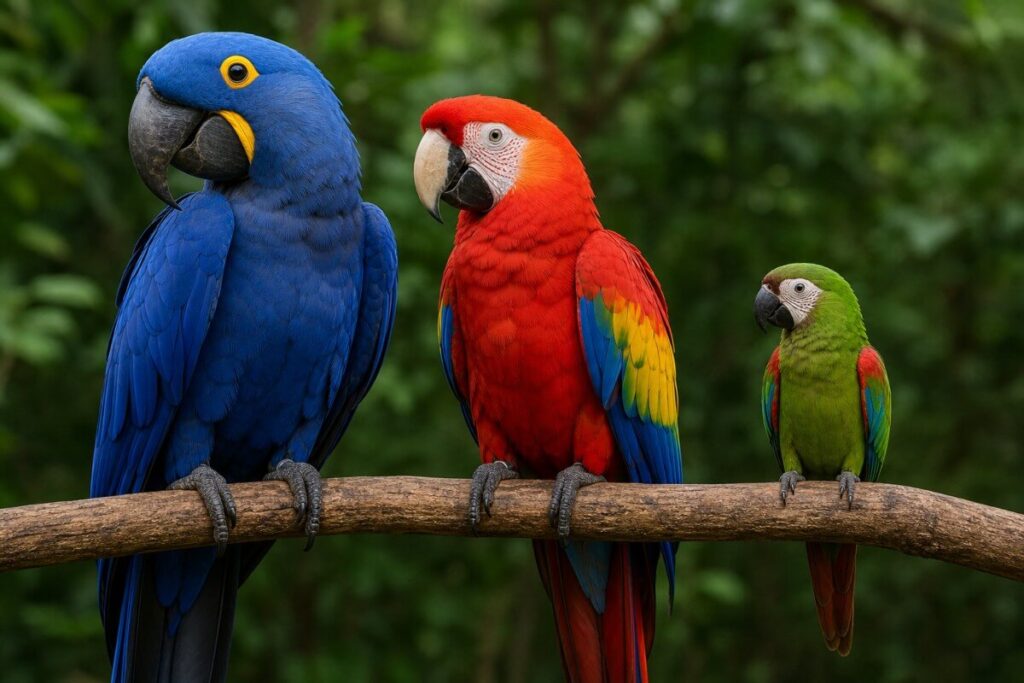
Large Macaws and Mini Macaws
The split between large and mini macaws is not taxonomic. It is a practical distinction, and it matters enormously if you are choosing a bird.
Large macaws — the Ara and Anodorhynchus species — run 70 to 100 cm and weigh 900 g to 1.7 kg. They need enormous enclosures, are extremely loud, and live 50 to 80 years.
Mini macaws — Primolius, Orthopsittaca, Diopsittaca, and the smaller Ara species like the chestnut-fronted — run 30 to 50 cm. They keep the macaw temperament, the facial patch, and the long tail, at roughly a third of the body mass.
The difference in practice is not just size. It is noise, cage cost, food volume, destructive capacity and lifespan. A Hahn’s macaw is a demanding pet. A hyacinth macaw is a fifty-year structural commitment to your home.
The Extinct Macaws
Cuban macaw (Ara tricolor). Red, orange, and blue, endemic to Cuba and the Isla de la Juventud. It was hunted for food and captured for the pet trade throughout the 1800s. Hurricanes and habitat clearing finished the job.
The last confirmed record dates to the 1860s. Around 19 museum specimens survive, and that is the entire physical record of the species.
Saint Croix macaw (Ara autochthones). Known only from bones recovered at archaeological sites in the Caribbean. A 2008 re-examination of material from Puerto Rico confirmed it as a valid species, though its original geographic range remains unknown.
Glaucous macaw (Anodorhynchus glaucus). Functionally gone, officially not. It was pale turquoise-blue with a large greyish head, about 70 cm long, and once ranged across northern Argentina, southern Brazil, Paraguay, and Uruguay.
Its dependence on the yatay palm made it acutely vulnerable. Nineteenth-century clearance of those palm groves removed both its food supply and its nesting sites, and there has been no confirmed sighting since the 1960s.
The IUCN still lists it as Critically Endangered rather than Extinct. Parts of its former range remain remote and poorly surveyed, and formal extinction declarations require a high evidentiary bar.
The Red List has a specific tag for exactly this situation: Critically Endangered (Possibly Extinct), written CR(PE). It applies when the evidence suggests a species is probably gone but certainty is lacking.
This one classification decision is the main reason macaw species counts disagree.
Several hypothetical extinct species appear in older literature: the Jamaican red macaw, the Guadeloupe macaw, the Dominican macaw and others. All were described from travelers’ accounts rather than specimens.
Most were probably traded birds of known species that reached an island and were later mistaken for distinct populations. Taxonomists do not accept them.
Spix’s Macaw: Extinct, Then Not
This is the most consequential conservation story in the parrot world, and it is still being written.
The collapse. Spix’s macaw was always rare. It was confined to a narrow strip of Caatinga dry forest along seasonal creeks in Bahia, northeastern Brazil, and depended on caraibeira trees for nesting.
Trapping for the international trade, combined with clearance of that gallery forest, wiped it out. The last known wild bird, a lone male, was monitored until October 2000 and then never seen again.
The captive population. By 2000, roughly 53 birds survived in private collections and breeding centers worldwide. A coordinated international program — Al Wabra in Qatar, ACTP in Germany, Pairi Daiza in Belgium, São Paulo Zoo and Brazilian facilities — grew that number to approximately 400 individuals by December 2025.
The return. In 2020, 52 birds were flown to Brazil under federal police escort. In June and December of 2022, 20 Spix’s macaws were released into two protected areas in Juazeiro and Curaçá.
Alongside them, conservationists released 15 wild-sourced blue-winged macaws to act as instructors. These were birds that already knew how to fly the terrain, find food, and recognize predators.
Every released bird carried a radio collar engineered to survive a macaw’s bill.
Wild chicks. In 2023, two chicks hatched in the wild — the first in over two decades. Neither survived to fledge. In May 2024, a second clutch produced fledglings that did fly. One conservationist involved has called the project the most carefully planned and most successful parrot reintroduction ever attempted.
The complications. In June 2024, the cooperation agreement between the Brazilian government and ACTP — the German center holding most of the world’s Spix’s macaws — ended without renewal, leaving the release pipeline uncertain.
Then in November 2025, Brazilian authorities announced that the eleven parrots still surviving in the wild had been found infected with a circovirus causing beak and feather disease. It is incurable and usually fatal.
The species remains classified Extinct in the Wild by the IUCN. Population modeling indicates the wild population needs 10 to 20 released birds every year for roughly two decades to become self-sustaining.
The project is both things at once: the most successful parrot reintroduction on record, and a population that could still vanish.
Why Macaws Eat Dirt
Every morning along certain riverbanks in the western Amazon, hundreds of parrots gather on exposed clay cliffs and eat the soil. Up to 18 species turn up at a single lick. It is one of the great wildlife spectacles on Earth, and for decades nobody could explain it properly.
The Tambopata Macaw Project in southeastern Peru has been directed by Donald Brightsmith of Texas A&M University since 1999. It has logged more than 20,000 hours of observation over 16 years, producing one of the most extensive datasets on tropical parrots anywhere.
The old explanation. The long-accepted theory held that clay binds and neutralizes the alkaloid toxins in the unripe fruit and seeds macaws eat. It sounds convincing, but it has one serious flaw. Parrots eat toxic seeds everywhere in the world, yet clay licking happens in only a few very specific places.
What the data showed. Analysis by Elizabeth Hobson and Brightsmith, published in Ibis, found the soil at these licks contains sodium at concentrations roughly 40 times higher than the plant foods available nearby.
Sodium is essential for nerve function, muscle contraction, and fluid regulation. In high-rainfall tropical forests it leaches out of the ecosystem continuously.
The decisive evidence came from timing. Clay lick use peaked during the breeding season, when nutritional demand is highest, rather than during annual lows in food availability, which is what the toxin theory would predict.
Given a choice, the birds also selected the soils with the highest sodium content rather than the ones best suited to binding toxins.
Sodium is the primary driver. Toxin binding may still occur as a secondary benefit, but it is not the reason the behavior exists.
This has a practical consequence. Clay licks are not incidental scenery. Whole populations depend on them, so protecting a single stretch of riverbank cliff protects every macaw that uses it.
Conservation: Half the Family Is in Trouble
Roughly half of all macaw species are listed as Vulnerable, Endangered, or Critically Endangered. All statuses below follow the IUCN Red List as assessed through 2025.
Extinct in the Wild
- Spix’s macaw — no self-sustaining wild population; reintroduction ongoing since 2022
Critically Endangered
- Great green macaw — logging of almendro trees across Central America
- Blue-throated macaw — 350–450 birds in the Bolivian Beni savanna
- Red-fronted macaw — trapping and habitat loss in Andean Bolivia
- Glaucous macaw — possibly extinct, with no confirmed sighting since the 1960s
Endangered and Vulnerable
- Lear’s macaw — Endangered, but recovering from fewer than 70 birds
- Hyacinth macaw — Vulnerable, from slow reproduction and continued habitat pressure
- Military macaw — Vulnerable across a wide but fragmenting range
- Blue-headed macaw — Vulnerable, with under 46,000 birds estimated
One that improved
- Blue-winged macaw — downlisted from Near Threatened to Least Concern in 2025, after its range expanded northward and populations stabilized
The three structural causes
Nest hollow dependence. Macaws nest in tree cavities that take decades to form. Logging removes them faster than forests replace them, and the largest species need the largest hollows, which are the rarest.
Specialist diets. The most threatened macaws are the most specialized: hyacinths on palm nuts, red-bellied macaws on moriche palm, great greens on almendro, Lear’s on licuri palm, blue-throated on motacú. Remove one tree species and the bird has nowhere to go.
Trade pressure. The traits that make macaws desirable — the color, the size, the intelligence — are exactly what drives trapping. Every macaw species is listed under CITES, and the most threatened are on Appendix I, which prohibits international commercial trade outright.
Macaws in Captivity: The Honest Version
Six species make up almost the entire pet trade: blue-and-yellow, scarlet, red-and-green, military, chestnut-fronted, and Hahn’s.
The large ones are not beginner birds, for four reasons.
- Noise. Macaw contact calls evolved to carry for miles across rainforest canopy. That capability does not switch off indoors.
- Destruction. A beak built to crack Brazil nuts treats furniture as light exercise.
- Lifespan. Fifty to eighty years for large species. Serious owners name a caretaker in their will.
- Space. A hyacinth macaw with a four-foot wingspan cannot live decently in a standard parrot cage.
Hyacinth macaws deserve a specific warning. They are Vulnerable in the wild and extremely expensive to buy.
They also require a specialized high-fat palm-nut diet that is difficult and costly to source, and enclosures most homes simply cannot accommodate.
If you are considering a large macaw, the blue-and-yellow is generally regarded as the most beginner-tolerant of them. Our Blue and Gold Macaw Care Guide covers real cage dimensions, 2026 costs, noise levels, and the health screening most breeders skip.

Frequently asked questions
Tap any question to open the answer.
How many types of macaws are there?
There are 17 recognized macaw species across six genera: Ara, Anodorhynchus, Cyanopsitta, Primolius, Orthopsittaca, and Diopsittaca. Sixteen are confirmed living, and the seventeenth, the glaucous macaw, has not been seen since the 1960s but is still officially listed as Critically Endangered rather than Extinct. Counting the extinct Cuban and Saint Croix macaws as well brings the total to 19, which is why sources disagree.
What is the largest macaw species?
The hyacinth macaw (Anodorhynchus hyacinthinus) at 100 cm is the largest macaw and the largest flying parrot in the world. It has a wingspan over four feet and weighs 1.4 to 1.7 kg. Only the flightless kakapo is heavier among parrots.
What is the smallest macaw?
The red-shouldered macaw (Diopsittaca nobilis) at 30 cm, no larger than an Aratinga conure. Its nominate subspecies is known in aviculture as the Hahn’s macaw.
What is the rarest macaw in the world?
The Spix’s macaw is the rarest, classified Extinct in the Wild. It was reintroduced to Brazil in 2022 and wild chicks have since hatched, but as of late 2025 only eleven birds survived in the wild, and all were found infected with a fatal circovirus.
What are mini macaws?
Mini macaws are the smaller species in the genera Primolius, Orthopsittaca, and Diopsittaca, plus smaller Ara species like the chestnut-fronted. They run 30 to 50 cm and keep the macaw temperament and facial patch at roughly a third of the body mass.
Is the Spix’s macaw extinct?
It is classified Extinct in the Wild, not fully extinct. Roughly 400 birds exist in captive breeding programs, and 20 were released into Brazil’s Caatinga in 2022. Wild chicks have hatched since, though a circovirus outbreak reported in November 2025 threatens the surviving wild birds.
Where do macaws live naturally?
Macaws are native to Mexico, Central America, and South America, with the greatest diversity in the Amazon Basin. Most species inhabit humid tropical forest, though the red-fronted macaw lives in dry Andean valleys and the blue-throated macaw in Bolivian savanna. No macaw occurs naturally outside the Americas.
Why do macaws eat clay?
Research from the Tambopata Macaw Project, based on more than 20,000 hours of observation, found the clay contains sodium at roughly 40 times the concentration of the birds’ plant foods. Clay lick use peaks during breeding season when nutritional demand is highest, which supports sodium supplementation rather than toxin binding as the primary driver.
What is the difference between a scarlet macaw and a red-and-green macaw?
The scarlet macaw has bright yellow wing coverts between the red and blue sections. The red-and-green macaw has dark green in that position and fine lines of red feathers across its white facial patch. The red-and-green is the heavier of the two.
How long do macaws live?
Most macaws live 30 to 50 years, with the largest species reaching 60 to 80 years or more in captivity with good care. Wild lifespans are typically shorter due to predation and habitat pressure.
Why the Count Keeps Shifting
Species numbers in this group move for two reasons, and both are worth understanding.
Extinction accounting. The glaucous macaw has not been confirmed since the 1960s, but the IUCN lists it as Critically Endangered rather than Extinct because its former range includes remote country and formal extinction declarations require a high evidentiary bar. Count only confirmed living birds and you get 16. Include the glaucous macaw and you get 17. Add the Cuban and Saint Croix macaws and you reach 19.
Taxonomic revision. The Primolius species were moved out of Propyrrhura. The red-shouldered macaw shifted from Ara to Diopsittaca. Subspecies get elevated and demoted as genetic work accumulates.
In June 2025, the three competing global bird checklists merged into a single unified standard called AviList, which is now updated annually and adopted by eBird and BirdLife International. It will not stop the numbers from changing, but it does mean everyone will be changing them together.
For the current conservation status of any individual species, the IUCN Red List is the authoritative source. BirdLife International is the designated Red List Authority for birds and assesses all roughly 11,000 bird species, so every macaw status quoted in this guide traces back to it.