

Ask how many cockatoo species there are, and the answer depends on who you ask. Britannica and Wikipedia both say 21. Some veterinary references still say 18. A few older sources say 20.
None of them are wrong exactly. They are out of date. In June 2025, the world’s three competing bird checklists merged into a single unified standard called AviList, and under that taxonomy the family Cacatuidae contains 22 species across seven genera.
This guide covers all of them: what they look like, where they live, how to tell the confusing ones apart, and which are closer to extinction than most people realize. It also covers the palm cockatoo that manufactures its own drumsticks, and the Goffin’s cockatoo that carries a toolkit to a job it has not started yet.
The short answer
A cockatoo is any parrot in the family Cacatuidae — 22 species in seven genera, found across Australia, New Guinea, Indonesia, the Philippines and the Solomon Islands.
They are distinguished from all other parrots by a movable crest and a gallbladder. True parrots have neither.
11 species occur only in Australia and 7 only in the islands to the north. The remaining four are found in both.
Sizes run from the 12-inch cockatiel to the 28-inch palm cockatoo. Lifespans run from around 15 years to over 60.
Three species are Critically Endangered — the red-vented, the yellow-crested and the citron-crested — with as few as 430 mature red-vented birds left in the wild.
Cockatoos at a Glance
| Family | Cacatuidae |
| Superfamily | Cacatuoidea |
| Order | Psittaciformes (parrots) |
| Species | 22 (AviList v2025) |
| Genera | 7 — Cacatua, Calyptorhynchus, Zanda, Callocephalon, Eolophus, Probosciger, Nymphicus |
| Range | Australia, New Guinea, Indonesia, Philippines, Solomon Islands |
| Size range | 12–28 inches (30–70 cm) |
| Lifespan | ~15 years (cockatiel) to 60+ years (large white species) |
| Diet | Seeds, nuts, tubers, corms, fruit, flowers, insect larvae |
| Distinguishing features | Erectile crest; gallbladder; mostly white, gray or black plumage |
| CITES status | All species listed; several on Appendix I |
What Makes a Cockatoo a Cockatoo
Cockatoos are parrots, but they sit in their own family. Three features separate them from the true parrots.
The crest. Every cockatoo has a movable crest of feathers it can raise and lower. No true parrot does. The crest is communication rather than decoration. It goes up in alarm, excitement, courtship, or aggression, and lies flat when the bird is relaxed or submissive.
The gallbladder. Cockatoos have one. True parrots do not. It is an unglamorous detail, but it is one of the anatomical markers that define the family.
Powder down. Cockatoos produce a fine white keratin dust from specialized feathers, used to waterproof and condition the plumage. Anyone who has kept a Moluccan or umbrella indoors knows that dust settles on everything.
They also lack the Dyck texture in their feathers — the microscopic structure that produces the blues and greens of other parrots. This is why cockatoo plumage runs to white, gray, black, pink and yellow, and never blue or green. The color that is present comes from pigment, concentrated in the crest, cheeks, and tail.
Cockatoos have zygodactyl feet — two toes forward, two back — like all parrots. Most species are left-footed when handling food, and research has linked strong foot preference to a larger nidopallium, the avian equivalent of the mammalian cortex.
Where the name comes from
The word comes from the Malay kakaktua. The exact meaning is debated. One reading combines kaka (parrot) and tuwah (sister). Another reads kakak (older sister) and tua (old). A third traces it to the Malay word for pincers, which is the most convincing of the three if you have ever been bitten by one.
The 22 Species, by Genus
Genus Cacatua — the white cockatoos and corellas (13 species)
This is the largest genus, and it contains most of the birds kept as pets.
| Species | Scientific name | Size | Range | IUCN |
|---|---|---|---|---|
| Sulphur-crested cockatoo | Cacatua galerita | 18–22 in | Australia, New Guinea | Least Concern |
| Umbrella cockatoo | Cacatua alba | 18 in | Indonesia (North Maluku) | Endangered |
| Salmon-crested cockatoo | Cacatua moluccensis | 20 in | Indonesia (South Maluku) | Endangered |
| Yellow-crested cockatoo | Cacatua sulphurea | 13 in | Indonesia, Timor-Leste | Critically Endangered |
| Citron-crested cockatoo | Cacatua citrinocristata | 13 in | Sumba, Indonesia | Critically Endangered |
| Blue-eyed cockatoo | Cacatua ophthalmica | 20 in | New Britain, PNG | Vulnerable |
| Pink cockatoo | Cacatua leadbeateri | 14 in | Inland Australia | Vulnerable |
| Red-vented cockatoo | Cacatua haematuropygia | 12 in | Philippines | Critically Endangered |
| Tanimbar corella (Goffin’s) | Cacatua goffiniana | 12 in | Tanimbar Islands | Near Threatened |
| Solomons corella | Cacatua ducorpsii | 12 in | Solomon Islands | Least Concern |
| Little corella | Cacatua sanguinea | 14 in | Australia, New Guinea | Least Concern |
| Western corella | Cacatua pastinator | 17 in | Western Australia | Least Concern |
| Long-billed corella | Cacatua tenuirostris | 16 in | Southeast Australia | Least Concern |
Note on the pink cockatoo. Long known as Major Mitchell’s cockatoo and placed in its own genus Lophochroa, it has been returned to Cacatua under current taxonomy. Many references still use the old name and genus, and older sources list it as Least Concern. It is now assessed as Vulnerable globally and Endangered under Australian federal law.
Note on the citron-crested cockatoo. Until 2023 this was treated as a subspecies of the yellow-crested cockatoo. It is now a full species in its own right, and both are Critically Endangered.
Genus Calyptorhynchus — the red-tailed black cockatoos (2 species)
| Species | Scientific name | Size | Range | IUCN |
|---|---|---|---|---|
| Red-tailed black cockatoo | Calyptorhynchus banksii | 24 in | Northern & western Australia | Least Concern |
| Glossy black cockatoo | Calyptorhynchus lathami | 19 in | Eastern Australia | Vulnerable |
The glossy black is a specialist. It feeds almost entirely on the seed cones of Allocasuarina trees, which makes it acutely vulnerable to habitat loss. Remove the trees and the bird has nowhere to go.
Genus Zanda — the white-tailed and yellow-tailed black cockatoos (3 species)
This genus was split out of Calyptorhynchus in recent taxonomic revisions, and it is one reason older sources give lower species counts.
| Species | Scientific name | Size | Range | IUCN |
|---|---|---|---|---|
| Yellow-tailed black cockatoo | Zanda funerea | 22–26 in | Southeast Australia | Least Concern |
| Carnaby’s black cockatoo | Zanda latirostris | 21–23 in | Southwest Australia | Endangered |
| Baudin’s black cockatoo | Zanda baudinii | 21–23 in | Southwest Australia | Endangered |
Together with the two Calyptorhynchus species, these make up Australia’s five black cockatoos. Our full guide to black cockatoo species covers all five, including how to tell Carnaby’s and Baudin’s apart.
Carnaby’s and Baudin’s are almost identical to look at. The reliable difference is bill length. Baudin’s has a notably longer upper mandible, adapted for extracting seeds from marri fruit. Both are listed as Endangered, both are confined to a small corner of Western Australia, and both are declining.
Genus Callocephalon — the gang-gang cockatoo (1 species)
| Species | Scientific name | Size | Range | IUCN |
|---|---|---|---|---|
| Gang-gang cockatoo | Callocephalon fimbriatum | 14 in | Southeast Australia | Endangered |
The gang-gang is slate-gray with a wispy, untidy crest. The male has a bright scarlet head; the female does not. It was uplisted to Endangered after the 2019–20 Australian bushfires destroyed a substantial portion of its range.
Its call is unmistakable and frequently described as a rusty hinge or a creaking gate.
Genus Eolophus — the galah (1 species)
| Species | Scientific name | Size | Range | IUCN |
|---|---|---|---|---|
| Galah | Eolophus roseicapilla | 14 in | Across Australia | Least Concern |
The galah has a rose-pink chest and face, gray wings and back, and a pale pink crest. It is one of the most abundant and widespread cockatoos, and one of the few species whose numbers have increased since European settlement, because cleared land and grain crops suit it.
In Australian slang, calling someone a galah means calling them a fool. The bird is a good deal smarter than the insult implies.
Genus Probosciger — the palm cockatoo (1 species)
| Species | Scientific name | Size | Range | IUCN |
|---|---|---|---|---|
| Palm cockatoo | Probosciger aterrimus | 22–28 in | Cape York, New Guinea | Vulnerable |
The palm cockatoo is the largest in the family and one of the most striking. It has smoky black plumage, a huge crest, an enormous beak, and bare red cheek patches that flush brighter when the bird is excited or agitated.
It is also, as far as anyone knows, the only parrot in the world that makes and plays a musical instrument. More on that below.
Genus Nymphicus — the cockatiel (1 species)
| Species | Scientific name | Size | Range | IUCN |
|---|---|---|---|---|
| Cockatiel | Nymphicus hollandicus | 12–13 in | Inland Australia | Least Concern |
The cockatiel is the smallest cockatoo, the most commonly kept, and the one most people do not realize is a cockatoo at all.
Its exact position in the family tree is still unresolved, beyond the fact that it branched off very early. It has the crest and the powder down that define the family, but its long tail and small size make it look more like a small parrot, and for a long time it was classified as one.
Cockatiels are also the exception on lifespan. Most cockatoos live 40 to 60 years or more; cockatiels manage 15 to 20.
Cockatoo plumage is limited to white, gray, black, pink and yellow. The family lacks the feather structure that produces blue and green in other parrots.

Telling the Confusing Ones Apart
Several species are mistaken for one another constantly, including by sellers who should know better.
Umbrella vs Salmon-crested (Moluccan)
Both are large white cockatoos from Indonesia. Both are commonly kept. Both are Endangered.
| Umbrella | Salmon-crested | |
|---|---|---|
| Crest | Pure white, broad, fans like an umbrella | Salmon-pink, visible when raised |
| Size | 18 inches | 20 inches, heavier build |
| Underwing | Pale yellow wash | Deeper salmon-pink wash |
| Origin | North Maluku | South Maluku (Seram) |
The crest is the giveaway. An umbrella’s crest is white throughout. A salmon-crested bird hides pink feathers underneath that only show when the crest goes up.
Sulphur-crested vs Yellow-crested
| Sulphur-crested | Yellow-crested | |
|---|---|---|
| Size | 18–22 inches | 13 inches |
| Range | Australia, New Guinea | Indonesian islands, Timor-Leste |
| Cheek | No color patch | Pale yellow cheek patch |
| IUCN | Least Concern | Critically Endangered |
The size difference is obvious once the two are side by side. The conservation difference matters more. One is common enough in parts of Australia to be treated as a pest; the other is down to a few thousand birds.
Goffin’s vs the corellas
Goffin’s cockatoo — properly the Tanimbar corella — is often confused with the little corella and the Solomons corella. All three are small, white, and short-crested. The reliable separators are range and the shape of the bare eye-ring. Unless you are looking at a wild bird in its home range, provenance paperwork tells you more than plumage does.
Carnaby’s vs Baudin’s
This is the hardest pair in the family. Both are white-tailed black cockatoos in southwest Australia. The only consistent field mark is bill length. Baudin’s upper mandible is markedly longer, an adaptation for prying seeds out of marri fruit. Even experienced observers rely on call and feeding behavior as much as appearance.
The Palm Cockatoo Drums
This is the most remarkable behavior documented in the family, and it is worth setting out in full.
Male palm cockatoos in northern Australia manufacture drumsticks. They break a branch, strip it, and shape it into a stick — or select and prepare a large seed pod. They then grip the tool in the left foot and beat it rhythmically against a hollow tree trunk during courtship display.
Research led by Robert Heinsohn at the Australian National University, published in 2017 and extended in 2023, established several things about this that were not expected.
The rhythms are regular. The beats are not random. They hold a consistent tempo, the way human music does rather than the way a woodpecker’s drilling does.
The rhythms are individual. Each male has his own signature style. Researchers can identify individual birds by their beat.
The instrument choice is individual too. Some males consistently prefer manufactured drumsticks; others consistently prefer seed pods. The preference holds across seasons.
That combination of tool manufacture, rhythmic regularity, and individual style has no close parallel outside human music. It is the only known case of a non-human animal making an instrument and using it for a rhythmic display.
The Goffin’s Cockatoo Solves Problems
If the palm cockatoo is the family’s musician, the Goffin’s is its engineer.
Goffin’s cockatoos are not tool users in the wild in any obvious way. Their curved beak makes holding objects forward-facing awkward, and they can usually solve physical problems with beak, tongue and claw alone. Which makes what they do in laboratory conditions more surprising, not less.
Figaro. A captive male at the Messerli Research Institute in Vienna spontaneously worked out how to cut elongated splinters from a wooden beam and use them to drag out-of-reach objects toward himself. He adjusted the dimensions of the splinters as required. Nobody taught him. Nobody had seen a Goffin’s do it before.
Social transmission. Once Figaro had the technique, other birds in the group learned it from watching him — the innovation spread through the flock.
Composite tools. In a 2022 study published in Scientific Reports, Goffin’s cockatoos solved the “Golf Club Task”, which requires using two objects together — one to control the movement of the other — to obtain a reward. Composite tool use is rare outside humans, chimpanzees and capuchins.
Toolsets carried for future tasks. In 2021, wild Goffin’s cockatoos in Indonesia were observed using three distinct tool types to extract seeds from fruit. Follow-up research showed they will carry a set of tools to a task they have not started yet — anticipating what they will need. Before this, only humans and chimpanzees were known to do it.
And the bin-opening
Separately, sulphur-crested cockatoos in suburban Sydney learned to flip the lids of household wheelie bins to reach food scraps. A 2021 study tracked the behavior spreading geographically from suburb to suburb — evidence of genuine social learning across an urban population, not independent discovery.
Residents responded with bricks on lids, bungee cords, and other deterrents. The cockatoos adapted to the deterrents. Researchers described the exchange, only half in jest, as an innovation arms race.
Conservation: The Part That Gets Skipped
Cockatoos photograph well, and most articles about them stop at the photogenic part. The conservation picture is considerably less cheerful.
All cockatoo species are listed under CITES. Several are on Appendix I, which prohibits international commercial trade entirely.
The Critically Endangered species
Red-vented cockatoo (Cacatua haematuropygia), the Philippine cockatoo — the rarest cockatoo in the world. Estimated at 430 to 750 mature individuals, with total population figures around 1,100 birds. It has declined roughly 80 percent in 40 years. Once found across almost the entire Philippines, it is now locally extinct through most of that range, with meaningful populations only on Palawan and in the Sulu Archipelago.
Yellow-crested cockatoo (Cacatua sulphurea) — Critically Endangered since 1994. Between 1980 and 1992, over 100,000 birds were legally exported from Indonesia, and that figure counts legal exports alone. The citron-crested cockatoo, split from it as a separate species in 2023, carries the same status.
The contrast between the two is bleak. The red-vented cockatoo is so rare it almost never appears in the pet trade or in rescues. The yellow-crested cockatoo is Critically Endangered in the wild and at the same time bred in large numbers in captivity, sold as a pet, and surrendered to rescues regularly.
Endangered and Vulnerable
- Umbrella cockatoo — Endangered. Habitat loss and trapping in North Maluku.
- Salmon-crested cockatoo — Endangered. Restricted to Seram and neighboring islands.
- Carnaby’s black cockatoo — Endangered. Southwest Australian range clearing.
- Baudin’s black cockatoo — Endangered. Confined to a small area of southwest Australia, dependent on marri and jarrah forest that has been extensively cleared, and slow to breed.
- Gang-gang cockatoo — Endangered. Uplisted after the 2019–20 bushfires.
- Pink cockatoo — Vulnerable globally, and listed as Endangered under Australian federal law.
- Palm cockatoo — Vulnerable. Slow reproduction compounds every other threat.
- Blue-eyed cockatoo — Vulnerable. Restricted to New Britain.
- Glossy black cockatoo — Vulnerable. Dependent on Allocasuarina stands.
Why the pattern looks like this
Three factors recur across the threatened species.
Nest hollow dependence. Cockatoos nest in tree cavities, and suitable hollows take decades to form. Logging removes them faster than forests can replace them, and the birds compete for what is left.
Slow reproduction. Most large cockatoos raise one or two chicks and do not breed every year. Palm cockatoos in particular have one of the lowest reproductive rates of any parrot. A population that loses adults cannot rebuild quickly.
Trade pressure. The traits that make cockatoos appealing, namely the crest, the intelligence and the sociability, are exactly the traits that drive demand. Island endemics with small ranges are hit hardest, because a species confined to one island group has nowhere to retreat to.
Cockatoos as Pets: The Honest Version
Only a handful of the 22 species are commonly kept: the umbrella, the salmon-crested, the sulphur-crested, the Goffin’s, the galah, and the cockatiel.
The cockatiel is a genuinely good beginner bird. It is small, quiet by parrot standards, affectionate, and lives 15 to 20 years rather than 60.
The large white cockatoos are not beginner birds, and they are the most surrendered parrots in rescue. The reasons are consistent:
- Noise. Umbrella and salmon-crested cockatoos reach around 135 decibels, louder than a lawnmower. Dawn and dusk calling is biological and cannot be trained away.
- Emotional demand. These are intensely social birds that bond hard and do not cope well with being left alone. Behavioral problems follow.
- Feather destruction. Cockatoos are among the species most prone to plucking, often driven by boredom or separation stress.
- Lifespan. Forty to sixty years is a commitment most buyers have not planned for.
If you are considering a cockatoo, read a species-specific guide before you buy, not after. Our Umbrella Cockatoo Care Guide for Beginners covers the noise levels, the emotional demands, and the honest case for and against.
The crest is communication, not decoration. Raised means alarm, excitement, courtship or aggression. Held flat means relaxed or submissive.
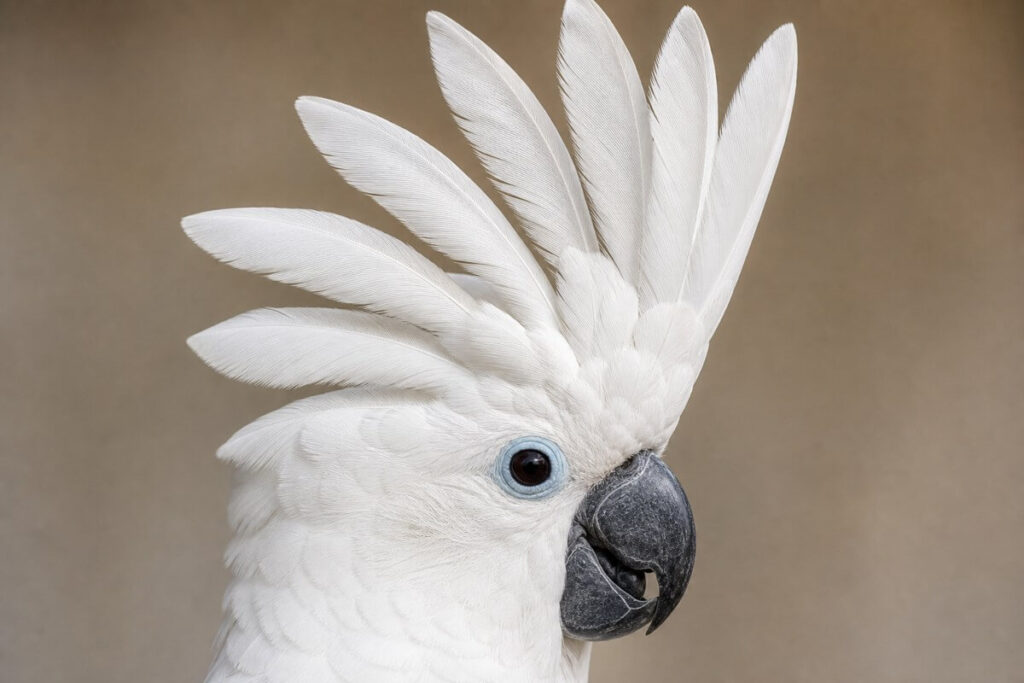
Reading the Crest
The crest is the most visible signal a cockatoo has, and misreading it is how people get bitten.
Fully raised, rigid, with the body upright and feathers tight — alarm or aggression. The bird has seen something it does not like. This is not the moment to reach in.
Raised and fanned, with a relaxed body and possibly a bobbing head — excitement, greeting, or play. Usually accompanied by vocalization.
Raised slowly during courtship, often with strutting or wing display — display behavior. Common in hormonal adults and frequently misread as friendliness.
Held flat against the head with the body compressed — fear or submission. A frightened bird that cannot retreat may bite.
Held flat with a relaxed, rounded body — content. This is a comfortable bird.
Read the whole bird, not just the crest. Pinned eyes, a flared tail, raised nape feathers and foot position all carry information, and all of it arrives before the beak does.
Why the Species Count Keeps Changing
It is worth understanding why sources disagree, because they will keep disagreeing.
Until June 2025, three separate global bird checklists were in use — one from the International Ornithologists’ Union, one from BirdLife International, and one from the Cornell Lab of Ornithology. They did not always agree on species limits, which is why 18, 20, 21 and 22 are all still in circulation.
AviList, launched 11 June 2025, merged all three into a single consensus taxonomy. It is now the standard reference, updated annually, and eBird and BirdLife are aligning their own lists to it.
Two recent changes account for most of the confusion in this family. The Zanda black cockatoos were separated from Calyptorhynchus, and the citron-crested cockatoo was recognized as a full species in 2023 rather than a subspecies of the yellow-crested.
For the current taxonomy and the reasoning behind each decision, the AviList global avian checklist is freely downloadable and is the source this article follows.
Frequently asked questions
How many cockatoo species are there?
There are 22 cockatoo species in seven genera in the family Cacatuidae, according to AviList v2025, the unified global bird checklist released in June 2025. Older sources give 18, 20, or 21 because taxonomy has changed — the Zanda black cockatoos were split from Calyptorhynchus, and the citron-crested cockatoo was separated from the yellow-crested cockatoo in 2023.
What is the rarest cockatoo species?
The red-vented cockatoo (Cacatua haematuropygia), also called the Philippine cockatoo, is the rarest. The IUCN estimates 430 to 750 mature individuals remaining, and the species has declined roughly 80 percent in 40 years. It is Critically Endangered and listed on CITES Appendix I.
Where do cockatoos live in the wild?
Cockatoos are native to Australia, New Guinea, Indonesia, the Philippines and the Solomon Islands. Eleven of the 22 species occur only in Australia, seven occur only in the northern islands, and the remaining four are found in both. No cockatoo species occurs naturally in Africa, the Americas, or Europe.
What is the largest cockatoo?
The palm cockatoo (Probosciger aterrimus) is the largest, reaching 22 to 28 inches with a wingspan over three feet. It is smoky black with bare red cheek patches and an enormous beak. It is also the only parrot known to manufacture and play a musical instrument.
What is the smallest cockatoo?
The cockatiel (Nymphicus hollandicus) at 12 to 13 inches. Many owners do not realize the cockatiel is a cockatoo at all, but it has the crest and the powder down that define the family.
What does a cockatoo’s crest mean?
A raised, rigid crest signals alarm or aggression. A raised, fanned crest with a relaxed body signals excitement or greeting. A crest held flat against the head with a compressed body signals fear or submission, while a flat crest on a relaxed body means the bird is content.
Are cockatoos intelligent?
Exceptionally. Palm cockatoos manufacture drumsticks and beat individual rhythms during courtship. Goffin’s cockatoos make and use tools, use composite tools, and carry toolsets to tasks they have not yet started. Sulphur-crested cockatoos in Sydney learned to open household bins, and the behavior spread between suburbs through social learning.
What is the difference between an umbrella and a Moluccan cockatoo?
The umbrella cockatoo has a pure white crest and reaches about 18 inches. The salmon-crested or Moluccan cockatoo is larger at around 20 inches, with a heavier build and salmon-pink feathers hidden in the crest that show when it is raised. Both are Endangered in the wild.
Do cockatoos talk?
Some do, though they are not in the same class as African Greys or Amazons. Sulphur-crested and umbrella cockatoos can learn words and phrases. They are far better known for volume than vocabulary, and for mimicking household sounds. The five Australian black cockatoos are the exception — they are highly vocal but not mimics.
Which cockatoos are endangered?
Three are Critically Endangered: the red-vented, the yellow-crested, and the citron-crested that was split from it in 2023. Five are Endangered: umbrella, salmon-crested, Carnaby’s black, Baudin’s black, and gang-gang. The palm, blue-eyed, pink, and glossy black cockatoos are Vulnerable.
Why are cockatoos so loud?
Wild cockatoos live in large, dispersed flocks and use contact calls to stay in touch across distance. Large white species reach around 135 decibels. Dawn and dusk calling is a biological rhythm and cannot be trained out, which is the single most common reason cockatoos are surrendered to rescues.