
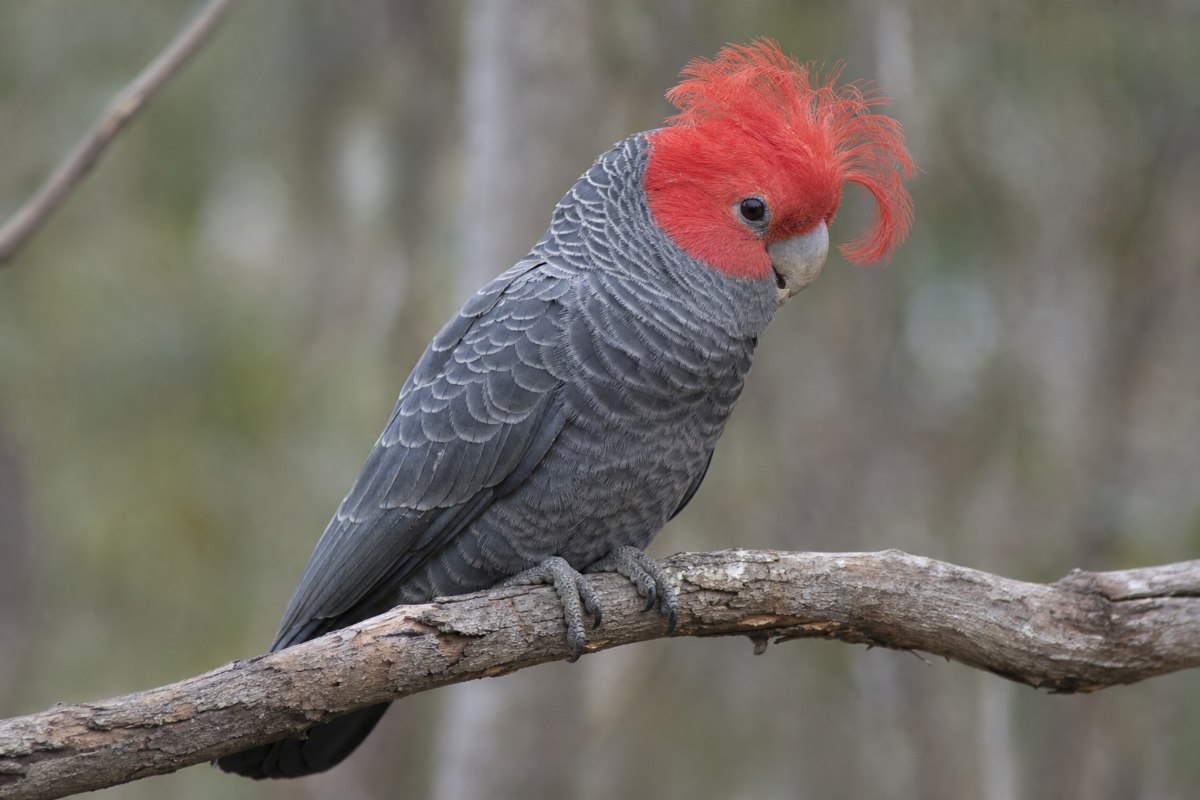
Short answer: the gang-gang cockatoo is a small gray Australian parrot, and the adult male is the only cockatoo in the world with a fully red head and crest.
Everything else about the bird is gray. The head is the whole show.
It is also the official animal emblem of the Australian Capital Territory, and it is in serious trouble. Australia listed it as Endangered in March 2022.
That last part matters, because a great many pages about this bird still tell you otherwise.
Key facts at a glance
| Question | Answer |
|---|---|
| Scientific name | Callocephalon fimbriatum |
| How many species in the genus? | One. It is the only member of its genus |
| Size | 32 to 36 cm long, wingspan 62 to 76 cm |
| Weight | 230 to 334 g, averaging around 257 g |
| Male | Scarlet red head and wispy red crest, slate gray body |
| Female | Gray head and small gray crest, feathers fringed yellow-orange |
| Where found | Southeastern Australia only |
| Conservation status | Endangered under Australian federal law since 2 March 2022 |
| Estimated population | Around 25,300 mature birds |
| Sound | A creaky, rising screech like a rusty gate hinge |
| Lifespan | Usually given as 20 years or more |
| Do they talk? | Barely. A few sounds at best. They are not real mimics |
| Good pets? | No, and in the US you cannot legally get one anyway |
| Animal emblem of | The Australian Capital Territory, adopted 1997 |
What is a gang-gang cockatoo?
It is a small, stocky cockatoo from the cool wet forests of southeastern Australia, and it is the only bird of its kind.
That is not a figure of speech. Scientists group similar species together into a genus, and the gang-gang has a genus entirely to itself. There is one gang-gang cockatoo, there are no subspecies, and nothing else sits alongside it in Callocephalon. Most Australian cockatoos share their genus with several close relatives. This one does not.
It is one of 14 cockatoo species found in Australia, and easily the most distinctive of them.
The British Royal Navy officer James Grant described the bird in 1803, after a voyage to the colony of New South Wales. He first called it Psittacus fimbriatus. The French naturalist René Lesson moved it into its own genus in 1837.
Both halves of the scientific name describe what you are looking at. Callocephalon combines the Ancient Greek kallos, meaning beauty, and kephalē, meaning head. The Latin fimbriata means fringed, which is the crest.
A beautiful head with a fringe. For once the scientific name is just an accurate description.
Why are they called gang-gang cockatoos?
Because the name comes from a New South Wales Aboriginal language and imitates the sound the bird makes.
Jeannie Gray and Ian Fraser, in Australian Bird Names: A Complete Guide, trace it to one of the NSW coastal languages, with Wiradjuri as another possibility. Some sources also point to Ngunnawal, the language of the Canberra region where the bird is best known.
The name is what linguists call onomatopoeic, meaning it copies a sound. Whichever language it came from, somebody was writing down a noise they heard in the bush.
That makes the English name of this species an Aboriginal word, used every day by people who have no idea that is what they are saying.
Is it gang gang cockatoo or gang-gang cockatoo?
Both spellings are in use, and the hyphenated form is the standard one.
Field guides, BirdLife Australia and Australian government documents all write it as gang-gang cockatoo. Plenty of people search for gang gang cockatoo without the hyphen, and it refers to exactly the same bird. Neither spelling is wrong.
How big is a gang-gang cockatoo?
Between 32 and 36 cm long, with a wingspan of 62 to 76 cm and a weight of 230 to 334 g.
BirdLife Australia gives an average of 34 cm and 257 g. That puts the gang-gang at the small end of the cockatoo family, closer to a galah than to an umbrella cockatoo.
| Species | Length | Typical weight | How it compares |
|---|---|---|---|
| Cockatiel | 30 to 33 cm | 80 to 100 g | Similar length, but a fraction of the weight |
| Gang-gang cockatoo | 32 to 36 cm | 230 to 334 g | The bird on this page |
| Galah | 34 to 38 cm | 270 to 350 g | The closest match, in both size and build |
| Umbrella cockatoo | 45 to 50 cm | 400 to 600 g | Clearly larger |
| Sulphur-crested cockatoo | 44 to 55 cm | 700 to 950 g | Roughly three times the weight |
Length can mislead you here, which is why the weight column matters. A cockatiel is nearly as long as a gang-gang, but most of that length is tail. Pick both birds up and the gang-gang is close to three times heavier. It is a chunky little bird, not a slender one.
Why do you see two completely different wingspan figures?
Because two different measurements are floating around, and one of them is regularly given the wrong name.
You will find pages saying the gang-gang has a wingspan of 20 to 26 cm, and other pages saying 62 to 76 cm. The gap is enormous, and it confuses people constantly. Both numbers are real. They measure different things.
| Measurement | Figure | What it actually means |
|---|---|---|
| Wing length | 20 to 26 cm | One folded wing, measured from the bend to the tip. This is the standard measurement ornithologists record |
| Wingspan | 62 to 76 cm | Tip to tip with both wings spread. This is what most readers picture |
The Australian Government’s conservation advice gives a wing length of 20 to 26 cm, citing Higgins 1999 and Menkhorst 2017. The NSW Scientific Committee gives a wingspan of 62 to 76 cm, also citing Higgins. Neither is a mistake.
The mistake happens when a page copies the 20 to 26 cm figure and labels it wingspan. If you see a wingspan under 30 cm for this bird, that is a wing length wearing the wrong label.
If you want to see how the gang-gang measures up against the rest of the family, our guide to all 22 cockatoo species sets every one of them side by side.
Gang-gang cockatoo male vs female: how do you tell them apart?
Look at the head. Red means male. No other cockatoo is this easy to sort out.
With most cockatoos you cannot tell males from females by eye at all, or you are squinting at eye color and hoping. The gang-gang simply shows you.
| Bird | Head and crest | Body and underparts |
|---|---|---|
| Adult male | Scarlet red head, wispy crest that curls forward | Mid to slate gray, feathers narrowly edged dull white. Some males carry pale yellow or dull orange on the breast |
| Adult female | Entirely gray head, small fluffy gray crest | Gray, with feathers broadly fringed yellow-orange. The barred effect is strongest on the underparts |
| Juvenile male | Red on the crown and forehead only, crest short and barely formed | Like the female, but washed green on the underparts and upper wing |
| Juvenile female | Like the adult female, crest barely formed | Like the female, with the same green wash |
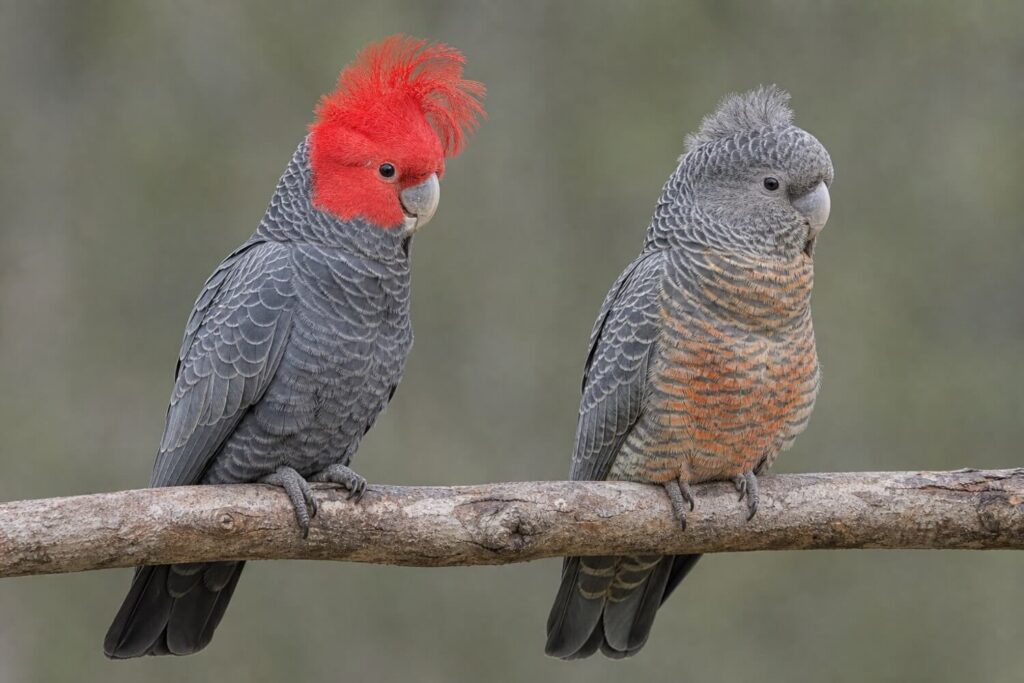
Young birds are the only real trap, and there are two clues. The crest is rudimentary, meaning barely there. And Higgins 1999 records that juveniles look washed green, particularly across the underparts and upper wing. A gray cockatoo with a faint green cast and almost no crest is a young bird, not a new species.
A patch of red on the top of the head with no full red hood means a young male. The full color takes time to come in.
What does a female gang-gang cockatoo look like?
Gray from head to tail, with broad yellow and orange fringes on every feather that give her a barred, scalloped look.
The female is not the dull one, whatever the male’s head suggests. She simply carries her color differently. Where the male puts everything into a scarlet hood and keeps the rest plain, the female is patterned all over.
Three things identify a female gang-gang:
- The head is entirely gray, crest included. No red anywhere at any age
- The feather fringing is broad and yellow-orange, strongest across the chest and belly. BirdLife Australia describes the underpart feathers as edged pink and yellow
- The crest is small, soft and fluffy rather than the long forward-curling wisp the male carries
Females are also the ones doing the house-hunting. She chooses the nest hollow, which is covered further down.
What does a gang-gang cockatoo sound like?
Like a rusty gate hinge being pushed open slowly. BirdLife Australia writes the call as a creaky rising screech, ky-or-ark.
The other common description is a cork being pulled from a wine bottle. Both are accurate, and the sound is unmistakable once you have heard it.
There is a second sound worth knowing. While feeding, gang-gangs make a soft, low growl that runs on continuously and sounds nothing like the screech.
Here is the part that surprises people who know other cockatoos. Gang-gangs are sociable but relatively quiet. They do not announce themselves the way sulphur-crested cockatoos do. Canberra birdwatchers usually find a flock by the sound of falling debris, chewed gum nuts and bitten twigs dropping out of a tree, rather than by any call at all.
So if a tree is raining bits of bark and seed pod and nothing is screeching, look up and check for a red head.
Is the gang-gang a black cockatoo?
No. It is not one of the black cockatoos, although where it belongs in the family tree is a question scientists have genuinely gone back and forth on.
The gang-gang looks like nothing else, and that has made it hard to place for over a century. The main problem is how different the male and female look from each other, which is unusual among cockatoos.
| Study | Where it placed the gang-gang |
|---|---|
| Brown and Toft, 1999 | An early offshoot of the black cockatoo group |
| White and colleagues, 2011 | On a separate branch, closer to the palm cockatoo |
Several bird sites still present the 1999 result as settled. It is not. The 2011 molecular study, from Murdoch University, used genetic evidence to move the bird somewhere else entirely, and that finding is more recent.
The practical answer is simpler than the scientific one. The gang-gang is not one of the five black cockatoo species, which are the red-tailed, glossy, yellow-tailed, Carnaby’s and Baudin’s. Those five are what Australians mean by the term. The gang-gang is its own thing, and it is gray rather than black in any case.
Which birds get mistaken for a gang-gang cockatoo?
Two, and for completely opposite reasons. The galah gets confused in flight because of the shape. The Australian king-parrot gets confused because of the red head.
Gang-gang cockatoo vs galah
Perched, the difference is obvious. In flight it honestly is not, and this is the mistake people make most often. Both are gray birds of almost identical size, and both show a similar shape against a bright sky.
| Feature | Gang-gang cockatoo | Galah |
|---|---|---|
| Body color | Slate gray all over | Gray back, deep pink chest and belly |
| Head | Red in males, gray in females | Pale pink crown |
| Crest | Wispy, curls forward, untidy | Smooth, short, pale pink |
| Flight | Slower and heavier, fairly direct | Fast, bouncy, often erratic |
| Flock size | Usually pairs, up to about 25 birds | Frequently hundreds |
| Voice | Creaking gate | Sharp metallic screech |
Flock size is the fastest clue in the field. A huge gray and pink flock wheeling over open country is galahs. Gang-gangs travel in small groups.
There is a twist worth knowing. Galahs also compete with gang-gangs for nest hollows, so the two species turn up in the same places for reasons that are not good news for the gang-gang.
Gang-gang cockatoo vs Australian king-parrot
This is the other red-headed parrot of eastern Australia, and the two get searched together constantly. The confusion is easy to clear up once you look past the head.
| Feature | Gang-gang cockatoo | Australian king-parrot |
|---|---|---|
| Family | A cockatoo | Not a cockatoo, a parrot |
| Male | Red head, gray body | Red head and red chest and belly, green back and wings |
| Female | Entirely gray | Green head and chest, red belly |
| Crest | Yes, wispy and forward-curling | None at all |
| Tail | Short | Long and green |
| Voice | Creaking gate | High-pitched whistle, rolling carr-ack in flight |
The crest settles it. Cockatoos have crests; king-parrots do not. If the bird has a red head and no crest, and there is green anywhere on it, you are looking at a king-parrot.
One wrinkle causes trouble here. BirdLife Australia describes the male Australian king-parrot as the only Australian parrot with a completely red head, which reads like a contradiction until you notice the wording. The gang-gang is the only cockatoo with a red head. The king-parrot is the only red-headed bird among the other parrots. Both statements are true and they are talking about different groups.
Are gang-gang cockatoos rare?
Yes. Around 25,300 mature birds are left, and Australia listed the species as Endangered on 2 March 2022.
The Australian Government’s conservation advice for Callocephalon fimbriatum puts the population at an estimated 25,300 mature individuals, within a likely range of 17,600 to 35,200.
| Listing authority | Status | Since |
|---|---|---|
| Australian federal law (EPBC Act) | Endangered | 2 March 2022 |
| IUCN Red List | Vulnerable | 2022 assessment |
| New South Wales | Endangered | April 2024, upgraded from Vulnerable in 2005 |
| Australian Capital Territory | Endangered | Brought into line with the federal listing in 2023 |
This is where much of what you will read online falls down. Several pages that rank well for this bird still describe it as Least Concern with a rising population. Least Concern was the global assessment before 2022. It is not the assessment now, and the population is not rising. If a page tells you gang-gang numbers are increasing, it has not been updated in at least four years.
The IUCN and Australian ratings differ, and neither one is an error. The IUCN grades species across the whole world. Australian law assesses the species inside Australia, which for a bird that lives nowhere else is the more meaningful measure of the two.
A recovery plan has been formally decided on for the species, which is a step above conservation advice alone. It reflects how many different states, land managers and agencies would have to act together to turn the decline around.
How many gang-gang cockatoos are left?
Around 25,300 mature birds, according to the Australian Government’s 2022 assessment.
The full estimated range runs from 17,600 to 35,200. The reason it is a range rather than a firm count is straightforward: nobody has ever run a dedicated national survey of this species.
The figure is built rather than counted. Researchers took the area where the birds are known to occur, doubled it to allow for remote country nobody has surveyed, applied an average density of 3.1 birds per square kilometer, and then subtracted the losses from the 2019 to 2020 fires.
Two things are worth knowing about that number. It counts only mature individuals, meaning birds old enough to breed, so the total number of gang-gangs alive is higher. And the species occupies a very large area, roughly 400,000 square kilometers, which is part of why counting them properly has never been done.
Why are gang-gang cockatoos declining?
Because the population fell by roughly 69 percent between 1999 and 2019, and then the 2019 to 2020 bushfires burned through about a third of its range.
That 69 percent figure comes from area searches, which the Threatened Species Scientific Committee described as the most reliable survey method available for this bird. It measures the decline before the fires even started.
Then came the Black Summer fires. Between 28 and 36 percent of the area where the species lives was hit, around 4.7 million hectares. A panel of experts estimated the population dropped by about a further 21 percent in the year after the fires, and predicted that even three generations later it would still sit 29 percent below where it started.
One honest caveat, because the Committee itself raised it. A different survey method, timed two-hectare searches, showed only a 15 percent decline over the same period with no clear trend. The Committee weighed both and concluded the real reduction was somewhere between 50 and 80 percent. The direction is not in doubt. The exact size of the drop is less certain than a single headline number suggests.
The underlying pressures have not gone away:
- Loss of nest hollows. Gang-gangs need hollows in large old trees, and those hollows take many decades to form. Logging, land clearing and hazard-tree removal take them out faster than forests can replace them
- Competition for the hollows that are left. Sulphur-crested cockatoos, rainbow lorikeets, galahs, eastern rosellas, corellas, common mynas and brushtail possums all want the same sites. So do feral honeybees, which occupy a large hollow for years at a time and effectively remove it from circulation
- Nest predation by brushtail possums, which take eggs and chicks. Conservation work on the related glossy black cockatoo showed that simply keeping possums out of hollows improved breeding success
- Heat. These are cool-climate birds. During Canberra’s record heat at the end of the 2019 to 2020 season, chicks died of heat exhaustion in their hollows and others tried to leave the nest early
- Slow breeding. Gang-gangs do not start breeding until around four years old and raise small broods, so a population that loses adults cannot rebuild quickly
- Psittacine beak and feather disease, a viral illness of parrots. The remaining Sydney population carries it at high levels
- Fire, which kills birds directly, destroys nest trees, and cuts the seed production the survivors depend on
Stacey Taylor, who studied gang-gang numbers across the ACT at the Australian National University, has made a point worth repeating. No formal long-term monitoring of this species was ever carried out. A bird that serves as the emblem of a national capital lost most of its population before anyone was in a position to explain exactly why.
What do gang-gang cockatoos eat?
Mostly eucalypt seed capsules and flowers, which account for 43 percent of all recorded feeding.
This is the best-documented part of the species, thanks to a 2023 study by Michael Mulvaney and Isobel Booksmythe published in the journal Corella. They gathered 4,135 feeding records from citizen science platforms, bird club databases and camera images, and identified 275 separate food items.
| Food group | Share of feeding events |
|---|---|
| Eucalypt seed capsules and flowers | 43% |
| Berries with large seeds and little flesh | 21% |
| Green cones, mainly pines and cypresses | 10% |
| Wattle seeds, almost entirely in spring and early summer | 8% |
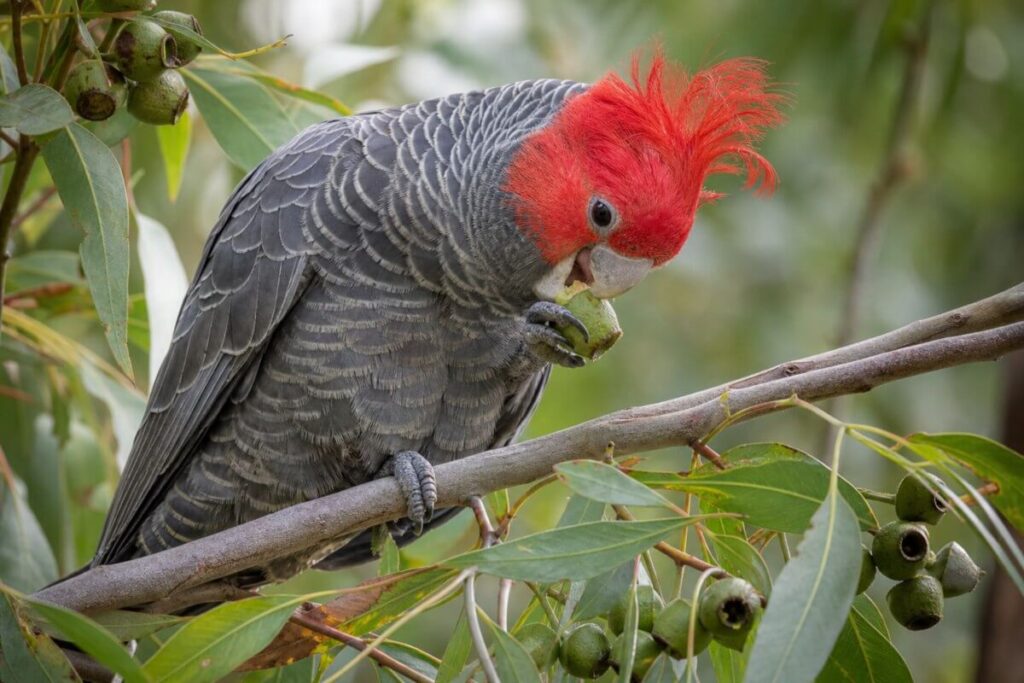
Broken down by individual plant rather than by group, the single most recorded food was hawthorn at 14 percent of all records, followed by blue gum Eucalyptus globulus at 12 percent and liquidambar at 7 percent.
Two of those three are introduced trees, not native ones. That is the finding worth pausing on. A threatened native bird now leans heavily on garden and street plantings, which is exactly why gang-gangs turn up in Canberra backyards working through cotoneaster and pyracantha berries.
There is a catch, and the Australian Government’s conservation advice is blunt about it. Ornamental garden trees are specifically excluded from what the law defines as habitat critical to the survival of the species. Suburban feeding keeps individual birds going. It does not substitute for forest.
The diet is wide but shallow. Of the 275 food items recorded, 143 were seen being eaten only once or twice. The twelve most common plants accounted for 54 percent of all feeding. Out in native bush away from Canberra gardens, the list narrows sharply to about 50 plants, mostly eucalypts and wattles.
Two other habits stand out. Gang-gangs are one of very few birds that will eat sawfly larvae, and they work steadily through an entire clump, one grub at a time. And they feed almost entirely up in the canopy, coming down to the ground only to drink or to pick over fallen pine cones.
How do gang-gang cockatoos nest and breed?
The female picks the hollow, and then both parents chew it out together, scraping the wood chips onto the floor to line the nest.
Most cockatoos take a hollow as they find it. Gang-gangs do their own carpentry, biting at the sides to enlarge the chamber, then using the debris as bedding.
That does not mean they can nest anywhere. Researchers Chris Davey and Michael Mulvaney measured the hollows gang-gangs actually use, and the specification is narrower than you would guess.
| Hollow feature | Typical measurement |
|---|---|
| Entrance height | Around 21 cm, and rarely below 12 cm |
| Entrance width | Around 13 cm, ranging from 9 to 24 cm |
| Chamber floor diameter | Around 20 cm |
| Chamber depth | Around 50 cm, ranging from 22 to 90 cm |
| Height above ground | Around 7.5 m, ranging from 5 to 9.4 m |
A cavity like that does not form in a young tree. Of the planted urban trees ever recorded holding a gang-gang nest, the youngest was 58 years old. That single number explains the whole conservation problem better than any argument could. Plant a tree today and it may be usable to this bird around 2085.
| Breeding detail | Figure |
|---|---|
| Breeding season | October to January, occasionally from late August |
| Clutch | Usually 2 white eggs, sometimes 1 or 3 |
| Incubation | 3 to 4 weeks, around 30 days, shared by both parents |
| Time to fledging | 7 to 8 weeks, around 56 days |
| Parents keep feeding for | A further 4 to 6 weeks after the young leave the nest |
| Age at first breeding | Around 4 years |
Gang-gangs are monogamous. They do not, however, simply reuse one tree forever. Davey and Mulvaney found that pairs rotate between several nest trees across different years, and only about half of the known nest trees are in use in any given season. The likeliest reason is that moving around makes a nest harder for a predator to find. Pairs do nest close together, often within a few hundred meters of each other.
The most appealing detail is what happens when several pairs nest side by side. The young birds are left in one shared roost tree, a crèche, while all the adults go off to feed. Cockatoo daycare, run by the neighborhood.
Where do gang-gang cockatoos live?
Along the Great Dividing Range in southeastern Australia, from the Hunter region of New South Wales in a broad arc down through the ACT and into Victoria.
The species moves with the seasons, but up and down rather than north and south. In summer it breeds in tall wet mountain forest with a dense shrub layer of wattle and banksia beneath the canopy, often in secluded valleys. As autumn arrives it drops to lower, drier, more open forest, and that is when it shows up in towns and gardens.
| Where | Notes |
|---|---|
| Canberra and the ACT | The most reliable place in the world to see one. Suburbs near Black Mountain, Aranda and Mount Ainslie, mostly in autumn and winter |
| Southeastern New South Wales | South coast up to the Hunter, inland roughly as far as Wagga Wagga and Albury |
| Victoria | Northeast and south, including east Melbourne, the Mornington Peninsula and the Otway Ranges |
| Kangaroo Island, South Australia | A small introduced population on the western tip |
| King Island, Tasmania | Introduced once, now considered extinct there |
One population deserves singling out. Gang-gangs in the Hornsby and Ku-ring-gai areas of northern Sydney are the last known breeding group left in the Sydney metropolitan area, and no more than 40 pairs remain. That group was listed as endangered on its own for years before the separate listing was folded into the species-wide NSW listing in 2024.
What does the gang-gang cockatoo range map look like?
A narrow crescent hugging the Great Dividing Range, hooking around the southeastern corner of the continent. It covers roughly 400,000 square kilometers, which sounds enormous until you see it against the size of Australia.
If you are picturing the map, trace this outline:
- Northern edge: the Hunter region of New South Wales, roughly level with Newcastle. Stray birds reach as far north as Coffs Harbour, but those are outliers, not range
- Western edge inland: roughly a line through Mudgee, Wagga Wagga, Albury, Seymour and Ballarat. Everything west of that is too hot and too dry
- Southern and southwestern edge: through southern Victoria to the Otway Ranges and the Grampians, reaching the South Australian border
- The dense middle: the ACT and the ranges either side of it, where the birds are most consistently found
- Two islands: Kangaroo Island in South Australia, where they were introduced and persist, and King Island in Tasmania, where they were introduced and died out
The important thing the map does not show is depth. That crescent is not uniformly filled. Within it the birds are patchy, concentrated wherever mature hollow-bearing forest survives, and increasingly absent from the lower, warmer edges of the range as the climate shifts.
What does the gang-gang cockatoo mean in Aboriginal culture?
Cockatoos run through songlines, Dreaming stories and Traditional Ecological Knowledge across southeastern Australia, and the gang-gang’s range crosses the Country of around thirty different peoples.
The Australian Government’s conservation advice names them, including the Ngunnawal, Wiradjuri, Yuin, Dharug, Dharawal, Gunaikurnai, Wurundjeri, Taungurung, Yorta Yorta, Bunurong and Eastern Maar peoples, among many others.
Two things are worth saying plainly here. These stories and this knowledge belong to specific communities with responsibility and kinship to these birds, not to a single generic tradition, and they differ from one another. And the conservation advice notes that cockatoo knowledge is tied to reading the seasons, to the movement of people, plants and animals, and to managing Country with fire and water.
The bird’s own name carries some of this, since gang-gang comes from a New South Wales Aboriginal language and imitates the call.
Are gang-gang cockatoos good pets?
No. Even setting aside the fact that you cannot legally buy one in the United States, this is not a bird that does well living with people.
Three separate problems stack up, and any one of them would be enough on its own.
They do badly in captivity. Gang-gangs have a reputation among keepers for being nervous rather than confident, and nervous parrots pluck. Feather picking when stressed or bored is the most commonly reported problem with this species, which is why the few sources with real experience describe it as a bird for experienced keepers and breeders rather than pet owners.
They do not bond the way people expect. Keepers who have tried to establish them in aviculture report pairs that refuse to bond, aggression between mates, and birds that stay wary of human handling for life. One breeder who worked with both galahs and gang-gangs described the galahs as straightforward by comparison.
They are endangered. The species lost most of its population in two decades and now sits on Australia’s threatened list. Creating demand for a bird in that position is not a neutral act, whatever the supply situation.
If you want a cockatoo for its personality, this is the wrong end of the family to be looking at. If you want one for its looks, a photograph costs nothing and the bird stays in its forest.
How much does a gang-gang cockatoo cost?
You will see figures from around $1,400 to $3,500 online. Treat all of them with suspicion, because they do not describe a real US market.
Those numbers circulate on price-comparison pages that list every cockatoo species side by side, whether or not the bird is actually available. Some are copied from Australian aviculture figures. Some appear to be invented. None of them reflect a legal American supply, because there is no legal American supply.
Any site advertising a gang-gang cockatoo for sale in the US, with a price and an add-to-cart button, is worth treating as a warning sign rather than an opportunity. The reasons are in the next section.
Can you keep a gang-gang cockatoo as a pet?
In the United States, no. This is the honest answer that pages selling the bird will not give you.
Three barriers stack up, and they are the same three that keep black cockatoos out of the country.
Australia does not export them. Australian federal law prohibits commercial export of live native wildlife. Gang-gangs cannot legally leave the country for the pet trade, and the species now carries an Endangered listing on top of that.
The United States stopped importing. The Wild Bird Conservation Act of 1992 sharply restricted imports of protected birds. Any gang-gang legally in the US would have to descend from birds already in the country before that date.
Almost none were ever brought over. While importing was still possible, the trade concentrated on species that sold well, which meant umbrellas, galahs and Moluccans. There was never any real breeding stock of gang-gangs in the US to build from.
So a site promising to ship one to your door is offering something that cannot legally happen.
In Australia the answer is different but still restrictive. Gang-gangs are a protected native species and now a threatened one, so keeping one requires a state wildlife license, and the rules vary from state to state.
If what you actually want is a cockatoo you can live with, the species available in the US are the umbrella, Moluccan, sulphur-crested, Goffin’s, galah and cockatiel. Our umbrella cockatoo care guide covers what that commitment really involves, including the parts that send so many of them to rescues.
How long do gang-gang cockatoos live?
Most sources say 20 years or more, and nobody has measured it properly.
Lone Pine Koala Sanctuary lists gang-gangs at 20 years and above, which is the figure most other sources repeat, and it is plausible for a cockatoo of this size.
One firmer number comes out of the conservation assessments rather than from longevity records. Research by Bird and colleagues in 2020 calculated the generation time of the world’s birds, and put the gang-gang at 6.9 years, within a range of 6.2 to 7.6. Generation time is not lifespan, but for a bird that first breeds at four, it points to a species that lives well into its second decade in the wild.
By cockatoo standards that is modest. Umbrella and Moluccan cockatoos routinely pass 50 years, and one Baudin’s black cockatoo was recorded at 47. The gang-gang appears to be shorter lived, though the honest position is that the data is thin.
Why is the gang-gang cockatoo the emblem of Canberra?
Because it is the bird Canberrans actually see, and in 1997 the ACT chose it ahead of any mammal.
That decision made the ACT the only Australian state or territory at the time to pick a bird as its animal emblem. Everywhere else chose a mammal. The territory later added the southern brush-tailed rock-wallaby as a mammal emblem in 2018, but the gang-gang came first.
It is also the emblem of the ACT Parks and Conservation Service and of the Canberra Ornithologists Group.
The affection is not limited to Canberra. In the 2021 Australian Bird of the Year poll, the gang-gang finished third out of fifty native birds, which is a striking result for a species most Australians will never see in person.
Interesting facts about gang-gang cockatoos
- The male is the only cockatoo with a fully red head. No other species in the family has one
- The English name is an Aboriginal word, taken from a New South Wales language and imitating the bird’s call
- A usable nest hollow takes about six decades to form. The youngest planted tree ever recorded holding a gang-gang nest was 58 years old
- They eat sawfly larvae, which very few birds will touch, working through a clump one grub at a time
- Their most recorded food is an introduced tree. Hawthorn accounts for 14 percent of all feeding records
- Chicks are left in a shared nursery tree, called a crèche, while all the parents go off to feed
- Pairs rotate between nest trees, using only about half of their known hollows in any one year
- Feral honeybees are a serious competitor, occupying large hollows for years and taking them out of circulation
- Juveniles look faintly green, particularly on the underparts and upper wing
- They are quiet for a cockatoo. Birdwatchers find flocks by the sound of falling debris rather than by calls
Frequently asked questions
What is a gang-gang cockatoo?
A small gray cockatoo, Callocephalon fimbriatum, found only in southeastern Australia. It is the only species in its genus. The adult male has a scarlet red head and wispy crest, while the female is gray-headed with yellow-orange fringing on her feathers. It is the animal emblem of the Australian Capital Territory.
Are gang-gang cockatoos rare?
Yes. The Australian Government estimates around 25,300 mature birds remain, within a range of 17,600 to 35,200. The species has been listed as Endangered under Australian federal law since March 2022, and as Endangered in New South Wales since April 2024.
Are gang-gang cockatoos endangered?
Yes. Australia listed the gang-gang cockatoo as Endangered on 2 March 2022, after its population fell by roughly 69 percent between 1999 and 2019. New South Wales listed it as Endangered in April 2024. The IUCN Red List grades it Vulnerable at the global level.
How many gang-gang cockatoos are left?
Around 25,300 mature individuals, with an estimated range of 17,600 to 35,200. That counts only birds old enough to breed. No dedicated national survey has ever been run, so the figure is calculated from occupied area and an average density of 3.1 birds per square kilometer.
Why are they called gang-gang cockatoos?
The name comes from a New South Wales Aboriginal language, most likely one of the coastal languages, with Wiradjuri and Ngunnawal also suggested. It is onomatopoeic, meaning it imitates the bird’s call. The English name for this species is an Aboriginal word.
Are gang-gang cockatoos good pets?
No. They are nervous in captivity and prone to feather plucking, keepers report pairs that will not bond and birds that stay wary of handling, and the species is endangered. In the United States you cannot legally obtain one in any case.
Why is the gang-gang cockatoo endangered?
Its population fell by roughly 69 percent between 1999 and 2019, and the 2019 to 2020 bushfires then burned 28 to 36 percent of its range. Loss of nest hollows, competition for the hollows that remain, heat stress on chicks and slow breeding all continue to drive the decline.
How can you tell a male gang-gang cockatoo from a female?
By the head. Adult males have a scarlet red head and a wispy crest that curls forward. Females have an entirely gray head and a small gray crest, with broad yellow-orange fringing on the feathers. Young males show red only on the crown, with a barely formed crest.
What does a gang-gang cockatoo sound like?
A creaky, rising screech that BirdLife Australia writes as ky-or-ark, most often compared to a rusty gate hinge or a cork being pulled from a wine bottle. While feeding they also make a soft, low growl. They are quieter than most cockatoos.
Is a gang-gang cockatoo a black cockatoo?
No. It is not one of the five Australian black cockatoos. Where it sits in the family tree is genuinely disputed: a 1999 study placed it as an early offshoot of the black cockatoos, while 2011 genetic work placed it closer to the palm cockatoo instead.
How big is a gang-gang cockatoo?
Between 32 and 36 cm long, with a wingspan of 62 to 76 cm and a weight of 230 to 334 g. Beware the figure of 20 to 26 cm that appears on some pages labeled as wingspan. That is wing length, meaning one folded wing, not the span across both.
How much does a gang-gang cockatoo cost?
Prices quoted online run from about $1,400 to $3,500, but none of them describe a real American market. There is no legal US supply of this species, so any listing offering one for sale with a price attached deserves serious scrutiny.
Can you buy a gang-gang cockatoo in the United States?
Effectively no. Australia bans commercial export of its native wildlife, the US Wild Bird Conservation Act of 1992 restricted imports, and very few gang-gangs were ever brought over beforehand. Listings offering one for sale in the US deserve serious scrutiny.
Do gang-gang cockatoos talk?
Barely. A gang-gang may pick up a few simple sounds, but it is not a real mimic and should never be chosen for talking ability. Among cockatoos, the umbrella and sulphur-crested are far more likely talkers, and African Greys outperform every cockatoo.
What do gang-gang cockatoos eat?
Mainly eucalypt seed capsules and flowers, which make up 43 percent of recorded feeding, plus berries, green pine and cypress cones, and wattle seeds. Hawthorn, an introduced tree, is the single most recorded food plant. They also eat insects, including sawfly larvae.
Where do gang-gang cockatoos nest?
In hollows in large old eucalypts, usually near water. The female chooses the hollow and both parents chew it larger, lining the floor with the wood chips. Hollows sit around 7.5 m up and take decades to form, which is why old trees matter so much to this species.
How long do gang-gang cockatoos live?
Commonly given as 20 years or more, though no reliable longevity study exists. Research by Bird and colleagues in 2020 put the species’ generation time at 6.9 years. They appear shorter lived than umbrella or Moluccan cockatoos, which routinely pass 50.
Where can you see a gang-gang cockatoo?
Canberra is the most reliable place, particularly suburbs bordering Black Mountain, Aranda and Mount Ainslie, and mostly in autumn and winter when the birds move down from the ranges. They also occur through southeastern New South Wales and parts of Victoria.
What is the difference between a gang-gang cockatoo and a galah?
Perched, the gang-gang is slate gray with a red head in males, while the galah has a pink chest and pale pink crown. In flight they look similar, so use flock size: gang-gangs move in small groups of up to about 25, galahs in flocks of hundreds.
Is a king parrot the same as a gang-gang cockatoo?
No. The Australian king-parrot is a different bird with a red head, but it has no crest, a long green tail, and green wings and back. The male also has a red chest and belly. Gang-gangs are gray all over apart from the male’s red head, and always have a crest.
Do gang-gang cockatoos mate for life?
They are monogamous, but they do not stay in one tree. Pairs rotate between several nest hollows across different years, with only about half in use in any season, most likely to make nests harder for predators to find. Both parents incubate and both feed the chicks.
Why is the gang-gang cockatoo the emblem of the ACT?
The Australian Capital Territory adopted it in 1997, making it the only state or territory at the time to choose a bird rather than a mammal as its animal emblem. It is also the emblem of the ACT Parks and Conservation Service and the Canberra Ornithologists Group.
The practical summary
One species, one genus, one country. The male’s red head makes it the easiest cockatoo in the world to tell apart by sex, and the creaking-gate call makes it one of the easiest to identify without seeing it at all.
It is also a bird in decline, and the scale of that decline is the thing most pages about it still get wrong. Around 69 percent gone between 1999 and 2019, Endangered since 2022, and roughly 25,300 mature birds left.
The whole problem comes down to one number. A hollow big enough for a gang-gang takes around sixty years to form, and nothing anyone plants this decade will help this bird before the 2080s. Every old tree left standing is the only version of conservation that works on this species’ timescale.
If you are in the United States hoping to own one, that is not a realistic goal, and the sites suggesting otherwise are selling something they cannot deliver.
If you want to see one, go to Canberra in winter and look through the suburban gardens near the bushland reserves. Then listen for the gate that needs oiling.
Sources and notes
- Conservation status, population estimate, habitat, threats and hollow data: Australian Government Conservation Advice for Callocephalon fimbriatum, in effect 2 March 2022 (linked above)
- Measurements, plumage, call and juvenile description: Higgins 1999, Handbook of Australian, New Zealand and Antarctic Birds; Menkhorst and colleagues 2017, The Australian Bird Guide; BirdLife Australia and Birds in Backyards species profiles
- Wingspan figure: NSW Threatened Species Scientific Committee determination
- Australian king-parrot comparison: BirdLife Australia and the Australian Museum species profiles
- Decline figures, survey methods and bushfire impact: Cameron and colleagues 2021, The Action Plan for Australian Birds 2020; Legge and colleagues 2021; Ward and colleagues 2020
- Diet data: Mulvaney, M. and Booksmythe, I. (2023), Gang-gang Cockatoo diet as assessed by camera images and written records, Corella
- Nest hollow measurements and nest tree use: Davey, C. and Mulvaney, M. (2020), Canberra Bird Notes
- Generation time: Bird and colleagues (2020), Generation lengths of the world’s birds and their implications for extinction risk, Conservation Biology
- Taxonomy: Brown and Toft 1999, Auk; White and colleagues 2011, Molecular Phylogenetics and Evolution
- Name origin: Gray, J. and Fraser, I. (2013), Australian Bird Names: A Complete Guide, CSIRO Publishing
- ACT emblem and research context: Australian National University; Canberra Ornithologists Group
This article is for general information. Gang-gang cockatoos are a protected and threatened species. If you find an injured bird in Australia, contact a licensed wildlife rescue rather than attempting to handle it yourself.