
Short answer: two macaw species are confirmed extinct, one is probably extinct but has not been declared so, and one is extinct in the wild but still alive in captivity.
The confirmed losses are the Cuban macaw and the St. Croix macaw. The probable loss is the glaucous macaw. The famous one, Spix’s macaw, is the bird from the film Rio, and its story took a serious turn for the worse in late 2025.
Most articles on this subject stop at 2022, when Spix’s macaws were released back into the wild in Brazil and the story looked like a triumph. What happened after that is the part you will struggle to find anywhere else.
Key facts at a glance
| Question | Answer |
|---|---|
| How many macaws are confirmed extinct? | Two: the Cuban macaw and the St. Croix macaw |
| Probably extinct | The glaucous macaw, Anodorhynchus glaucus |
| Extinct in the wild | Spix’s macaw, Cyanopsitta spixii |
| Living macaw species | 17 |
| Total including extinct | 19 |
| Last confirmed Cuban macaw | Around 1885 |
| Cuban macaw specimens left | 19 skins, held in 15 museums |
| Spix’s macaws alive today | Roughly 360 to 400, nearly all in captivity |
| Spix’s macaws flying free | 11, and all 11 tested positive for a lethal virus in November 2025 |
| Closest to extinction now | Blue-throated macaw, 208 to 303 adults |
| Largest macaw species | Hyacinth macaw, about one meter long |
Which macaws are extinct?
Two species are confirmed extinct, and a third is almost certainly gone. A fourth survives only because people bred it in captivity.
The confusion in this topic comes from the word “extinct” itself. It gets used four different ways here, and only three of them are official.
| Term | What it actually means |
|---|---|
| Extinct | Gone. No individuals left anywhere, in the wild or in captivity |
| Extinct in the Wild | None left in nature, but living birds remain in captivity |
| Possibly Extinct | Almost certainly gone, but not enough evidence to say so formally |
| Hypothetical species | Described in old accounts, but no specimen or bones ever confirmed it existed |
The fourth is not an official category at all. It is what happens when historical writers describe a bird that nobody ever collected.
Here is where each macaw sits.
| Species | Scientific name | Status | Last seen |
|---|---|---|---|
| Cuban macaw | Ara tricolor | Extinct | Around 1885 |
| St. Croix macaw | Ara autochthones | Extinct | Known only from bones |
| Glaucous macaw | Anodorhynchus glaucus | Critically Endangered, Possibly Extinct | 1960s |
| Spix’s macaw | Cyanopsitta spixii | Extinct in the Wild | Last wild bird around 2000 |
| Guadeloupe macaw | Ara guadeloupensis | Hypothetical, never confirmed | Around 1760 |
The bottom row matters more than it looks. The Guadeloupe macaw, also called the Lesser Antillean macaw, is known only from written accounts and old illustrations. No specimen was ever preserved.
And it is not alone. As many as thirteen extinct Caribbean macaw species have been proposed over the years, according to the scientific literature on the St. Croix macaw. Almost all of them rest on thin evidence. Macaws were carried long distances by people in both prehistoric and colonial times, so when bones turn up on an island, there is often no way to tell whether the bird lived there or was brought there.
The honest count is two confirmed, one probable, one hanging on by human effort.
What are the 17 species of macaw?
Seventeen macaw species are alive today, spread across six genera. Adding the two confirmed extinct species gives the nineteen you will see on other sites.
This is the cleanest explanation of a number that confuses everybody. PetMD says seventeen. Wikipedia’s list of macaws says nineteen. Neither is wrong.
| Genus | Living species | Which ones |
|---|---|---|
| Ara | 8 | Blue-and-yellow, blue-throated, military, great green, scarlet, red-and-green, red-fronted, chestnut-fronted |
| Anodorhynchus | 3 | Hyacinth, Lear’s, glaucous |
| Primolius | 3 | Blue-headed, blue-winged, golden-collared |
| Cyanopsitta | 1 | Spix’s |
| Orthopsittaca | 1 | Red-bellied |
| Diopsittaca | 1 | Red-shouldered, also called Hahn’s |
| Total living | 17 | |
| Ara, extinct | 2 | Cuban macaw, St. Croix macaw |
| Total including extinct | 19 |
Two footnotes on that table, because both are contested.
The glaucous macaw is counted as living. It has not been reliably seen in over sixty years, but BirdLife International has not declared it extinct, so it stays in the column.
And Spix’s macaw is counted as living, which is correct, but every single one of them is either in a cage or being tracked by a conservation team.
If you want the full picture of the surviving species, our guide to every macaw species covers all seventeen in detail.
Macaw species names, common and scientific
Every macaw carries two names, and the scientific one is the only one that never changes.
Common names shift between countries. The blue-and-yellow macaw is the blue-and-gold macaw in the United States. Lear’s macaw is the indigo macaw. The scientific name is the anchor.
| Common name | Scientific name |
|---|---|
| Hyacinth macaw | Anodorhynchus hyacinthinus |
| Lear’s macaw, indigo macaw | Anodorhynchus leari |
| Glaucous macaw | Anodorhynchus glaucus |
| Spix’s macaw, little blue macaw | Cyanopsitta spixii |
| Blue-and-yellow, blue-and-gold macaw | Ara ararauna |
| Blue-throated macaw, Caninde macaw | Ara glaucogularis |
| Military macaw | Ara militaris |
| Great green macaw | Ara ambiguus |
| Scarlet macaw | Ara macao |
| Red-and-green, green-winged macaw | Ara chloropterus |
| Red-fronted macaw | Ara rubrogenys |
| Chestnut-fronted, severe macaw | Ara severus |
| Cuban macaw, Cuban red macaw | Ara tricolor, extinct |
| St. Croix macaw | Ara autochthones, extinct |
| Red-bellied macaw | Orthopsittaca manilata |
| Blue-headed macaw | Primolius couloni |
| Blue-winged, Illiger’s macaw | Primolius maracana |
| Golden-collared, yellow-collared macaw | Primolius auricollis |
| Red-shouldered, Hahn’s macaw | Diopsittaca nobilis |
Two conventions worth knowing. A dagger symbol before a scientific name means the species is extinct, so you will see the Cuban macaw written as †Ara tricolor. And a multiplication sign between two names means a hybrid rather than a species, which is covered further down.
The Cuban macaw: the one that is definitely gone
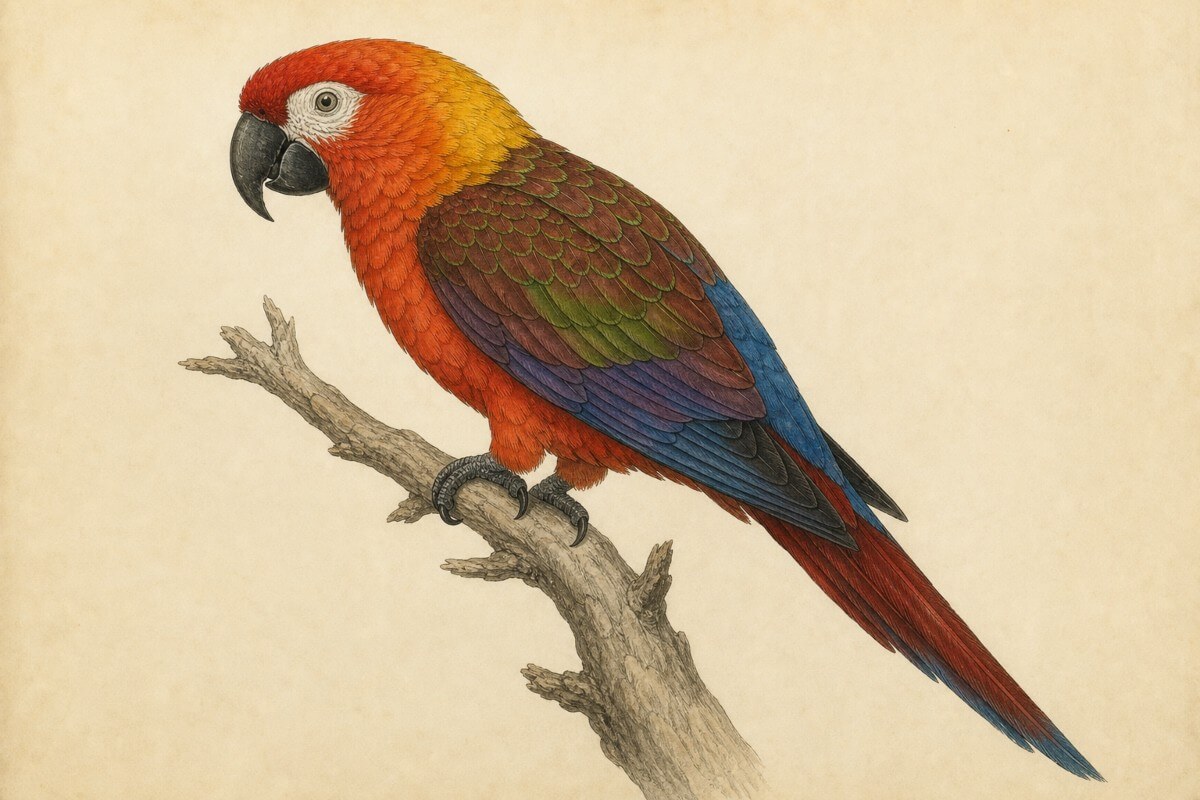
A red, orange and blue macaw that lived only on Cuba, hunted and trapped out of existence by about 1885. Nineteen skins survive, scattered across fifteen museums.
Ara tricolor was the most colorful bird in this article and the best documented of the true losses. Christopher Columbus wrote about macaws in Cuba in the 1490s. By the middle of the 1800s the bird was already rare.
The Cuban naturalist Juan Gundlach found some of the last surviving birds near the Zapata Swamp in 1849 and 1850. Within about thirty-five years there were none left anywhere.
How big was the Cuban macaw?
About 45 to 50 cm long, or 18 to 20 inches, which made it one of the smallest macaws.
For comparison, a hyacinth macaw reaches around a meter. A scarlet macaw runs to about 85 cm. The Cuban macaw was closer in size to a chestnut-fronted macaw than to the giants it is usually pictured alongside.
Its head ran red at the forehead, fading through orange to yellow at the nape. The body carried red, orange, green, brown and blue, with a blue rump and wings and a large black bill.
| Cuban macaw | Detail |
|---|---|
| Length | 45 to 50 cm, 18 to 20 in |
| Range | Cuba, and probably Isla de la Juventud |
| Habitat | Lowland forest, palm savanna, and the Zapata Swamp |
| Nested in | Cavities in large palms, probably royal palm |
| Diet | Seeds and fruits, based on contemporary reports |
| Extinct by | Around 1885 |
Why is so little known about it?
Because it disappeared before anyone studied it properly, and because no complete skeleton exists.
This is the detail that says the most about how completely a species can be erased. Of the Cuban macaw there are nineteen preserved skins, held in fifteen different museums around the world. Several of those birds had lived as pets or in zoos rather than in the wild.
There is no complete modern skeleton. What exists are a few old bone fragments dug up in Cuba, too recent to be true fossils, including part of a wing bone, a beak and a piece of skull.
Nothing is recorded about its clutch size, its eggs, or how it raised young. The nesting information comes secondhand, from what Cuban locals told Gundlach in the 1860s and 1870s.
One thing modern science has been able to add. A 2018 DNA study, using tissue from those museum skins, found the Cuban macaw’s closest living relatives: a group of two red and two green macaws still alive today. Where it belonged in the family had been argued over for a century, and it took genetics to settle it, more than 130 years after the last bird died.
The glaucous macaw: probably extinct, officially not
A large pale turquoise macaw from South America, not reliably seen since the 1960s, and still listed as Critically Endangered rather than Extinct.
Anodorhynchus glaucus was 70 cm long, mostly pale blue-green with a heavy gray head, and closely related to both the hyacinth macaw and Lear’s macaw. In Guarani it is called gua’a hovy, a name taken from its call.
It ranged across northern Argentina, southern Paraguay, southern Brazil and Uruguay, along the corridors of the Paraná and Uruguay rivers.
How many glaucous macaws are left?
Almost certainly none, though nobody has been willing to say so officially.
There were only two reliable sighting records in the entire twentieth century. The last confirmed one was in the 1960s. Every organized search since has come back empty.
So why is it not declared extinct? Two reasons, and both are defensible.
Local people within its former range still occasionally report seeing it. Those reports are unverified, but they are not nothing.
And its historical habitat has not been searched exhaustively. Declaring a species extinct removes it from conservation planning and funding, which is an irreversible step. BirdLife International uses the tag Critically Endangered (Possibly Extinct) precisely for this situation, where the science says gone but the paperwork is not yet closed.
The likeliest cause of its disappearance was the clearing of yatay palm groves for agriculture. The bird depended heavily on those palms, and when they went, so did it.
Is the Spix’s macaw extinct in 2026?
No. Around 360 to 400 are alive, but the species is still classed as Extinct in the Wild, and the attempt to change that hit a serious problem in late 2025.
This is the macaw people mean when they ask about extinct macaws, largely because of the 2011 film Rio. The film’s premise, a lone male searching for the last female, was already out of date when it was released. The last known wild Spix’s macaw likely died around 2000.
Here is the honest timeline.
| When | What happened |
|---|---|
| 1819 | Spix collects the first specimen known to science. The bird is already rare |
| 1980s | Illegal trade strips the last wild birds. By 1987 only two remain in the wild |
| 2000 | The last known wild individual disappears |
| 2016 | A bird is filmed over Curaçá. Almost certainly an escaped captive |
| 2019 | IUCN formally declares the species Extinct in the Wild |
| 2020 | 52 birds transferred from Germany to Brazil to prepare for release |
| June and December 2022 | 20 birds released in Curaçá, Bahia. The comeback story begins |
| 2023 to 2024 | Wild breeding succeeds. Chicks hatch and fledge in the wild |
| May 2025 | Circovirus detected at the Curaçá breeding center |
| November 2025 | All 11 surviving free-flying birds test positive |
How many Spix’s macaws are left?
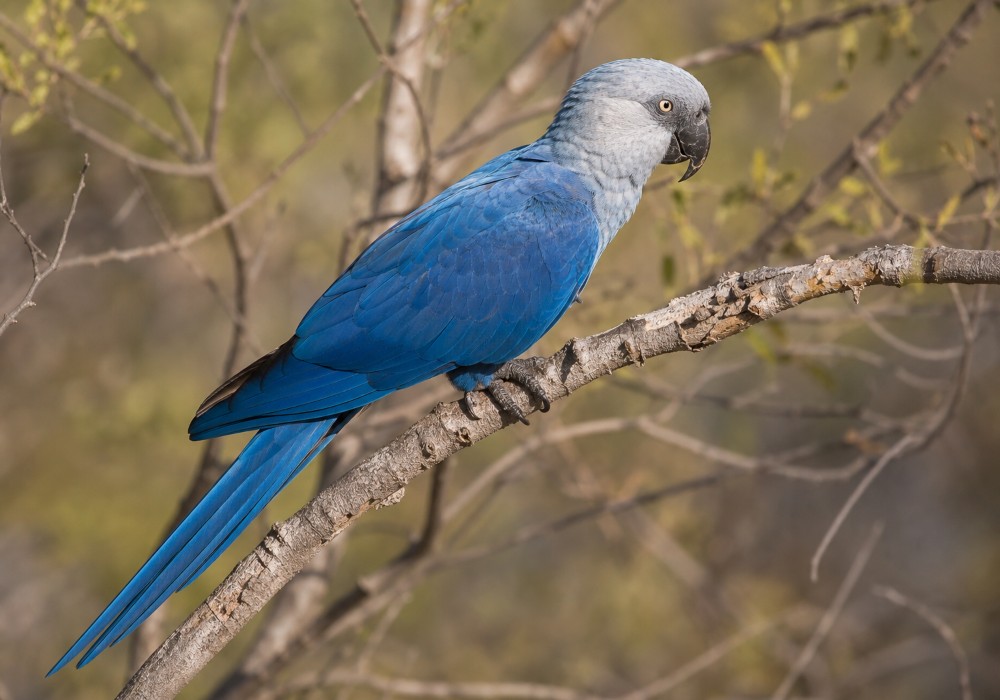
Roughly 360 to 400 in total. Only 11 are flying free, and all 11 are infected.
The global population sits somewhere around 360 to 400 birds, almost all of them in captive breeding facilities. That is up from fewer than 60 in the early 2000s, which is a genuine conservation achievement and should not be dismissed.
The wild figure is the sobering one. About 20 birds were released from 2020 onward. By November 2025 only 11 were still alive, and mortality had already been high before the virus was found.
What happened to the released Spix’s macaws in 2025?
Brazil’s wildlife agency captured all 11 free-flying birds for testing and every one of them came back positive for circovirus, the virus behind psittacine beak and feather disease.
This is the part almost no article about extinct macaws currently includes, and it changes the conclusion completely.
Circovirus damages feathers and beaks and is usually fatal in parrots. Brazil’s conservation agency ICMBio stated plainly that the disease has no cure and kills the bird in most cases. It poses no danger to humans.
The outbreak was first found in May 2025, when the breeding center in Curaçá reported seven positive birds. One of them was a chick that had hatched in the wild and had never been in captivity. Then, on 27 November 2025, ICMBio confirmed that all 11 free-living birds had tested positive.
Around 21 more birds, out of roughly 90 held at the Bahia breeding center, also tested positive.
Two details make this worse than a run of bad luck.
The virus is not native to South America. It originated in Australia, and before 2025 it had never been recorded in a wild bird anywhere in Brazil. It did not appear on its own.
There was a warning sign. In January 2025, one of 41 Spix’s macaws being shipped from a German breeding center to Brazil tested positive for circovirus. A second test eight days later came back negative and the shipment went ahead. ICMBio’s own report notes that one negative result does not clear a bird, because the virus comes and goes in the body and a clean test can easily be a false one.
The people running the breeding program dispute the interpretation. Their scientific coordinator has said the German bird never produced a confirmed positive, and has questioned whether the virus was there at all. Brazilian officials declared a sanitary emergency and fined the facility after inspections found dirty feeders and handlers working without protective clothing.
Meanwhile Brazil had already terminated its cooperation agreement with the German organization in 2024, after it sold 26 Spix’s macaws to a private zoo in India without Brazilian consent. That organization holds roughly three quarters of the world’s registered Spix’s macaws.
So is Spix’s macaw back? Not yet. It exists, it has bred in the wild, and that is real. But as of 2026 it remains dependent on human care, the free-flying population is infected with an incurable disease, and calling it a recovered species would be wrong.
Which macaws could be next?
The blue-throated macaw, with somewhere between 208 and 303 adults left in a small corner of Bolivia.
Losing a species is rarely sudden. Each of the macaws above spent decades sliding before the last one died. These are the birds currently on that slide.
| Species | Status | Population | Trend |
|---|---|---|---|
| Blue-throated macaw | Critically Endangered | 208 to 303 adults | Small range in Bolivia |
| Red-fronted macaw | Critically Endangered | Small | Declining |
| Glaucous macaw | Critically Endangered, Possibly Extinct | Probably zero | See above |
| Lear’s macaw | Endangered | Around 1,700 total | Increasing |
| Hyacinth macaw | Vulnerable | About 4,300 breeding adults | Pressured |
| Military macaw | Vulnerable | Unknown | Declining |
Lear’s macaw is the one bright entry on that list, and it is worth dwelling on. In 1983 the entire known population was 60 birds. Counts reached 246 by 2001, then over 1,100, and the species now sits around 1,700 and rising.
A macaw down to 60 individuals came back. That is the best argument anyone has for not giving up on the blue-throated macaw at 208.
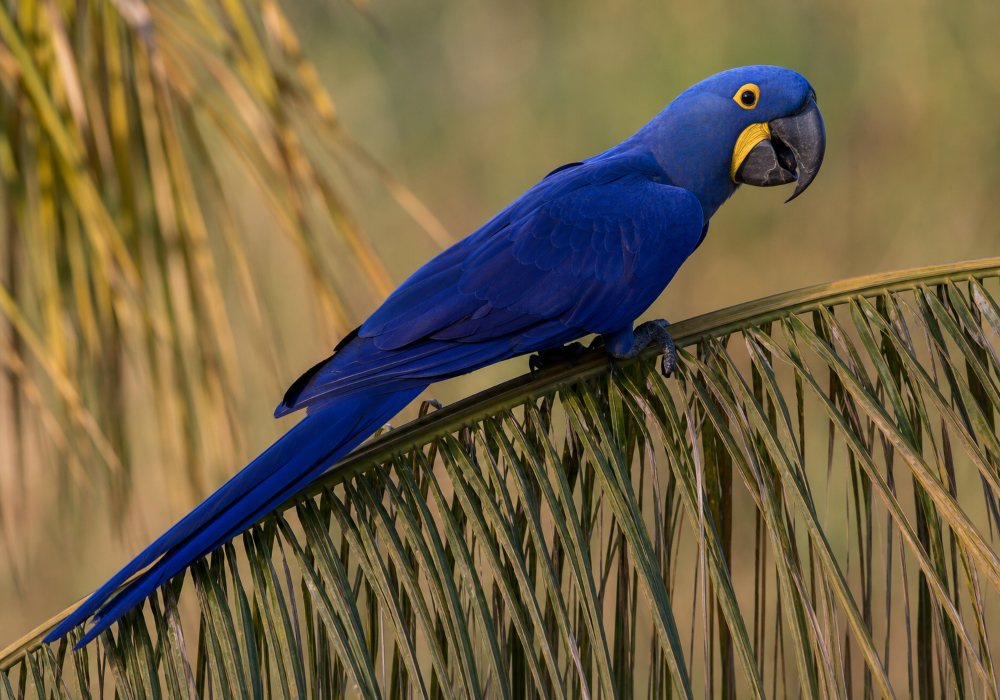
The hyacinth macaw deserves a note too, since it is the species most people picture. It is the largest macaw and the largest flying parrot in the world, at roughly one meter from head to tail tip. It is listed as Vulnerable, with around 4,300 mature individuals, most of them in Brazil’s Pantanal wetland.
Is a Catalina macaw a species?
No. The Catalina macaw is a hybrid, a cross between a blue-and-gold macaw and a scarlet macaw, and it has no scientific name.
This turns up constantly in searches next to genuine macaw species, so it is worth clearing up.
A Catalina macaw is written as Ara ararauna × Ara macao, using a multiplication sign, because that is what it is: two species crossed. It was first bred in 1940 at the Catalina Bird Park on Santa Catalina Island, off the California coast, which is where the name comes from.
| Hybrid name | Cross |
|---|---|
| Catalina, also called rainbow | Blue-and-gold × scarlet |
| Harlequin | Green-winged × blue-and-gold |
| Camelot | Scarlet × Catalina |
| Milligold | Blue-and-gold × military |
| Ruby | Scarlet × green-winged |
Hybrids matter to this article for a reason that is not obvious. Unlike mules or ligers, hybrid macaws are often fertile, at least in the first two generations. That means hybrid genes can move back into breeding populations.
Some breeders consider deliberate hybridizing of threatened macaws unethical for exactly this reason. A hybrid that looks identical to a pure parent species can quietly carry another species’ genes, and if a captive population is ever needed to restock a wild one, that matters enormously.
The Spix’s macaw program depends on knowing precisely which birds are pure. Hybrid contamination in a program like that would not be a cosmetic problem.
The four blue macaws
In 1900, Berlin Zoo displayed all four blue macaws together. A century later, one is probably extinct, one is extinct in the wild, and the other two are both on the threatened list.
The display included Lear’s, glaucous, hyacinth and Spix’s macaws side by side. At the time it was a curiosity, four striking blue birds in one exhibit. Nobody watching would have guessed that within a hundred years every one of them would be in trouble.
| Species | Status in 1900 | Status in 2026 |
|---|---|---|
| Hyacinth macaw | Common | Vulnerable, around 4,300 mature birds |
| Lear’s macaw | Barely known to science | Endangered, around 1,700 and rising |
| Glaucous macaw | Already scarce | Probably extinct |
| Spix’s macaw | Rare but wild | Extinct in the wild |
There is no better summary of what happened to this group of birds in the twentieth century than that one exhibit and what became of it.
Why did these macaws disappear?
Small ranges, a fussy diet, a slow breeding rate, and a trade that wanted the rarest birds most.
Four things show up again and again across every macaw that has been lost or nearly lost.
Island and small-range endemism. The Cuban macaw, the St. Croix macaw and the Guadeloupe macaw were all confined to islands. Spix’s macaw was tied to a narrow ribbon of trees along one river system in northeastern Brazil. The blue-throated macaw occupies one small region of Bolivia. A species with nowhere else to go cannot retreat from a bad decade.
Habitat specificity. The glaucous macaw depended on yatay palms. Lear’s macaw depends on licuri palm nuts. When a bird eats essentially one thing, clearing that one thing is enough.
Slow reproduction. Macaws are large, long-lived birds that raise small broods and do not breed every year. A population that loses adults faster than it replaces them cannot recover quickly, even if the pressure stops.
Rarity itself becomes the threat. This is the cruelest of the four. Once a species became scarce, its value to collectors rose, which increased trapping pressure, which made it scarcer. Field surveys of Spix’s macaw found five birds in 1985 and three in 1986. Two of the last were taken for trade in 1987.
To that list, 2025 added a fifth: disease moving with conservation itself. Circovirus reached wild Brazilian parrots through a program designed to save them.
Frequently asked questions
Which macaws are extinct?
Two are confirmed extinct: the Cuban macaw, Ara tricolor, which died out around 1885, and the St. Croix macaw, Ara autochthones, known only from bones. The glaucous macaw is Critically Endangered and probably extinct, and Spix’s macaw is extinct in the wild but alive in captivity.
Is the Spix’s macaw extinct in 2026?
No. Roughly 360 to 400 Spix’s macaws are alive, and 11 are flying free in Bahia, Brazil. But the IUCN still lists the species as Extinct in the Wild, and in November 2025 all 11 free-flying birds tested positive for circovirus, an incurable and usually fatal parrot disease.
How many Spix’s macaws are left?
Around 360 to 400 in total, up from fewer than 60 in the early 2000s. Nearly all are in captive breeding facilities, with about 90 held at a center in Bahia, Brazil. Only 11 live outside a cage, and all 11 are infected with circovirus.
What are the 17 species of macaw?
Seventeen macaw species are alive today across six genera: eight in Ara, three in Anodorhynchus, three in Primolius, and one each in Cyanopsitta, Orthopsittaca and Diopsittaca. Adding the two confirmed extinct Ara species gives the figure of nineteen that some sources use.
Why do some sites say there are 19 macaw species?
Because they are counting the extinct ones. Wikipedia’s list of macaws includes the Cuban macaw and the St. Croix macaw, both extinct, which brings the total from seventeen to nineteen. Neither number is wrong; they are counting different things.
How big was the Cuban macaw?
About 45 to 50 cm long, or 18 to 20 inches, making it one of the smaller macaw species. Its head was red at the forehead fading to orange and then yellow at the nape, with a red, orange, green, brown and blue body and a large black bill.
How many glaucous macaws are left?
Almost certainly none. There were only two reliable sightings in the entire twentieth century, the last in the 1960s. BirdLife International still lists it as Critically Endangered (Possibly Extinct) rather than Extinct, because unverified local reports continue and not all its former range has been searched.
Is the glaucous macaw extinct?
Probably, but not officially. The IUCN classifies it as Critically Endangered (Possibly Extinct), a category used when a species is very likely gone but the evidence falls short of certainty. Declaring extinction removes a species from conservation planning, so the bar is set deliberately high.
Is a Catalina macaw a real species?
No. The Catalina macaw is a captive-bred hybrid between a blue-and-gold macaw and a scarlet macaw, first produced in 1940 at the Catalina Bird Park in California. Hybrids have no scientific name and are written using a multiplication sign, as Ara ararauna × Ara macao.
What is the largest macaw species?
The hyacinth macaw, Anodorhynchus hyacinthinus, at roughly one meter from head to tail tip. It is the largest macaw and the largest flying parrot in the world. The IUCN lists it as Vulnerable, with around 4,300 mature individuals, most in Brazil’s Pantanal.
What is the rarest macaw?
It depends on whether you count captive birds. Spix’s macaw is the rarest in the wild by far, with just 11 free-flying individuals. The blue-throated macaw has the smallest genuine wild population of any macaw, at 208 to 303 adults. By total numbers Spix’s sits higher, at 360 to 400, because nearly all of them are in cages.
Is Lear’s macaw still endangered?
Yes, but its numbers are rising. Lear’s macaw is listed as Endangered, with around 1,700 individuals. In 1983 the known population was 60 birds. It is the clearest example of a macaw pulled back from the edge by sustained conservation work.
Why did the Cuban macaw go extinct?
Hunting for food and feathers, trapping of chicks for the European cage-bird trade, and the felling of nesting trees and clearing of forest for agriculture. It was already rare by the mid-1800s and gone by about 1885.
How many Cuban macaw specimens still exist?
Nineteen preserved skins, held across fifteen museums worldwide. No complete skeleton exists. A few old bone fragments have been dug up in Cuba, including part of a wing bone, a beak and a piece of skull.
Were there other extinct Caribbean macaws?
As many as thirteen extinct Caribbean macaw species have been proposed, but almost all rest on very little evidence. Macaws were transported long distances by people in both prehistoric and colonial times, so bones found on an island do not prove the bird lived there naturally.
What killed the released Spix’s macaws?
None have died of it yet, but all 11 free-flying birds tested positive for circovirus in November 2025. The virus causes psittacine beak and feather disease, which ICMBio describes as incurable and fatal in most cases. It is not native to South America and had never previously been found in a wild Brazilian bird.
The practical summary
Two macaws are gone and are not coming back. The Cuban macaw left behind nineteen skins and no skeleton. The St. Croix macaw left bones and no picture at all.
The glaucous macaw is almost certainly a third loss, held on the list only because declaring extinction is a step nobody wants to take too early.
Spix’s macaw is the one that matters most right now, because it is the test case. If a bird can be bred back from fewer than 60 individuals, returned to its home range, and made to breed in the wild, then extinction in the wild is not always final. Twenty birds went out in 2022 and chicks hatched under open sky for the first time in a generation.
Then a virus that should never have been on that continent turned up in all 11 survivors.
The lesson is not that the effort failed. It is that saving a species takes longer, and can be undone more easily, than the headlines suggest. The blue-throated macaw sits at 208 to 303 adults today. Lear’s macaw was at 60 in 1983 and is now near 1,700.
Both outcomes are still available.
Sources and notes
- Extinct and hypothetical species, specimen counts and subfossil records: Wikipedia species accounts for the Cuban macaw, St. Croix macaw and Lesser Antillean macaw, drawing on Fuller 1987 and Wetherbee 1985
- Cuban macaw phylogeny: 2018 DNA study of museum material placing Ara tricolor with living red and green macaws
- Conservation statuses and population figures: IUCN Red List; BirdLife International
- Spix’s macaw history and reintroduction: BirdLife International 2018 extinction assessment; the Spix’s Macaw Conservation Programme
- Circovirus outbreak: ICMBio statements of May and 27 November 2025, as reported by BirdGuides (linked above), AFP and Mongabay
- Species counts: PetMD and Parrot Essentials for 17 living species; Wikipedia’s list of macaws for 19 including extinct
- Catalina macaw and hybrid genetics: Wikipedia accounts for the Catalina macaw and hybrid macaws
- Lear’s macaw recovery figures: World Parrot Trust
This article is for general information. Every macaw species is protected under CITES, and several are illegal to trade in any form. If you are considering a macaw as a pet, buy only from a licensed breeder who can document the bird’s origin.