
Most people meet a Blue and Gold Macaw at a bird expo or a pet store, fall in love with the colors, and go home thinking about it for three weeks straight. What almost nobody tells you in that first conversation is that the bird you are looking at will probably outlive your mortgage, and possibly your marriage.
That is not a reason to skip the idea. It is a reason to read something honest before you buy.
This Blue and Gold Macaw care guide covers what the first year actually looks like: real cage dimensions, what these birds eat, what they cost after you have paid for the bird, how loud they get, and the health problems that send owners to an avian vet at 9 PM on a Sunday. We sell birds and supplies at Wild Birds USA, so we have watched a lot of these placements work and a few of them fail. The ones that fail almost always fail for the same handful of reasons, and they are all avoidable.
The short answer
A Blue and Gold Macaw (Ara ararauna) is a 30–34 inch parrot that typically lives 40 to 60 years, needs a cage of at least 36 × 48 × 60 inches, eats a diet of roughly 60–75 percent formulated pellets with fresh vegetables, and screams at 100 to 106 decibels.
Expect to pay $1,500 to $6,500 for the bird, roughly $2,000 to $4,500 to set up, and $150 to $350 a month after that.
They are the most beginner-tolerant of the large macaws, but they are not an apartment bird and they are not a first bird.
Blue and Gold Macaw at a Glance
| Scientific name | Ara ararauna |
| Also called | Blue-and-Yellow Macaw |
| Length | 30–34 inches, tail included |
| Weight | 900–1,200 grams |
| Lifespan | 40–60 years typical; 70+ documented |
| Minimum cage | 36″ W × 48″ D × 60″ H, 1–1.5″ bar spacing |
| Out-of-cage time | 3–4 hours daily, supervised |
| Talking ability | Strong; 20–50 words is common |
| Noise level | 100–106 dB at peak |
| Purchase price (2026) | $1,500–$6,500 depending on source |
| Good for beginners? | Only with real preparation |
What This Bird Actually Is
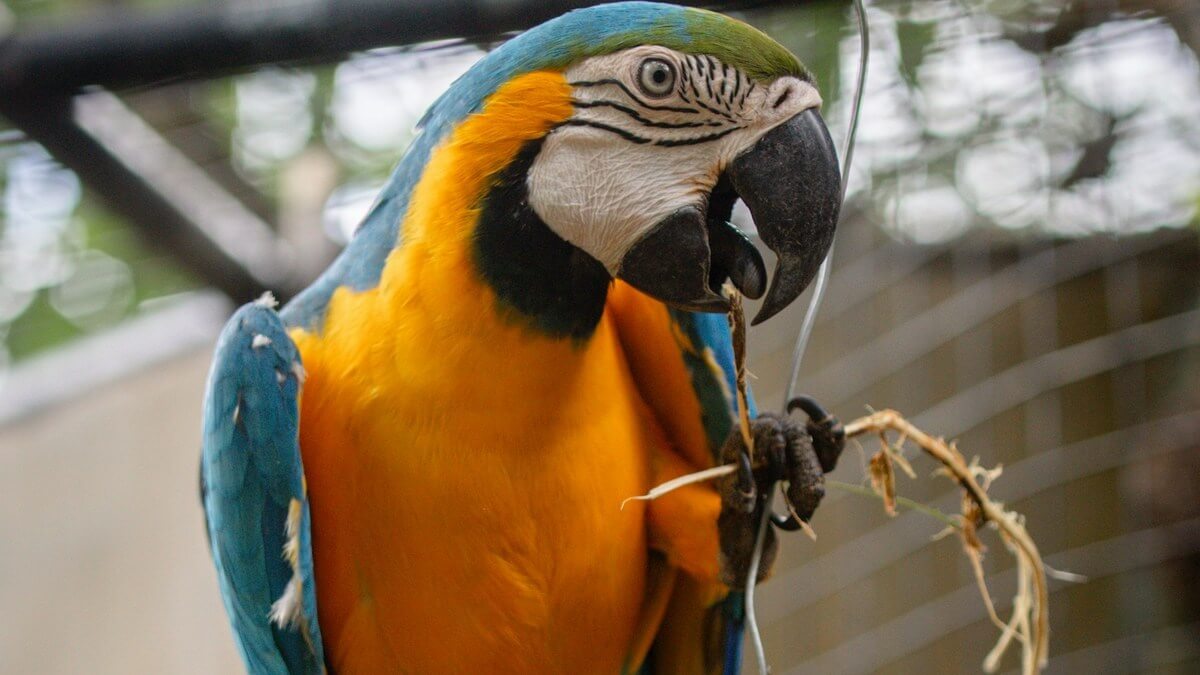
The Blue and Gold Macaw, known scientifically as Ara ararauna and also called the Blue-and-Yellow Macaw, is a large Neotropical parrot with blue upperparts, a golden-yellow chest, a green forehead, and a bare white face marked with fine black feather lines.
The species comes from the lowland forests and palm swamps of Central and South America, from Panama down through Brazil, Bolivia, and Paraguay. In the wild they nest in dead Mauritia palms, which matters more than it sounds, because a bird evolved to excavate and chew palm wood is going to do something similar to your kitchen cabinets.
They are among the largest parrots kept as pets, with a wingspan of 41 to 45 inches. A relaxed adult on your forearm is a genuine weight, and that beak generates enough force to crack Brazil nuts without effort. Nobody who has held one thinks of them as decorative.
The species is listed under CITES Appendix II, which regulates international trade while still allowing legal sale of captive-bred birds with proper documentation. The IUCN currently lists it as Least Concern, though wild populations are declining with habitat loss, and paperwork still matters when you buy.
Temperament, honestly
Blue and Golds have a reputation as the friendliest of the large macaws, and it is mostly deserved. Compared to Scarlets, which can be moody and nippy, a well-socialized Blue and Gold tends to like the whole household rather than fixating on one person. That makes them the standard recommendation for families among the big macaws.
“Mostly deserved” is doing some work in that sentence, though. These birds still go through a period around two to four years old that owners describe as adolescence: more testing, more biting, more opinions. It passes if you handle it consistently. It does not pass if you respond by putting the bird in the cage every time it bites, which teaches it that biting ends interaction.
They are also emotionally readable in a way smaller birds are not. Pinning eyes, flared tail, raised nape feathers, a slight lean away from your hand — a macaw tells you what it is about to do. Owners who get bitten repeatedly are usually owners who have not learned to read the warning.
Housing: Where Most Beginners Get It Wrong
The cage is the single biggest first-year expense, and it is where people cut corners hardest.
Blue and Gold Macaw Cage Size
Width × depth × height. Larger is always better — these are floors, not targets.
| Tier | Dimensions | What it means in practice |
|---|---|---|
| Absolute minimum | 36″ × 48″ × 60″ | The working floor. Enough room to turn, climb, and stretch without hitting the bars. |
| Also cited | 40″ × 30″ × 60″ | Some sources list this instead. Shallower footprint, so it suits narrower rooms. |
| Recommended Best | 48″ × 36″ × 72″ | If you can manage this size, buy it. Fewer behavioural problems, and you will not be replacing it later. |
Why the floor matters: a Blue and Gold will find the weak point in a thin-barred cage and work at it for days. Cage size is the single biggest first-year expense, and it is where people cut corners hardest.
Buy stainless steel or high-quality powder coating. Skip anything zinc-plated or with an unknown coating, because heavy metal toxicity from chewed cage bars is a real avian ER case, not a theoretical one. A good stainless macaw cage runs $800 to $2,000. That number puts people off, so they buy a $300 cage instead and end up replacing it within eighteen months anyway.
Placement
Put the cage where the family actually is: the living room, the family room, wherever the noise and movement happen. A macaw isolated in a spare bedroom will scream, and it will scream because you built the conditions for screaming.
Keep it away from:
- Kitchen airflow. Overheated PTFE nonstick coatings release fumes that kill birds within minutes. This is not an exaggeration and it happens every year. Nonstick pans, self-cleaning oven cycles, some space heaters and hair dryers.
- Direct afternoon sun with no shade option
- Drafty windows and exterior doors
- Aerosols of any kind — air freshener, hairspray, cleaning spray, scented candles, essential oil diffusers
Against a wall or in a corner is better than dead center in a room. Birds rest better with their back covered.
Inside the cage
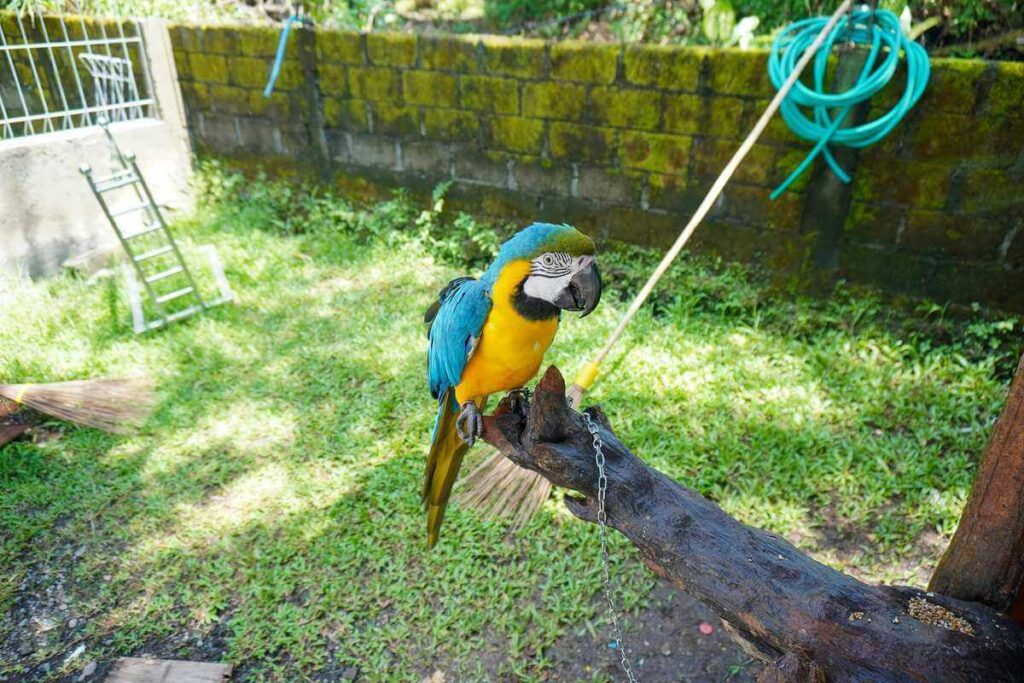
Give the bird natural wood perches in at least three different diameters: manzanita, java wood, or safe untreated branches from apple, willow, or eucalyptus. The dowel perches that come with most cages are all one diameter, which over the years produces pressure sores on the feet. Replace them.
A macaw destroys toys, and that is exactly what toys are for. Budget for chewable wood, leather, and cardboard being consumed and replaced monthly, plus foraging toys that make the bird work for its food. Rotate three or four toys in and out so the cage does not become boring furniture. <!– IMAGE 2 HERE –>
What Blue and Gold Macaws Eat
In the wild, Blue and Gold Macaws eat seeds, nuts, fruit, and clay from riverbank licks. That diet is high in fat, which works fine for a bird flying miles a day through the canopy. It does not work for a bird sitting on a perch in Ohio.
The working ratio
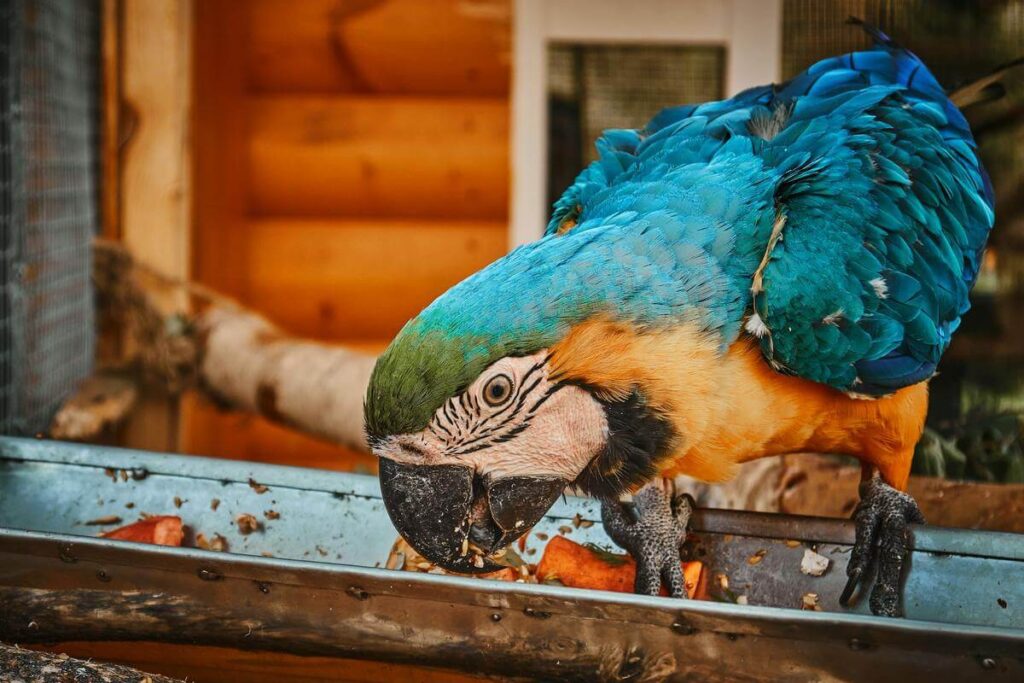
Pellets: 60–75% of daily intake. A quality formulated pellet sized for large parrots. This is the base and it is non-negotiable. All-seed diets produce vitamin A deficiency, obesity, and fatty liver disease, and they are still one of the most common causes of preventable illness in pet macaws.
Fresh vegetables: 20–30%. Dark leafy greens, carrot, bell pepper, sweet potato, squash, broccoli, peas, and green beans. Chop them, offer them fresh each day, and remove leftovers after a few hours in warm weather.
Fruit: 5–10%, moderation. Apple (no seeds), berries, mango, papaya, melon. Fruit is sugar. Treat it that way.
Nuts: as training rewards, not meals. Almonds, walnuts, a Brazil nut occasionally. Macadamias are extremely high in fat. Nuts are the most effective training currency you have, so spending them on free feeding is a waste.
Change the water daily, or twice daily if the bird dunks food in it. They usually do.
Toxic — never feed
Avocado, chocolate, caffeine, alcohol, onion, garlic, apple seeds and stone fruit pits, anything heavily salted, and xylitol.
Avocado and chocolate are the ones that come up most often in emergency calls.
Practical feeding notes
Serve the fresh food in the morning, when the bird’s appetite is highest. Most macaws eat their best meal within an hour of waking. Foraging toys stuffed with pellets stretch out the eating process, which is closer to how they spend their time in the wild and cuts down on boredom screaming.
Weigh your bird weekly on a gram scale. A 1,050-gram macaw that drops to 980 grams over a month has a problem you cannot see by looking at it. Birds hide illness, since it is a prey species reflex, and a weight log is often the only early warning you get.
Noise: Read This Section Twice
A Blue and Gold Macaw scream measures roughly 100 to 106 decibels, which is about the level of a chainsaw. Recorded hyacinth macaw alarm calls have hit 106 dB, and a scarlet macaw was measured at 102 dB from fifteen feet away.
Blue and Golds are on the more moderate end for macaws. “More moderate” still means chainsaw.
Here is the part that matters: healthy, well-adjusted macaws vocalize loudly at dawn and again around dusk. That is flock-calling behavior and it is normal. You cannot train it out, and you should not try. What you can prevent is the other kind of screaming — the constant, attention-seeking, all-day screaming that comes from boredom, loneliness, and inconsistent handling.
Apartments are usually a no. Sound testing has shown interior levels of 100–104 dB dropping to around 75 dB immediately outside a closed door, and 75 dB carries through shared walls. Check your lease. Talk to your neighbors before the bird arrives, not after the first complaint.
If your household includes someone who works night shifts, someone with noise sensitivity, or an infant, think carefully. This is the single most common reason Blue and Golds end up in rescue.
Talking and Intelligence
Blue and Gold Macaws are strong talkers, though not African Grey strong. Greys have better contextual use and clearer diction. Still, a Blue and Gold will typically build a vocabulary of 20 to 50 words and phrases, plus household sounds: the microwave, the doorbell, your laugh, your ringtone, the dog.
Their voice is loud and slightly gravelly, which some people love and others find grating.
Getting a bird to talk
Say the word every time the associated thing happens. “Good morning” when you uncover the cage. “Grape” when you hand over a grape. Consistency and context, repeated for weeks. Recordings on loop do not work well; birds learn from live social interaction, not audio wallpaper.
Some Blue and Golds never talk much. That comes down to individual variation, not to your effort or the bird’s intelligence.
If you want to hear what a talking macaw actually sounds like before you commit to one, we post funny talking clips of our birds on Instagram, TikTok, and YouTube. They are worth a watch for entertainment alone. They are also useful: a macaw voice at full volume on your phone speaker is one thing, and the same voice at 7 AM in your living room is another, but the clips will at least tell you what you are signing up for.
Training basics
Target training, which means teaching the bird to touch a stick with its beak on cue, is where everyone should start. It builds the reward loop, gets the bird moving deliberately, and gives you a way to direct it without using your hands. From there: step up, step down, recall, and stationing.
Keep sessions to five or ten minutes, twice a day, with a nut as payment. Never train a bird that has just eaten a full meal; it will not care about your almond.
Never punish. A macaw that learns to associate your hand with an unpleasant outcome becomes a macaw that bites your hand. Everything runs on positive reinforcement and on ending the session before the bird gets frustrated.
Health: What Actually Goes Wrong
Find an avian vet before you get the bird. You want a certified avian veterinarian, not a general small-animal practice that sees birds occasionally. Establish care with a wellness exam within the first two weeks, and budget $200 to $400 for that first workup, including a fecal test and bloodwork.
The big ones
Proventricular Dilatation Disease (PDD). This is the one macaw owners fear. It was originally called Macaw Wasting Disease because it was first identified in macaws imported to the US and Germany in the late 1970s. It is caused by avian bornavirus, and it is a progressive neurologic disease that becomes fatal once clinical signs develop. Signs include chronic weight loss, often after an initial increase in appetite, regurgitation, and passage of undigested food — whole seeds showing up in droppings is the classic tell. Some birds show neurologic signs instead: tremors, ataxia, difficulty perching, seizures. Median age of onset is around three to four years. There is no cure, and this is a strong argument for buying only from breeders who test their flock.
Psittacosis (parrot fever). A bacterial infection caused by Chlamydia psittaci. Signs are puffy or swollen eyes, lethargy, appetite loss, and weight loss. It responds to doxycycline. It is also zoonotic, meaning humans can catch it, which is why vets treat it seriously.
Feather destructive behavior. Plucking is rarely one thing. It can be nutritional deficiency, skin disease, a systemic illness, boredom, anxiety, or a habit that outlasted its original cause. A bird that starts plucking needs a full medical workup before anyone assumes the cause is behavioral. Once the habit is chronic, the feather follicles may be permanently damaged.
Hypovitaminosis A. Almost entirely a seed-diet disease. Produces respiratory infections, poor feather quality, and mouth lesions. Preventable with pellets and vegetables.
Aspergillosis. A fungal respiratory infection, more common in birds housed in damp or poorly ventilated conditions.
Warning signs — call the vet today
Fluffed and sitting on the cage floor. Tail bobbing with each breath. Any discharge from nostrils or eyes. A change in dropping color or consistency lasting more than a day. Sudden weight loss. Loss of appetite for more than 24 hours. Sitting with both feet on the perch and eyes closed during active hours.
Birds mask symptoms until they cannot. By the time a macaw looks sick, it has usually been sick for a while.
For more on avian bornavirus and PDD specifically, the Merck Veterinary Manual’s section on viral diseases of pet birds is the most reliable free reference available.
What It Costs
Buying the bird
Prices in 2026 vary more than most people expect, mainly by source.
| Source | Typical range |
|---|---|
| Rescue or adoption | $400–$1,500 |
| Rehomed adult, private sale | $1,500–$3,000 |
| Hand-fed baby, reputable breeder | $2,500–$6,500 |
Prices have risen since 2024, driven by demand for birds from breeders who do early socialization work with their chicks. A listing under $1,500 for a hand-fed baby is worth investigating carefully, since unusually low prices often signal poor socialization, missing paperwork, or unethical sourcing.
Rescue is worth serious consideration. A five-year-old Blue and Gold at a rescue is past the baby stage, often already talking, and costs a fraction of what a breeder bird does. The trade-off is that you may inherit a behavioral history you did not create.
First-year setup
| Item | Cost |
|---|---|
| Cage | $800–$2,000 |
| Play stand | $150–$400 |
| Perches and toys, initial | $200–$400 |
| First vet exam and bloodwork | $200–$400 |
| Carrier | $100–$250 |
| Food, first year | $600–$1,200 |
| Total setup | $2,050–$4,650 beyond the bird |
Ongoing
Monthly running costs land between $150 and $350 for pellets, fresh produce, nuts, and replacement toys. The annual vet exam adds $150 to $300. Set up an emergency fund as well, because avian medicine is not cheap and a single hospitalization can run over $1,000.
Then there is the part nobody prices out: fifty years of it. If you buy a baby macaw at thirty, you are financially responsible for this animal into your eighties. Serious owners name a caretaker in their will and set aside money for the bird. That sounds dramatic until you meet a 45-year-old macaw in a rescue because its owner died and nobody in the family wanted it.
Is a Blue and Gold Macaw Right for You?
Honest answers, not sales answers.
A Blue and Gold probably works if: you own your home or have a very permissive lease, someone is home most of the day, you have at least $4,000 available for year one, you are not noise-sensitive, and you have thought concretely about who takes the bird if something happens to you.
A Blue and Gold probably does not work if: you live in an apartment with shared walls, you travel frequently for work, you have very young children, this would be your first bird of any kind, or you are drawn primarily to how they look.
That last one deserves emphasis. The most common failure is buying the bird for its appearance and discovering that it is a loud, demanding, destructive, forty-year toddler with a bolt cutter for a face.
Better starter options
If the commitment is too much right now, that is a completely reasonable conclusion, and there are smaller parrots with similar intelligence and much less noise.
Our African Grey Parrot care guide covers a species with arguably better talking ability and a smaller footprint, though with its own sensitivity to change.
If it is the affectionate, cuddly temperament you are after more than the size, the Umbrella Cockatoo care guide for beginners is worth reading, with the honest caveat that cockatoos come with their own demanding reputation.
Your First 30 Days
Days 1–3. Do almost nothing. Set the cage up before the bird arrives, put the bird in it, and let it watch you. Talk normally, move normally, do not reach in beyond food and water. New macaws are often quiet for the first few days and then get loud once they feel settled. Quiet does not mean happy.
Days 4–10. Sit near the cage and read out loud, or work on a laptop nearby. Offer a nut through the bars. Do not force handling. If the bird takes food from your fingers, that is real progress.
Days 11–20. Start step-up work if the bird is a hand-raised baby, or target training if it is a rehome with unknown history. Short sessions. End on a success. Open the cage door and let the bird come out on its own rather than reaching in and hauling it out.
Days 21–30. Establish the routine you intend to keep for the next several decades: consistent uncover time, consistent bedtime, consistent feeding schedule, consistent out-of-cage hours. Macaws thrive on predictability and 10 to 12 hours of dark, quiet sleep per night. Erratic schedules produce anxious, screamy birds.
Three more things to do in that first month: book the avian vet appointment, buy a gram scale, and start the weight log.
Frequently asked questions
Tap any question to open the answer.
How long do Blue and Gold Macaws live?
Blue and Gold Macaws typically live 40 to 60 years in captivity with good care, and well-documented cases pass 70. Wild lifespans are shorter due to predation and habitat pressure.
Are Blue and Gold Macaws good pets for beginners?
They are the most beginner-tolerant of the large macaws, but a beginner-friendly large macaw is still a demanding bird. Most avian professionals suggest starting with a smaller parrot first.
Can a Blue and Gold Macaw live in an apartment?
Rarely successfully. Peak vocalizations of 100 to 106 dB carry through shared walls even at reduced levels. Check your lease and be realistic about your neighbors.
How much does a Blue and Gold Macaw cost?
A Blue and Gold Macaw costs between $1,500 and $6,500 depending on the source, plus roughly $2,000 to $4,500 in first-year setup and $150 to $350 per month afterward.
Do Blue and Gold Macaws talk?
Yes. Most Blue and Gold Macaws build a vocabulary of 20 to 50 words and phrases. Clarity varies by individual, and some never talk much regardless of training.
Do they bite?
They can, and that beak is capable of serious injury. Bites usually come from fear, hormonal periods, or ignored body language rather than from aggression as a personality trait. Learn to read the warning signs.
Male or female — which is better?
Behaviorally there is very little difference in this species. They are not visually sexually dimorphic, so DNA sexing is the only reliable method. Choose the individual bird, not the sex.
How much out-of-cage time do they need?
Three to four hours daily, supervised. More is better.
Before You Buy
Ask any breeder or seller for proof of hatch date, DNA sexing results, a recent avian vet health certificate, disease testing that includes bornavirus screening, and a video of the specific bird you are buying. A breeder who will not provide these is telling you something.
Visit in person if at all possible. Watch how the birds are housed, whether the babies are being handled, and whether the seller asks you questions. Good breeders screen their buyers. It is a good sign when someone seems reluctant to sell you a macaw.
And take the time. This bird will be part of your life for longer than most of your other decisions. A few extra weeks of research costs you nothing.
Wild Birds USA — care guides, supplies, and honest advice for parrot owners.
Follow us for funny talking clips, training videos, and the occasional macaw behaving badly: Facebook · Instagram · YouTube · TikTok · Pinterest · X / Twitter