
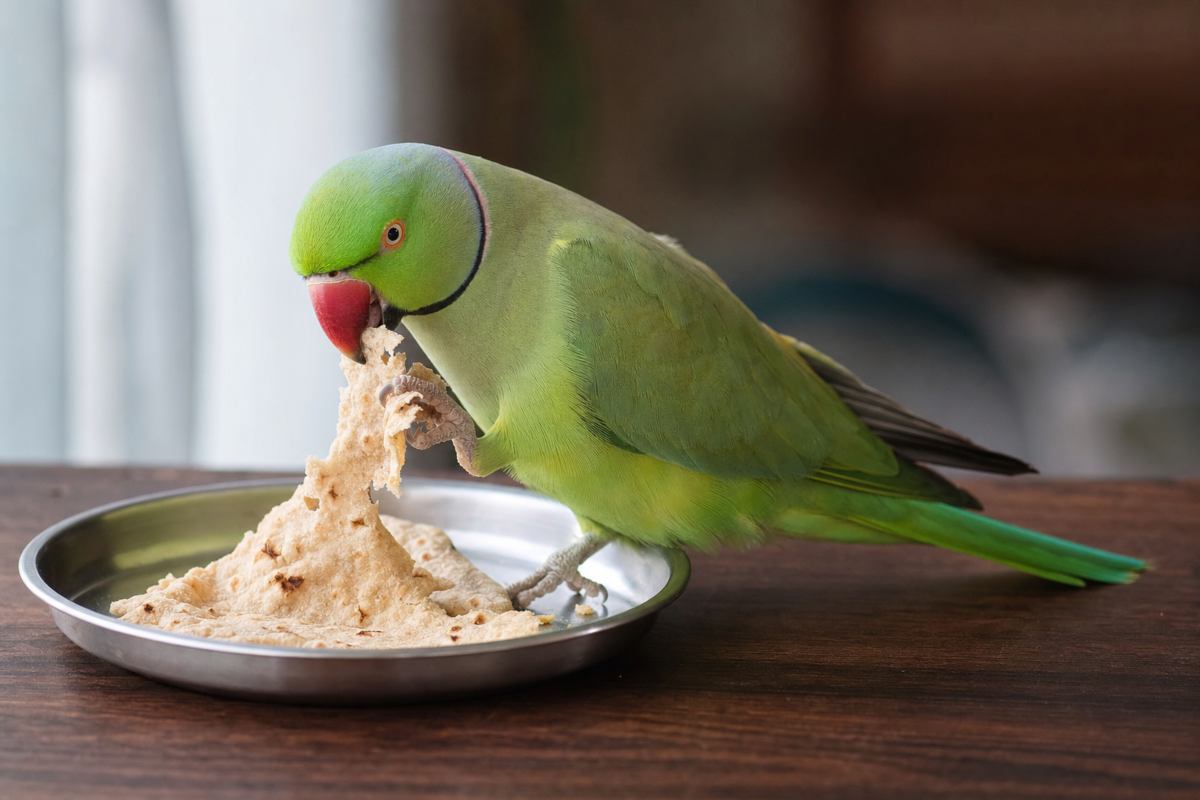
Yes, a small piece of plain roti is safe for a parrot. Made from nothing but flour and water, cooked dry on a hot pan with no oil, it will not harm your bird.
The problem is that almost nobody makes roti that way.
In most kitchens the dough has salt in it. Ghee goes on top the moment it leaves the pan. And the piece handed to the bird has often been softened in tea first.
All three are a problem. One of them is genuinely dangerous.
Search this question in English and you will find articles about sliced white bread, written for a Western kitchen. Almost none of them mention roti at all.
Key facts at a glance
| Question | Answer |
|---|---|
| Can parrots eat plain roti? | Yes, a small piece once a week |
| Is roti good for parrots? | No. It is filler, not food |
| Roti with ghee or butter? | No |
| Roti softened in tea? | Never. Tea contains caffeine, which is toxic to birds |
| Roti softened in milk? | No. Birds cannot digest lactose |
| Salted dough? | Avoid. Most household dough has salt in it |
| Which flour is best? | Bajra, jowar or ragi. Not maida |
| Naan, paratha, puri? | No to all three |
| How much? | A fingernail for a budgie, half a roti for a macaw. Once a week |
| Better alternative | Cooked millet, cooked rice, or a vegetable |
Can parrots eat roti?
Yes. Plain roti made from atta and water, cooked without oil, is not toxic to a parrot. Torn small and sized to the bird, once a week does no harm. Portions by species are set out further down.
Whether it is worth giving is a different question. Roti is starch. A small bird fills up on it fast and gets very little back: no vitamin A, barely any calcium, and not much protein. Vitamin A deficiency is the most common nutritional problem avian vets see in pet parrots, and roti does nothing to help with it.
So roti sits in the same category as sliced bread. Not poison, not useful, and easy to overdo because birds like it and it is always on the table.
Our full guide to what parrots eat sets out where a treat like this fits against pellets, vegetables and fruit.
What makes a household roti unsafe?
A plain roti and a household roti are two different foods, and this is where the real answer sits.
| What gets added | Why it matters for a bird |
|---|---|
| Salt in the dough | Almost every household adds it. A bird’s kidneys cannot handle a sodium load the way ours can |
| Ghee or butter on top | Standard practice the moment it leaves the pan. Fat a parrot does not need, and a known cause of liver disease |
| Oil brushed on while cooking | Same problem, and it makes the roti heavier than it looks |
| Tea, used to soften it | Caffeine. See the next section, because this one is serious |
| Milk, used to soften it | Birds have no lactase. Milk causes digestive upset |
| Ajwain, jeera, chili in the dough | Unnecessary at best, an irritant at worst |
| Leftover roti from a shared plate | Assume salt, ghee and spice unless you made it yourself |
To give your bird roti safely, the piece has to come off before the ghee goes on and before anyone salts anything. In practice that means making one small plain one, or taking the bird’s piece straight off the pan.
Can you soften roti in tea for a bird?
No. This is the one genuine danger on this page, and it is an everyday habit rather than a theoretical risk.
Dipping roti in chai to soften it is completely normal in a South Asian home. It is also how a great deal of leftover roti reaches birds and animals.

Tea contains caffeine, and caffeine is toxic to parrots.
Caffeine belongs to a group of chemicals called methylxanthines. Birds lack the liver enzymes to break them down efficiently, so the compound builds up instead of clearing.
The Veterinary Center for Birds and Exotics lists caffeine among the ten everyday items most toxic to birds. Even a few sips of tea or coffee can be extremely hazardous, and the effects include raised heart rate, arrhythmias, hyperactivity and cardiac arrest.
The same chemical family is what makes chocolate dangerous to birds. Theobromine and caffeine sit side by side in that group.
Size is what makes this serious. The same cup of tea that does nothing to you carries a meaningful dose for a thirty gram bird. A roti soaked in chai delivers that dose inside a piece of food that looks completely harmless.
If the roti has touched tea, it does not go to the bird. Milk-soaked roti is a smaller problem but still one, because birds produce no lactase and cannot digest lactose.
To soften roti for a bird, use plain warm water. Nothing else.
Which flour makes the best roti for a parrot?
Roti is not one food. It depends entirely on which flour went into it, and some of those flours sit far closer to a bird’s natural diet than others.
This is the part that gets missed everywhere else, because these flours are not in a Western kitchen at all.
| Flour | What it is | Verdict for a parrot |
|---|---|---|
| Bajra | Pearl millet | Best of the group. Pearl millet is already an ingredient in birdseed |
| Jowar | Sorghum | Also good. Sorghum is in commercial birdseed too |
| Ragi | Finger millet | Good, and high in calcium compared with wheat |
| Makki | Corn | Acceptable. Plain, no butter |
| Atta | Wholewheat | Fine in small amounts. The everyday default |
| Missi | Wheat with gram flour | Fine if unspiced, but missi roti is almost always spiced |
| Maida | Refined white flour | The weakest option. Nothing left in it |
Bajra and jowar are the interesting ones here. Both grains already sit in commercial birdseed, which means a plain bajra roti is really just cooked millet in a different shape.

That does not turn it into a health food. Bajra roti is still cooked starch, and it still lacks vitamin A and calcium. But if you are going to give your bird a piece of roti anyway, a plain bajra or jowar one is a better piece than a maida one.
There is a simpler version of the same idea. If millet is what makes bajra roti worth anything, feed the millet and skip the roti.
Plain cooked millet, cooked rice, quinoa and lentils all do the job better, and they mix into a vegetable chop in a way roti does not. So does a spoon of chopped carrot or broccoli, both of which carry the vitamin A that roti has none of.
Which flatbreads are safe and which are not?
Two of these are acceptable in small amounts. The rest are not.
| Flatbread | What is in it | Verdict |
|---|---|---|
| Plain roti or chapati | Atta, water | Small piece, once a week |
| Bajra or jowar roti | Millet flour, water | The best of them, still a treat |
| Tandoori roti | Atta, often salt, sometimes milk | Avoid. Usually salted |
| Rumali roti | Maida, often milk | Avoid |
| Naan | Maida, yogurt or milk, sugar, often egg, ghee on top | No |
| Paratha | Atta layered with ghee, then fried in more of it | No |
| Aloo or gobi paratha | The above, plus salt and spice | No |
| Puri | Deep fried in oil | No |
| Bhatura | Deep fried, fermented with yogurt | No |
| Roti torn from a plate of sabzi or daal | Salt, oil, onion, garlic, chili | No. Onion and garlic damage red blood cells in birds |
Naan deserves its own line because people assume it is just a softer roti. It is not. Naan usually contains milk or yogurt, sugar, and often egg, and it gets brushed with ghee before it reaches the table.
How much roti can a parrot eat?
Very little, and rarely. Roti has no place in a daily routine.
| Bird | Typical weight | Piece of plain roti | How often |
|---|---|---|---|
| Budgie, parrotlet | 25 to 45 g | A crumb the size of a fingernail | Once a week at most |
| Cockatiel, lovebird | 80 to 110 g | A piece the size of a thumbnail | Once a week |
| Conure, caique | 60 to 170 g | A piece the size of two thumbnails, torn small | Once a week |
| African Grey, Amazon | 400 to 550 g | A quarter of a roti, torn into pieces | Once a week |
| Cockatoo, macaw | 550 g and up | Half a roti, torn into pieces | Once a week |
Look at the frequency column rather than the size column. Vegetables and fruit belong in a bird’s week two or three times over. Roti belongs once, at most.
That gap is the whole point. Vegetables earn their place in the bowl. Roti is taking up room that something better could fill.
How do you prepare roti for a parrot?
- Make one small plain roti for the bird, or tear its piece off before anyone adds anything.
- No salt in the dough. No ghee, no butter, no oil on the pan or on top.
- Let it cool completely.
- Tear it into small pieces. Do not hand your bird a folded piece to work at, because it will simply eat more.
- If it needs softening, use plain warm water. Never tea, never milk.
- Serve a measured amount in a shallow dish, not from your plate.
- Remove leftovers within two hours. Damp roti grows mold quickly in a warm room.
That last step matters more in a hot climate than it might sound. A piece of damp roti left in a cage through a Karachi or Lahore afternoon is growing something by evening.
Can budgies and parakeets eat roti?
Yes, but the portion is genuinely tiny. A budgie weighs about thirty grams, so a crumb the size of your fingernail is already a real serving for it.
- A fingernail-sized crumb, once a week at most
- Tear it small enough for the bird to pick up whole
- Plain only. A budgie has even less margin for salt than a larger bird
- Skip it entirely if the budgie is overweight
Rose-ringed parakeets are the birds most likely to be involved in this question. They are the common pet parrot across Pakistan and India, and they also live wild in every major city there.
Both the caged ones and the ones on your roof will take roti happily. Neither of them needs it.
Should you feed roti to wild birds?
Crows, mynas, sparrows and wild parakeets will all eat roti scraps, and in most South Asian cities somebody leaves them out daily.
Roti will not poison them. The objection is the same one that applies to pet birds. It fills them without feeding them, and it pushes out better food. Wild birds also face a risk that caged ones do not, because leftover roti attracts rats and grows mold in the sun.
Plain uncooked millet, cracked wheat or sunflower seed does far more good than the same weight of roti. Put out a shallow dish of clean water alongside it, which in a hot climate matters more than the food.
When should you skip roti entirely?
- Overweight birds. Roti is dense starch and nothing else
- Birds that refuse pellets or vegetables. Roti is soft and easy, exactly what a fussy bird will hold out for
- Chicks still being hand-fed. Hand-rearing formula only until they are weaned
- Any bird with liver disease. Ask your avian vet before adding starch
- Any roti you did not cook yourself. Assume salt and ghee
- Any roti that has touched tea, milk, sabzi or daal
Frequently asked questions
Can parrots eat roti?
Yes, a small piece of plain roti made from flour and water with no salt, ghee or oil. It is not toxic, but it is starch with very little nutrition. Keep it to once a week, sized to your bird, and think of it as a treat rather than as food.
Can parrots eat chapati?
Yes. Roti and chapati are two words for the same bread, so the answer is identical. Plain, unsalted, no ghee, torn small, once a week.
Can parrots eat roti with ghee?
No. Ghee adds fat a parrot does not need, and excess dietary fat is a known cause of fatty liver disease in caged birds. Take the bird’s piece straight off the pan, before anyone reaches for the ghee.
Can I soak roti in tea for my bird?
No. This is the single most important answer here. Tea contains caffeine, which belongs to the same chemical family as the theobromine in chocolate. Birds cannot break these compounds down efficiently, and avian vets list caffeine among the most dangerous everyday substances for birds. Use plain warm water to soften roti instead.
Can parrots eat roti with milk?
No. Birds produce no lactase and cannot digest lactose, so milk causes digestive upset. Warm water works just as well for softening.
Which roti is best for parrots?
A plain bajra or jowar roti. Both grains already appear in commercial birdseed, which puts a millet roti closer to a bird’s natural food than a wheat one. Plain atta roti is fine too. Maida is the weakest option.
Can parrots eat naan?
No. Naan is usually made with maida and contains milk or yogurt, sugar, and often egg, then gets brushed with ghee. Every one of those is a reason to keep it away from a bird.
Can parrots eat paratha or puri?
No to both. Paratha is layered with ghee and cooked in more of it. Puri is deep fried. Fried food has no place in a parrot’s diet at all.
Can budgies eat roti?
Yes, a crumb the size of a fingernail, once a week at most. A budgie weighs around thirty grams, so what looks like a scrap to you is a real portion to the bird. Plain only, and skip it if the budgie is overweight.
Is roti better than bread for parrots?
Slightly, if it is plain and made from wholewheat or millet flour, because it has no added sugar, no preservatives and usually less salt than sliced bread. Both are still starch, and neither belongs in a daily diet.
Can I feed roti to wild birds?
You can, and it will not poison them, but plain millet, cracked wheat or sunflower seed does far more good. Leftover roti attracts rats and grows mold in the heat. Clean water alongside matters more than the food does.
What should I give instead of roti?
Plain cooked millet, cooked brown rice, quinoa or lentils, all served without salt or oil. Better still, a chopped vegetable. Cooked sweet potato, carrot or dark leafy greens supply the vitamin A and calcium that roti does not.
If you are unsure what suits your own bird, an avian vet can weigh it and work out portions from its actual condition. That beats any chart, including this one.
The short version
Plain roti is safe. A small piece, sized to your bird, once a week, will not hurt it.
Three things are worth carrying away.
The roti is rarely the problem. Salt in the dough, ghee on top and oil in the pan are what make a normal household roti unsuitable. Tear the bird’s piece off before any of that happens.
Never use tea to soften it. Caffeine is toxic to birds, and chai-soaked roti is one of the most common ways it reaches them. Plain warm water does the same job.
If you are giving roti anyway, make it bajra or jowar. Pearl millet and sorghum are already in birdseed, which puts a millet roti closer to real bird food than a wheat one. Better still, skip the roti and give the millet.
Sources and notes
- Caffeine among the most dangerous everyday substances for pet birds, with effects including raised heart rate, arrhythmias and cardiac arrest: Veterinary Center for Birds and Exotics, 10 Everyday Items That Are Toxic to Birds, linked above
- Methylxanthine toxicity in birds, covering both caffeine and theobromine: published avian toxicology reviews
- Pearl millet and sorghum as standard commercial birdseed ingredients: avian nutrition references
- Nutrient composition of wheat, pearl millet, sorghum and finger millet flours: USDA FoodData Central and Indian Food Composition Tables
- Diet proportions for pet parrots: Veterinary Partner (VIN), Diets for Healthy Parrots
This article is for general information and does not replace veterinary advice. If your bird has swallowed tea, coffee or anything containing caffeine, contact an avian veterinarian straight away rather than waiting for symptoms.