

Search for a blue and gold macaw price and you will get two different answers. Most guides say $1,200 to $3,000. Most breeders with birds for sale right now are asking $4,600 to $7,500. Both cannot be right.
This guide sorts out which one to trust. The numbers below come from breeder listings that were live in August 2026, adoption fees published by four named parrot rescues, and a real avian clinic price list. Nothing here is copied from an older article.
How much does a blue and gold macaw cost in 2026?
A blue and gold macaw costs $400 to $7,500 in the United States in 2026. Where the bird comes from matters more than anything else. A baby from a breeder costs $4,600 to $7,500. An adult from a parrot rescue costs $400 to $800.
The bird is only your first payment. A cage and the rest of the setup adds $1,800 to $4,700 before the macaw comes home.
That is a very wide range for a pet, which is why the published figures disagree so much. Here are the two ends of the market as of August 2026.
| Where you get the bird | Typical price | What you get |
|---|---|---|
| Rescue or sanctuary | $400 to $800 | Adult bird, health checked, often with a cage |
| Private rehome | $800 to $2,000 | Adult bird, often with the full setup |
| Breeder, weaned baby | $4,600 to $7,500 | Hand raised, sex tested, disease tested |
| Breeder, unweaned baby | $4,000 to $5,000 | You finish the hand feeding yourself |
A weaned bird is one that has learned to eat on its own. An unweaned bird still needs to be fed by hand several times a day, which is why it costs less. More on why that discount is a trap further down.
Why do published price guides disagree so much?
Most blue and gold macaw price guides are quoting figures that were accurate years ago and have never been rechecked. As a rule, the lower the price a guide gives, the older its information is.
Here is what the main published sources say, and when each one was written.
| Source | Published | Price it gives |
|---|---|---|
| A-Z Animals | 2024 | $700 to $2,500 |
| Parrot Care Central | March 2026 | $1,200 to $3,000 |
| SpectrumCare | March 2026 | $1,300 to $5,500 |
| Earth of Birds | June 2026 | $1,500 to $3,000 |
| Mo’s Birds | August 2026 | $2,750 to $4,500 |
Now compare that with what birds were actually selling for. On BirdBreeders.com, a national marketplace where breeders list individual birds, hand raised babies were priced at $4,600, $4,999, $6,500, $6,500 and $7,500 when we checked in August 2026. ParrotCrown listed birds at $6,000.
Not one guide in the table above even reaches the middle of that range. If you budget $2,000 based on a search result, you will not be able to buy a baby blue and gold macaw from a good breeder in 2026.
Three things pushed prices up. Many large parrot breeders retired over the last fifteen years and nobody replaced them. Hand raising a macaw until it can eat on its own takes four to five months of daily work, and that work costs more now than it used to. And demand for large parrots jumped during the pandemic years and never fully came back down.
What are breeders actually charging right now?
Breeders are charging $4,600 to $7,500 for a weaned blue and gold macaw baby in 2026. That price normally includes hand raising, a DNA sex test, and disease testing. Unweaned babies sold to experienced hand feeders cost less, around $4,000 to $5,000, because the buyer takes on the remaining work and the risk.
Here is what moves the price within that range.
| Factor | Effect on price |
|---|---|
| Weaned instead of unweaned | Adds $1,000 to $2,000 |
| DNA sex test and disease panel | Adds $150 to $400 |
| Leg band and hatch paperwork | Usually included by good breeders |
| Age | Babies cost the most, adults the least |
| Where you live | Cities and coastal states run higher |
| Shipping | Adds $400 to $700 |
Mo’s Birds, which sells birds rather than only writing about them, gives a 2026 starting price of $2,749 and a normal range of $2,750 to $4,500. That is the lowest believable breeder figure we found, and it is the floor of the market rather than the average.
Give shipping its own line in your budget. Buying from another state adds $400 to $700 for live animal air cargo, and that is on top of the bird.
How much does it cost to adopt a blue and gold macaw from a rescue?
Adopting a blue and gold macaw from a parrot rescue costs $400 to $800 in most of the United States. That is roughly one eighth of what a breeder charges. Several rescues publish their fees openly, which makes these the most reliable adoption numbers available.
| Rescue organization | Fee for a blue and gold macaw | Notes |
|---|---|---|
| Companion Parrots Re-homed | $400 | Same fee for all large macaws |
| Florida Parrot Rescue | $650 | Cage included if the bird came with one |
| Heart and Soul Parrot Rescue | $800 | Same fee for scarlet and green wing |
| Rhode Island Parrot Rescue | $700 to $900 | Depends on the macaw species |
Every one of these groups has its birds seen by a vet before adoption. Florida Parrot Rescue states that each bird gets a full well bird check with an avian veterinarian, and that the adoption fee rarely covers what that costs them.
Several popular cost guides put macaw adoption at $100 to $500. Against four published fee schedules, that is too low, and planning around it will leave you short.
There is a real tradeoff here, and it is worth saying plainly. A rescue macaw is usually an adult with a history. It may scream at certain times of day, may distrust certain people, or may already pluck its own feathers. A baby from a breeder arrives without those habits, and that is a large part of what the extra money buys. Which one suits you depends on your experience, not your budget.
What does the cage and setup cost?
The cage and setup for a blue and gold macaw costs $1,800 to $4,700 before the bird arrives. The cage alone is the biggest single item, and it is the cost most first time buyers forget to plan for.

| Item | Cost |
|---|---|
| Macaw cage, stainless steel or heavy powder coated | $1,200 to $3,000 |
| Play stand or java tree | $150 to $500 |
| Perches in different widths and materials | $80 to $200 |
| Stainless steel food and water bowls | $40 to $80 |
| First month of toys | $100 to $250 |
| Travel carrier | $120 to $250 |
| First avian vet visit | $115 to $450 |
A blue and gold macaw needs a cage of at least 48 by 36 by 60 inches, with gaps between the bars no wider than one inch. Bigger is better. A grown blue and gold can destroy a painted or lightly built cage with its beak, which is why stainless steel and heavy powder coated cages cost what they do. Our guide to macaw cage size covers the measurements and bar spacing in detail.
Buying a used cage is the one place you can safely save a few hundred dollars, as long as it is the right size, made of bird safe material, and in genuinely good condition.
What does a blue and gold macaw cost every year?
Keeping a blue and gold macaw costs $2,000 to $4,200 a year, which works out to $180 to $350 a month. Toys and vet care are the two lines people underestimate most.
| Yearly expense | Cost |
|---|---|
| Pellets and seed mix | $400 to $700 |
| Fresh fruit and vegetables | $600 to $1,100 |
| Nuts and treats | $200 to $400 |
| Toys and things to chew apart | $600 to $1,200 |
| Yearly avian vet checkup | $115 to $450 |
| Replacing cage parts and perches | $100 to $300 |
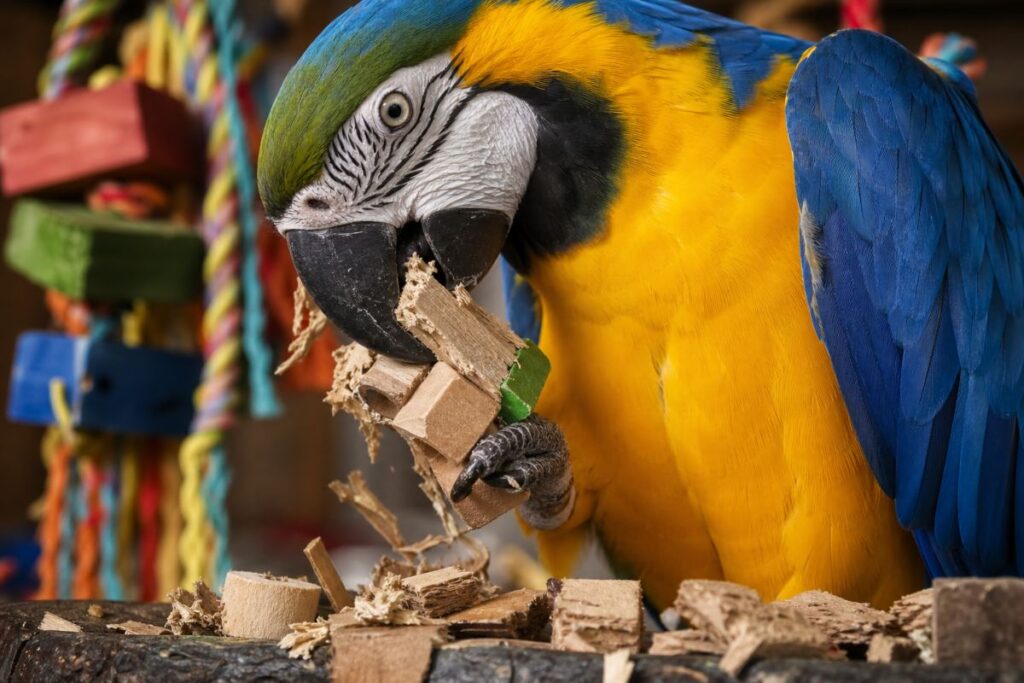
Toys are not optional and they are not a small expense. A blue and gold macaw shreds wood, rope, and cardboard as a normal part of its day. A bird with nothing to destroy will start on its own feathers instead. Budget for destruction as something that happens every month, not now and then.
Food costs less than people expect if you feed correctly, and more if you do not. A diet based on pellets with measured fresh produce works out cheaper over ten years than treating obesity or a vitamin A shortage later on. If you are new to feeding large parrots, our guide to what parrots eat covers the basic ratios, and our article on nuts for parrots explains why nuts are a treat rather than a daily food for a bird this size.
For vet care, a published price list is more useful than a general estimate. Avian and Exotic Vet Care lists a 30 minute wellness exam at $115, a 30 minute medical exam at $135, and a 60 minute behavior consultation at $160. Blood work and fecal testing add another $100 to $300. VCA Animal Hospitals recommends a yearly health exam for macaws and points owners to the Association of Avian Veterinarians directory to find a vet who actually treats birds.
Keep an emergency fund of $1,000 to $5,000 on top of your yearly budget. Bird specialists charge specialist rates, and one serious illness can cost more than a full year of routine care.
What will a blue and gold macaw cost over its whole life?
A blue and gold macaw costs $82,000 to $264,000 over its lifetime. It lives 40 to 60 years, and the yearly cost never stops. Almost no price guide works this out, and it is the number that matters most.
| Scenario | Bird | Setup | Per year | Years | Lifetime total |
|---|---|---|---|---|---|
| Rescue adult, careful spending | $650 | $1,800 | $2,000 | 40 | $82,450 |
| Breeder baby, average spending | $5,500 | $2,800 | $3,000 | 50 | $158,300 |
| Breeder baby, expensive area | $7,500 | $4,700 | $4,200 | 60 | $264,200 |
Some blue and gold macaws have lived 70 to 80 years. If you buy a baby in your thirties, the bird will outlive your working life. Writing down who takes the macaw after you is part of owning one, not something to think about later.
The lifetime number also answers the question of whether the purchase price really matters. The gap between a $650 rescue bird and a $7,500 breeder baby is under five percent of what you will spend on that bird in total. Picking the cheaper bird to save money means focusing on the smallest number on the list.
Why is a cheap blue and gold macaw a warning sign?
A blue and gold macaw advertised for under about $1,500 in 2026 is a warning sign. That price is far below what it costs a real breeder to raise one. Four to five months of daily hand feeding is not work anyone gives away.
While researching this article, one website advertised a hand raised blue and gold macaw at $850 and called the price more competitive than other sellers. On the same page, it said the normal range is $1,000 to $3,000. The listing was undercutting the market it had just described. Meanwhile breeders on a national marketplace were asking $4,600 to $7,500 that same month.
Here is what an unusually low price usually means.
| What you see | What it usually means |
|---|---|
| Price far below everyone else | A scam. There is no bird |
| Payment only by wire, gift card, or crypto | You cannot get your money back |
| Seller will not do a live video call | The photos came from somewhere else |
| No health records or sex test | Untested, unbanded, possibly unweaned |
| Pressure to decide today | Standard scam tactic |
| Bird is free, you only pay shipping | Almost always a scam |
Two rules cover most of it. Never send money before you have seen that specific bird live on video, moving, with the seller in the frame. And never buy a macaw you cannot visit in person unless the seller has a real business address and references you have actually called.
How do you tell a good breeder from a bad one?
A good blue and gold macaw breeder sells only weaned birds to first time buyers, hands over written health records, and asks you as many questions as you ask them. A breeder who does not care where the bird ends up is telling you something about how it was raised.
Ask these before you commit.
| Question | What a good answer sounds like |
|---|---|
| Is the bird fully weaned? | Yes, eating on its own for several weeks |
| Can I see the parent birds? | Yes, in person or on video |
| Is it sex tested and banded? | Yes, with the paperwork to show it |
| What disease testing was done? | Named tests, with results you can see |
| What is it eating right now? | A specific diet you can keep going |
| Would you take the bird back? | Yes, at any point in its life |
| Can my own vet examine it first? | Yes, at your expense |
That last question is the strongest single test. A breeder who refuses to let your own avian vet examine the bird before you pay has a reason, and it is not a good one.
Unweaned babies need a specific warning. Some breeders sell them cheaper because hand feeding is difficult. Get it wrong and the formula goes into the lungs or burns the crop, the pouch in the bird’s throat where food collects. Both can kill the bird. Unless you have hand fed large parrots before, buy a weaned bird and pay the difference.
Is a blue and gold macaw worth the price?
A blue and gold macaw is worth it for an experienced parrot owner who has the space, the daily time, and a fifty year plan. It is a poor choice for anyone who mainly likes how it looks. The money is actually the easiest part to prepare for.
The harder parts do not show up in a budget.
| What people underestimate | The reality |
|---|---|
| Noise | A blue and gold’s call passes 105 decibels up close. Not an apartment bird, and not one for a shared wall |
| Time | Three to four hours of daily attention and time out of the cage. A macaw left alone starts screaming and plucking |
| Space | A 48 by 36 by 60 inch cage plus a play area takes up a serious corner of a room. There is no smaller version |
| Lifespan | 40 to 60 years. You need a plan for the bird if your life changes |
Blue and gold macaws end up in rescue more often than most large parrots. That is exactly why their adoption fees are lower than an African grey’s. It is a fact worth thinking about before you buy a baby. To see what daily life with this species actually looks like, read our blue and gold macaw care guide before you decide.
If the price is the problem, a smaller parrot is a better answer than a cheaper macaw. If you specifically want a macaw, our guide to all macaw species covers the mini macaws, which cost less to buy, less to house, and less to feed while keeping much of the same personality.
Frequently asked questions
How much is a blue and gold macaw in 2026?
Between $400 and $7,500. Rescues charge $400 to $800 for an adult. Breeders charge $4,600 to $7,500 for a weaned baby, with $2,749 being the lowest believable breeder starting price we found.
Why do some websites say $1,200 to $3,000?
Because most price guides quote old figures and never recheck them. Breeder listings that were live in August 2026 ran $4,600 to $7,500, well above what those guides report.
Is it cheaper to adopt a blue and gold macaw?
Yes, much cheaper. Published rescue fees run $400 to $800, and several rescues include the cage. The bird will be an adult with a history rather than a baby.
How much does a blue and gold macaw cost per month?
$180 to $350 a month for food, fresh produce, toys, and a share of the yearly vet bill.
Why are blue and gold macaws so expensive?
Hand raising one takes four to five months of daily feeding, and far fewer large parrot breeders operate now than a decade ago. The price reflects labor and short supply, not rarity. Blue and gold macaws are not a rare species.
What is the cheapest macaw to buy?
The mini macaws, including Hahn’s, severe, and yellow collared macaws. Rhode Island Parrot Rescue lists Hahn’s and severe macaws at $700, and they cost less to house and feed than a blue and gold.
Should I buy an unweaned blue and gold macaw to save money?
No, unless you have hand fed large parrots before. Feeding mistakes can send formula into the lungs or burn the crop, and both can kill the bird.
How much does it cost to ship a blue and gold macaw?
$400 to $700 for live animal air cargo within the United States, separate from the price of the bird.
Prices in this article were checked in August 2026 using live breeder listings, published rescue fee schedules, and published avian clinic pricing. Bird prices change. Check current listings before you set your budget.