
Search for macaw cage size and you get eight different answers on the first page. One site says 36 by 24 by 48 inches. Another says 40 by 30 by 60. A third says 48 by 36 by 72.
Two of them have the width and depth swapped, which tells you nobody checked.
And not one of them explains where the number came from.
That matters. A blue and gold macaw lives 50 to 60 years in captivity, and spends most of that time inside whatever box you buy. This isn’t a small mistake you fix later. These cages cost hundreds of dollars and weigh more than the person assembling them.
So this guide does something different. It starts with the bird’s actual measurements. Then it applies the one real veterinary standard, and shows you what that standard says.
Then it tells you honestly what to do about the answer, because the answer is uncomfortable.
Quick answer
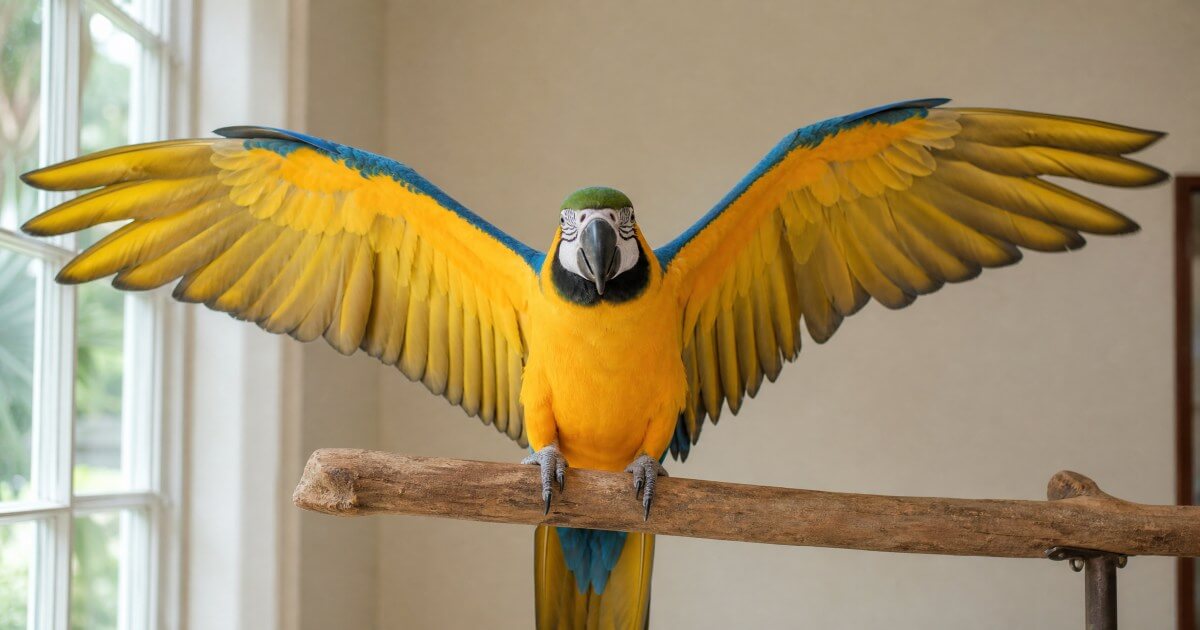
The Merck Veterinary Manual says a cage should be at least one and a half times the bird’s wingspan in every direction. A blue and gold macaw has a 41 to 45 inch wingspan. That puts the veterinary minimum at roughly 62 to 68 inches wide, deep, and tall.
Almost no cage sold as a “macaw cage” meets that mark. The biggest common retail size is around 48 by 36 by 72 inches. It clears the height and falls well short on width and depth.
What to do in practice:
- Buy the biggest cage your room and budget allow
- Treat 40 by 30 by 60 inches as an absolute floor, not a target
- Use 1 to 1.5 inch bar spacing in heavy gauge stainless steel or powder-coated wrought iron
- Give generous daily out-of-cage time. That isn’t a bonus. It’s how you make up the difference
Key facts at a glance
- Blue and gold macaw wingspan: 41 to 45 inches (104 to 114 cm)
- Body length including tail: 34 to 36 inches, and more than half of that is tail
- Weight: roughly 900 to 1,200 grams
- Veterinary standard: cage at least 1.5 times the wingspan in all directions
- What that works out to: about 62 to 68 inches in every dimension
- Typical retail “macaw cage”: 40 by 30 by 60 up to 48 by 36 by 72 inches
- Bar spacing: 1 to 1.5 inches
- Bar gauge: heavy. A macaw bends thin bars rather than squeezing through them
- Out-of-cage time: 3 to 4 supervised hours daily, minimum
- Lifespan: 50 to 60 years in captivity, so buy once and buy properly
How big is a blue and gold macaw?
Most cage recommendations online skip this step. That’s why they all disagree.
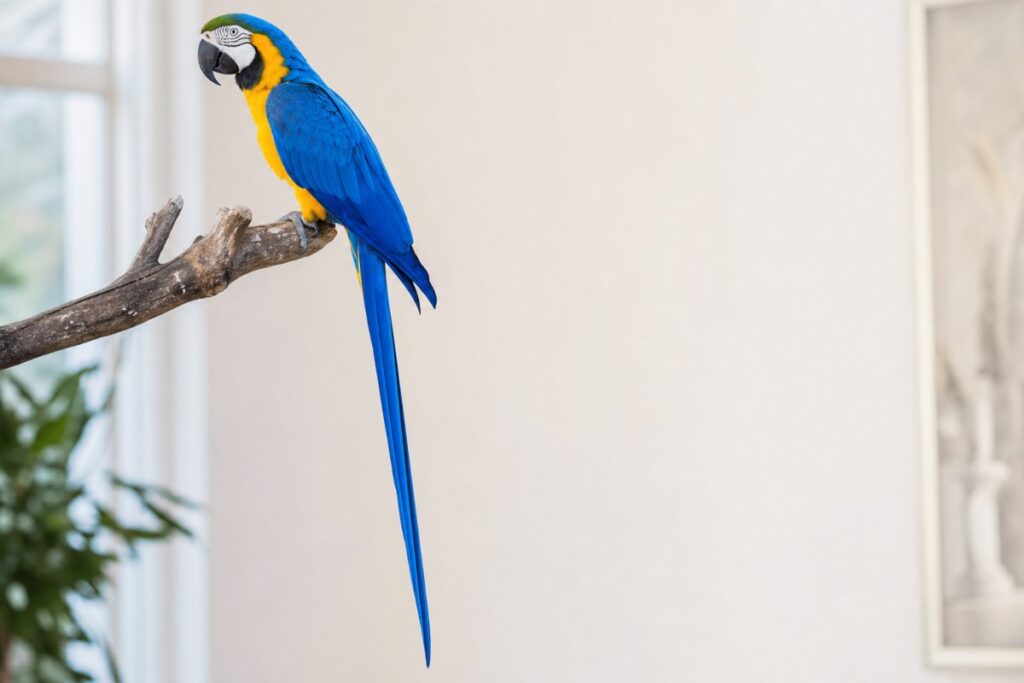
A blue and gold macaw (Ara ararauna) is one of the largest parrots kept as a companion. Adults run 34 to 36 inches from the top of the head to the tip of the tail. The wingspan is 41 to 45 inches. They weigh around 900 to 1,200 grams, roughly two to two and a half pounds.
The number people forget is the tail.
More than half that body length is tail. A blue and gold carries twelve long tail feathers that extend roughly two feet behind it. Those feathers are the first thing a badly sized cage destroys, and the damage is visible from across the room.
Keep three numbers in mind from here on: 45 inches of wing, 36 inches of body, 24 inches of tail. Every decision below comes back to them.
What is the actual veterinary standard for macaw cage size?
Most cage advice online is retail convention. Someone decided years ago what size cage to stock. Everyone copied the dimensions. The numbers became “the minimum.”
There is, however, one real veterinary standard.
The Merck Veterinary Manual guidance on providing a home for a bird states it plainly. The cage should be at least one and a half times the size of the bird’s wingspan in all directions, so the bird has room to stretch.
That page is written by Laurie Hess, DVM, DABVP, and peer reviewed by Joyce Carnevale, DVM, DABVP of Iowa State University. It is a formula, not a product listing.
So let’s run it.
41 inch wingspan × 1.5 = 61.5 inches 45 inch wingspan × 1.5 = 67.5 inches
The veterinary minimum for a blue and gold macaw is therefore around 62 to 68 inches wide, 62 to 68 inches deep, and 62 to 68 inches tall.
In all directions means all directions. Not just height.
The formula works for any macaw
You don’t need a blue and gold to use this. Take your bird’s wingspan, multiply by 1.5, and that is your target in every direction.
That’s why a Hahn’s macaw can live comfortably in a cage that would be cruel for a hyacinth. The species name does not set the requirement. The wingspan does.
If you are still deciding which macaw suits the space you have, our guide to the types of macaws covers the species and how big each one gets.
The uncomfortable part
Here is how that compares to what the market sells.
| Source | Recommended size | Meets the vet standard? |
|---|---|---|
| Common retailer minimum | 36 × 24 × 48 in | No, badly short |
| Frequently cited minimum | 40 × 30 × 60 in | No |
| Upper end of retail | 48 × 36 × 72 in | Height only |
| Veterinary standard | ~62 × 62 × 62 in | This is the target |
Essentially nothing sold as a macaw cage meets the standard. The best retail options clear the height requirement, then fall 15 to 25 inches short on width and depth.
Nobody selling cages is going to tell you that. It’s still true, and you deserve to know it before you spend the money.
So what do you actually do?
Don’t give up on cages. Do three things instead.
Buy the largest cage that physically fits. Measure your room first. Measure your door frames too, because you have to carry the panels through them. Then buy at the top of what fits, not the middle.
Treat out-of-cage time as part of the housing. If the cage cannot give the bird 1.5 times its wingspan, the room has to. Three to four supervised hours a day is the working minimum, and more is better.
Consider a room or an aviary if you can. For comparison, avian veterinarian Susan Clubb, DVM recommends suspended cages of roughly 5 by 5 by 8 feet for large macaw pairs. That is what professionals build when they are not limited to what stores sell.
What should a macaw be able to do in its cage?
Numbers are easier to judge when you know what they’re for. A blue and gold macaw’s cage has four jobs. Test any cage against these before you buy.
Turn around without touching the bars. Put the bird on a center perch. It should rotate a full circle without its tail or wing tips brushing anything. Most cages fail this test, and they fail it on depth, not height.
Flap in place. Macaws flap hard while gripping a perch. It is exercise and it is normal behavior. In a cage narrower than the wingspan, the bird either stops doing it or hits the bars every time.
Let the tail hang clear. Put the bird on the highest useful perch. Those 24 inches of tail need to hang free without touching the grate or the floor. This is why height alone is not enough. The tray, the grate, and the perch position all use up height before the tail gets any.
Let the bird climb. Macaws move around vertically far more than they fly. Horizontal bars on at least two sides matter more than most buyers realize, because vertical-only bars give the feet nothing to grip.
If a cage passes all four, the number on the box matters a lot less.
Measure it yourself before you buy
Take a tape measure to the store, or check the listing dimensions against this:
- Width should be at least the bird’s full wingspan. For a blue and gold, that is 45 inches minimum, ideally more.
- Depth should let the bird turn without the tail hitting bars. Around 36 inches is workable, 40 or more is better.
- Interior height is what matters, not overall height. Subtract the stand and the tray. What is left must clear 24 inches of tail below the top perch.
- Confirm the listed size is the cage and not the cage plus its stand. Many listings quietly include the stand.
That last point catches a lot of buyers. A cage advertised at 72 inches tall can have only 50 inches of usable interior.
What size macaw cage should you actually buy?
| Tier | Dimensions (W × D × H) | Honest assessment |
|---|---|---|
| Absolute floor | 40 × 30 × 60 in | Only acceptable with heavy daily out-of-cage time. The bird cannot fully extend its wings side to side |
| Good | 48 × 36 × 72 in | The realistic target for most homes. Widely available. Still below the vet standard on width and depth |
| Better | 60 × 40 × 72 in | Approaching the standard. Usually custom or premium |
| Best | 62 in or more in all directions, or a dedicated bird room | Meets the veterinary guidance |
If you are choosing between a taller cage and a wider one at the same price, take the wider one.
Height is the one measurement retail cages give you plenty of. Tall cages look impressive and take up less floor space in a shop. Width and depth are what the bird actually runs out of.
What bar spacing and gauge does a macaw need?
Two different things get confused here, so here is what each one means.
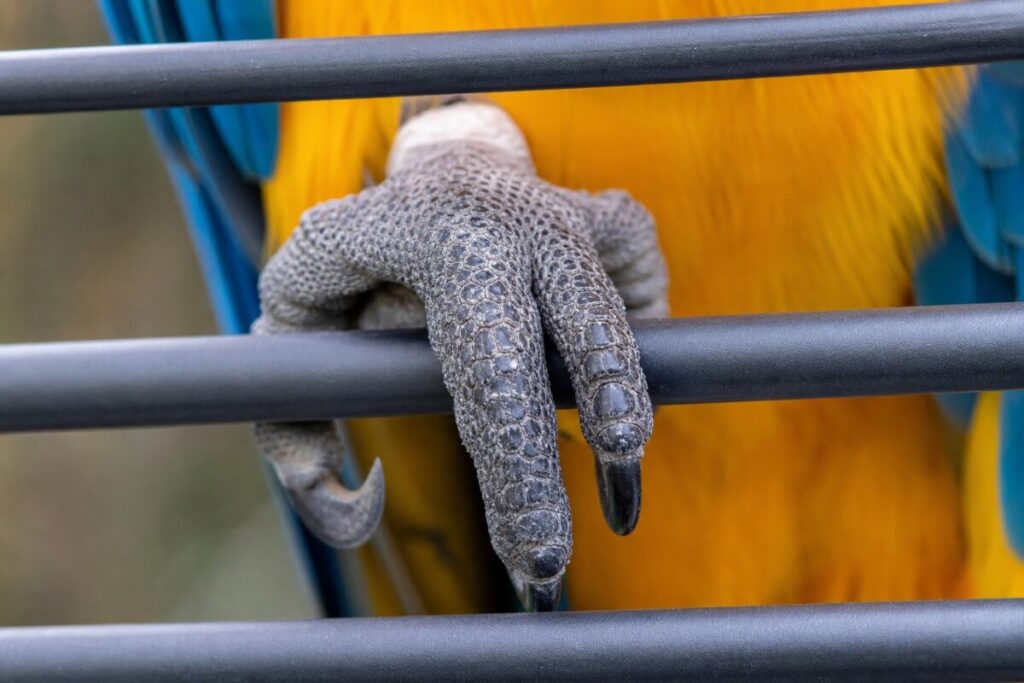
Bar spacing is the gap between the bars. For a large macaw it should be 1 to 1.5 inches. Any wider and a young or slim bird can get its head through. Any narrower and toes get caught.
Bar gauge is the thickness of the metal itself. Almost nobody mentions it, and it matters more.
A blue and gold macaw’s beak can crack a Brazil nut. It does not escape a cage by squeezing through a gap. It escapes by working a bar until the bar bends, or by taking a latch apart.
So spacing keeps the bird from slipping through. Gauge decides whether the bar survives ten years of a bird testing it.
Look for bars around 5 to 6 mm thick, or ask the seller for the gauge directly. If a listing advertises spacing but says nothing about gauge, treat that as a warning sign.
One more test: lift a panel if you can. A cage built for a macaw is genuinely heavy. If it feels light, the bars are too thin.
The same logic applies to latches. Macaws are problem solvers and they have all day. Simple slide bolts get opened. Look for locks that need two separate actions, or add a padlock or spring clip yourself.
What material should a macaw cage be made of?
Stainless steel is the right answer if you can afford it. It doesn’t chip, doesn’t rust, can’t poison the bird, and will outlast you. It costs two to four times more than powder coating up front. Spread across a 50 year lifespan, it often works out cheaper per year.
Powder-coated wrought iron is the practical mainstream choice. Check that the coating is specified as non-toxic and bird-safe. Inspect it every few months. Once a macaw chips the coating, the bird will keep working at that same spot, and the bare metal underneath can rust.
Avoid entirely: anything galvanized, because the zinc coating is poisonous to birds. Also brass or lead parts, any paint not labeled bird-safe, and nickel or chrome plating that can flake off.
Dome top, play top, or round: which shape is best?
The Merck guidance notes that most birds prefer rectangular cages over round ones, because they like having corners to settle into. Round cages also make perch placement awkward and give the bird no secure resting spot.
Dome top cages give more usable interior volume in the same footprint. For a bird this size, that is worth having.
Play top cages trade some interior space for a stand on the roof. That’s a fair trade if you’ll actually use it, and macaws generally like being up there.
A myth worth correcting
You will find cage retailers claiming that a play top is a bad idea because putting a large parrot above your head makes it “dominant” and causes aggression.
This is not supported by behavioral science. It has been repeated for decades without evidence. Birds go high because high feels safe, not because they are climbing a hierarchy.
There is a real reason to be careful about a bird sitting above your eye level. It just isn’t dominance. It is that you cannot read a face you cannot see.
The body language warnings that let you back off before a bite are invisible when the bird is on top of a cage above you. If you use a play top, work with the bird at your eye level and leave the top for its own time. The same principle applies to shoulder access, which we cover in the guide to training a step up without bites.
What goes inside the cage?
A large empty cage isn’t enrichment. It’s a large empty cage.
Perches. Use at least three, in varied diameters and textures. For a blue and gold, the main perches should be roughly 1.5 to 2 inches across, so the foot wraps about two thirds of the way around. Natural hardwood branches beat dowels. A dowel is the same width all the way along, so it presses on the same points of the foot every single day, and that causes sores over the years. Rotate them.
Now a practical problem nobody warns you about. Natural perches longer than about 32 inches are very hard to find. In a cage 48 inches wide, one perch will not span the width.
Plan for two shorter perches at different heights instead of one long one. Position them so the tail hangs clear, and so droppings from the upper perch do not land on the lower one.
Food and water. Never put a bowl directly under a perch. Spread several food stations around the cage so the bird has to move between them. That matters, because macaws put on weight easily. Keep fresh produce in a separate bowl from pellets.
Toys and foraging. Rotate them weekly. A macaw that gets the same three toys forever stops engaging and starts finding its own entertainment. That usually means the cage bars, its own feathers, or your furniture. Foraging toys that make the bird work for food do more for behavior than any amount of extra cage width.
Leave open space. Don’t fill the interior. The bird needs clear room in the middle to move and flap.
Where should you put a macaw cage?
Position matters nearly as much as size.
Put the cage in a room the family uses. Macaws are intensely social, and isolation drives screaming and feather damage. Keep at least one side against a wall, because a cage exposed on all four sides leaves the bird nowhere that feels secure.
Avoid the kitchen entirely. Cooking fumes are a serious hazard for birds, and overheated non-stick coatings can kill a parrot within minutes.
Avoid direct sun, drafts, air conditioning vents, and heating vents. Birds do well at the temperatures people find comfortable.
One point from the veterinary guidance contradicts common advice: most birds should not have their cages covered at night. Covering can be stressful. If the room is cold, warm the room or move the cage away from the draft instead of reaching for a cover.
Out-of-cage time is not optional
If you take one thing from this article, take this.
No cage you can buy meets the veterinary space standard for a blue and gold macaw. So the cage isn’t the whole habitat. It’s the safe base the bird comes back to. The rest of the space has to come from your home.
Three to four supervised hours a day is the working minimum. Many experienced macaw keepers do considerably more, with the cage door open and the bird moving freely between the cage, a play stand, and a java tree.
Set the room up so that works. A stand away from the cage. A couple of climbing structures. Windows and cords secured. No toxic plants, no open water, no ceiling fan running.
The goal is a space where the bird can be out safely without you watching it every second.
A macaw in a slightly small cage with six hours of daily freedom is far better off than one in a slightly larger cage that never opens.
Can two macaws share a cage?
Generally no, not in anything you can buy at retail.
The veterinary guidance says clearly that a cage holding more than one bird needs to be bigger still. A single blue and gold already needs roughly 62 inches in all directions. A pair realistically needs an aviary or a dedicated room, not a bigger cage.
There is also a compatibility question. Not all birds get along, and two large macaws in a tight space can do serious damage to each other. Bonded pairs sometimes share happily. Two birds put together because it was convenient often do not.
Talk to an avian vet before housing any two large parrots together.
How do you know if the cage is too small?
Watch for these. They show up before the bird gets seriously unwell.
- Frayed, broken, or bent tail feathers. The clearest physical sign, and usually the first
- Wing tips catching the bars when the bird flaps or turns
- Repetitive pacing along the same bar or the same route
- Bar chewing focused on one spot
- Feather damaging behavior, particularly on the chest and shoulders
- More screaming, especially at predictable times of day
- Reluctance to move at all, sitting in one place for hours
- New aggression when you reach into the cage
Any of these deserves a conversation with an avian vet, because several have medical causes too. But if your cage measures below the numbers in this article, start there.
How much does a macaw cage cost?
A cage that is actually big enough for a blue and gold macaw is expensive. A good powder-coated cage at 48 by 36 by 72 inches typically runs several hundred dollars. Stainless steel at that size runs into four figures.
That is worth saying plainly, because it leads somewhere uncomfortable: if the cage budget isn’t there, the bird isn’t affordable yet.
A blue and gold macaw is a 50 year commitment. There are veterinary costs, food costs, toy replacement costs, and eventually the cost of arranging its care after you are gone.
The cage is only one line in that budget. Our blue and gold macaw care guide covers the rest of it, including diet, health, and what daily life with one of these birds actually looks like.
Buying a small cage now and planning to upgrade later almost never happens. Life gets busy, money goes elsewhere, and the bird spends years in a cage that’s too small for it.
Used cages are a good option and worth hunting for. Check carefully for rust, chipped coating, bent bars, and broken latches. Then disinfect thoroughly before use.
Frequently asked questions
What is the minimum macaw cage size for a blue and gold?
The veterinary standard works out to roughly 62 by 62 by 62 inches. That comes from one and a half times a 41 to 45 inch wingspan, in all directions. In practice, treat 40 by 30 by 60 inches as an absolute floor, and aim for 48 by 36 by 72 inches or larger with plenty of daily out-of-cage time.
What bar spacing does a blue and gold macaw need?
One to 1.5 inches. Bar thickness matters just as much, around 5 to 6 mm, because a macaw is more likely to bend a bar than squeeze through a gap.
Is a taller cage or a wider cage better for a macaw?
Wider. Height is the dimension retail cages over-deliver on. Width and depth are what a bird with a 45 inch wingspan actually runs out of, and depth is what limits turning around.
Can a macaw live in a cage full time?
No. No commercially available cage meets the veterinary space standard for this species, so out-of-cage time is how the shortfall gets covered. Three to four supervised hours daily is the working minimum.
How much does a proper blue and gold macaw cage cost?
Several hundred dollars for a quality powder-coated cage at 48 by 36 by 72 inches, and into four figures for stainless steel at that size. Stainless costs more up front but often less per year across a 50 year lifespan.
Do macaws need a round or rectangular cage?
Rectangular. Veterinary guidance notes that most birds prefer corners to settle into, and round cages make perch placement difficult while offering no secure resting spot.
Should I cover my macaw’s cage at night?
Usually not. Veterinary guidance is that covering can be stressful for most birds. If the room gets cold, warm the room or move the cage away from drafts instead.
Can two blue and gold macaws share one cage?
Not in a retail cage. A pair needs an aviary or a dedicated room. Compatibility also has to be assessed individually, because two large macaws in a confined space can injure each other badly.
Still unsure about your setup? If your macaw shows frayed tail feathers, repetitive pacing, or bar chewing in one spot, the cage is worth measuring against the numbers above. Talk to a certified avian veterinarian if the behavior is new or comes with any change in appetite, droppings, or posture.
Bottom line
The honest answer on macaw cage size isn’t a product recommendation.
A blue and gold macaw needs about 62 inches in every direction to meet veterinary guidance. Essentially nothing on the market delivers that. You close the gap with out-of-cage time, not by pretending the cage is big enough.
Buy the widest cage that fits your room. Check the bar gauge, not just the spacing. Put it where the family is. Open the door for several hours every day.
And if that honest version doesn’t fit your home or your budget right now, it’s far better to know before the bird arrives than five years after.
Sources consulted
- Merck Veterinary Manual, Providing a Home for a Bird, Laurie Hess DVM DABVP, reviewed by Joyce Carnevale DVM DABVP, Iowa State University
- Merck Veterinary Manual, Overview of Pet Birds, minimum cage size and bar spacing recommendations
- SeaWorld / United Parks, Blue and Gold Macaw species facts, size, and wingspan data
- Animal Diversity Web, University of Michigan Museum of Zoology, Ara ararauna species account
- Susan Clubb DVM, Blue and Gold Macaw species profile, aviary, and caging specifications
- Association of Avian Veterinarians husbandry guidance on companion parrot housing
Disclaimer: This guide is educational and does not replace veterinary advice. If your macaw shows feather damage, repetitive behavior, or any change in appetite, droppings, or posture, contact a qualified avian veterinarian.