
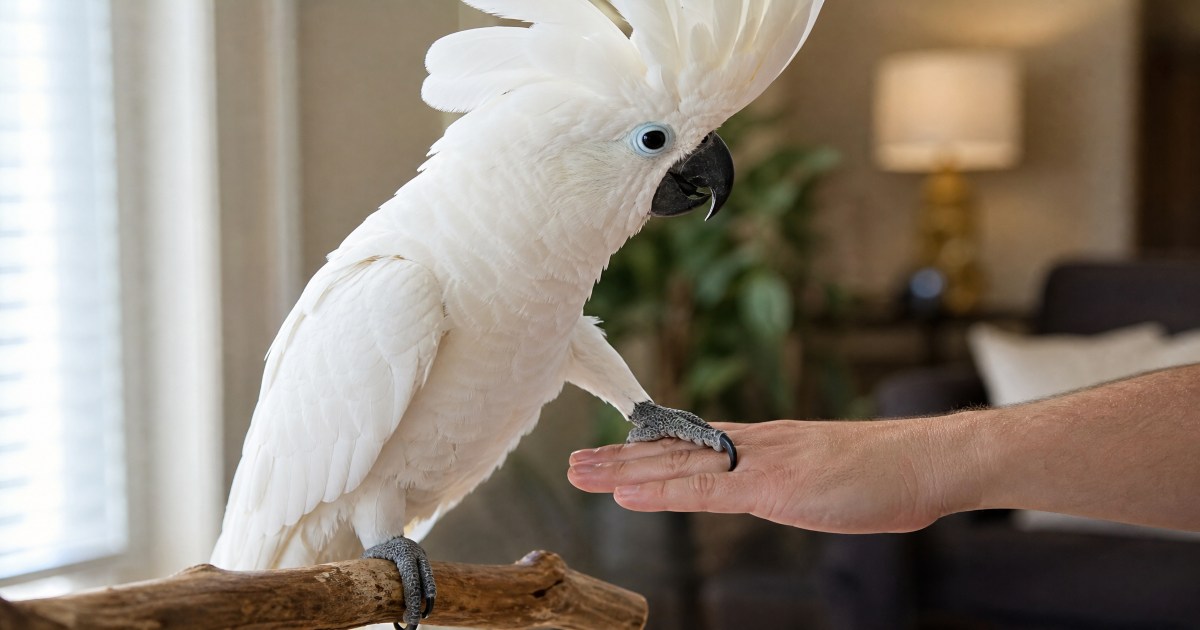
Ask any parrot rescue which species fills their intake list, and cockatoos come up first. Not because they are bad birds. Because they are the ones somebody gave up on after a bite.
Here is what nobody tells a new owner. A cockatoo that bites your hand is not broken, and it is not trying to boss you around. It is a bird that already asked you to stop in three or four quieter ways, got ignored every time, and finally found the one signal that works.
That is the problem. It is also the solution.
So if you want to know how to train a cockatoo to step up without getting bitten, the work starts before your hand moves. It starts with learning what your bird is already telling you.
The training itself is simple. You break the step up into pieces so small the bird cannot fail. You reward every piece. And you let the bird leave whenever it wants.
Quick answer
Work on a perch away from the cage. Use a treat your bird loves and never gets any other time. Reward it for looking at your hand, then leaning toward it, then lifting one foot, then putting both feet on. Keep your hand still. Let the bird step off again right away, every time. Add the words “step up” only after the foot is already moving. Never push your hand into the chest and never pull at the toes. Stop the moment the crest flattens or the body goes stiff.
Most cockatoos learn this in two to six weeks.
Key facts at a glance
- What “step up” means: the bird voluntarily climbs onto your hand, your arm, or a perch you are holding, when asked.
- Why cockatoos bite during the step up: almost always because an earlier step up was forced, or because the bird’s warning signals were ignored and it learned that biting makes hands retreat.
- The method that works: positive reinforcement shaping. Break the behavior into small steps and reward each one.
- Typical time to learn: a few days for a hand-raised baby, two to four weeks for a settled adult, several months for a rescue bird afraid of hands.
- Best treats: tiny pieces of cashew, pine nut, walnut, almond, or sunflower seed, given only during training.
- Session length: two to five minutes, two or three times a day.
- Warning signs to stop: flattened crest, slicked feathers, pinned eyes with a stiff body, hissing, beak clicking, or leaning away.
- Never do this: press your hand into the bird’s chest, pry its toes off the perch, punish a bite, or use gloves.
What you need
- A perch away from the cage: a T-stand, a play stand, or the back of a chair
- One high-value treat, broken very small (cashew, pine nut, walnut, almond, or sunflower seed)
- A marker: a clicker, or a short word like “yes” said the same way every time
- Five quiet minutes, two or three times a day
- No dog, no TV, no other birds screaming in the next room
That is it. No gloves. No towel. No stick to poke with.
Why cockatoos bite when you ask for a step up
The bite is the last warning, not the first
Owners say “he bit with no warning” all the time. In almost every case there was a warning. It just did not look like one.
Before a cockatoo bites, it usually does one or more of these things:
- Shifts its weight away from your hand
- Slicks its feathers down flat and tight
- Drops the crest against its head
- Pins its eyes, meaning the pupils shrink and widen fast
- Opens the beak slightly
- Lifts one foot and stalls halfway
- Hisses, or clicks the beak sharply
That is your bird saying no in the only language it has. Push past it and the bird has to try something louder, because louder is all that is left.
And here is the uncomfortable part: it works. Your hand pulls back. You have just run a very effective training session, only not the one you meant to run.
VCA Animal Hospitals gives the same advice about how you react afterward. A big reaction teaches the bird that biting gets attention or gets control, so the biting increases.
Most owners use force without knowing it
There is an old instruction still floating around online: press the back of your hand firmly into the bird’s lower belly so it has to step up to keep its balance.
It works, in the sense that the bird ends up on your hand. It is also force. The bird steps up to make something unpleasant stop.
Two things follow. The bird learns that stepping up is the price of relief, not something worth doing. And you become part of the unpleasant thing. Trust drains away slowly, then all at once.
Reward-based training flips this. The bird steps up because something good reliably happens next. Nothing unpleasant is applied, so there is nothing to escape from, and no reason to bite.
This is not the soft option. It is what avian behavior specialists like Susan Friedman, Barbara Heidenreich, and Steve Martin have been teaching veterinarians for over twenty years. It is also what good avian clinics use today.
Why a hand feels dangerous to a parrot
Cockatoos are not built to fight. No teeth, no claws worth mentioning, almost no weight. Their whole survival plan is to leave.
Now take a bird that is caged, maybe wing-clipped, and cannot leave. Point a big human hand at it. The beak is the only tool left.
Rescue and rehomed cockatoos have it worse. Many have been grabbed, chased or wrapped in towels for years. For those birds an open palm is a real fear trigger, and training has to start much earlier than “offer your hand.”
Read the crest before you move your hand
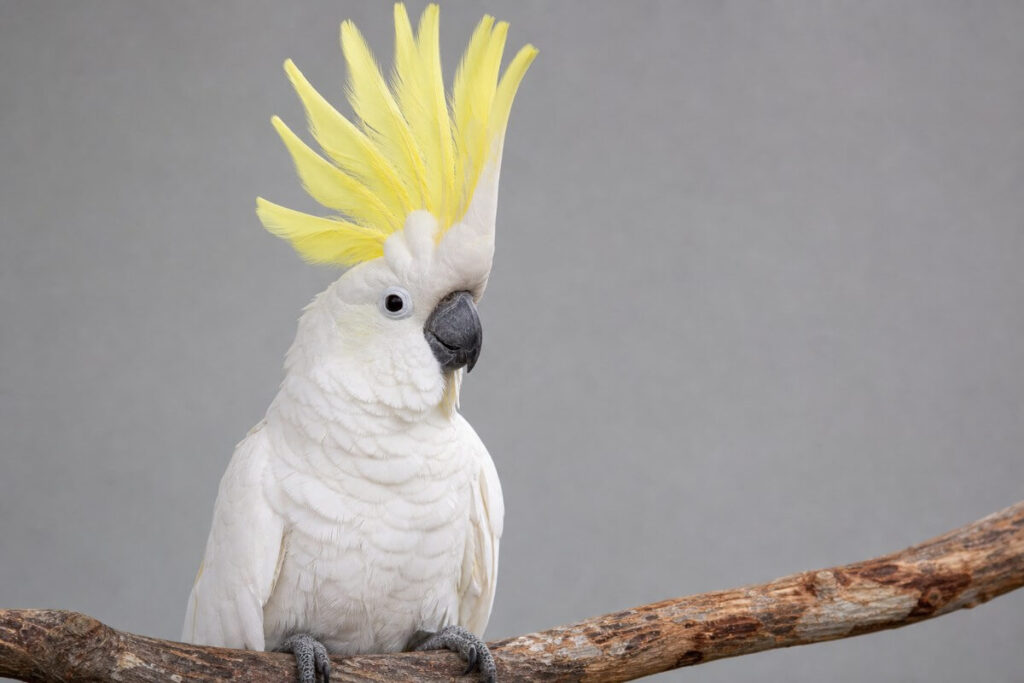
This is the skill that separates people who get bitten from people who do not.
Cockatoos raise the crest for good reasons and bad reasons, so crest position on its own tells you nothing. Read it together with the body.
| What you see | What it means | What to do |
|---|---|---|
| Crest half up, feathers loose, weight even | Relaxed and interested | Train now. This is your window |
| Crest fully up, body loose, leaning in | Excited or curious | Fine, but keep it short |
| Crest fully up, body stiff, hard stare | Tense and defensive | Freeze. Do not move closer |
| Crest slicked flat to the head | Scared, or about to bite | Back off calmly. End the session |
| Eyes pinning, stiff body, leaning forward | Very worked up. Bite is close | Withdraw slowly. No sudden moves |
| Weight shifted away, body turned aside | A polite no | Respect it. Try again in five minutes |
| Beak clicking, hissing, open beak | A clear threat | Stop. Do not push through this |
| Tail fanned, wings held off the body | Extremely worked up | Stop |
One correction, because half the internet gets this wrong. Eye pinning on its own is not aggression. Cockatoos pin when they are excited, curious, or concentrating. Pinning combined with a stiff body and flat feathers is what predicts a bite.
Back off at the first quiet signal instead of the last loud one, and two things happen. You do not get bitten. And your bird never learns that biting was necessary. After a few weeks the warnings start to fade, because the bird stops needing them.
Set the session up so a bite cannot happen
Get away from the cage. Cage territory raises the odds of a defensive reaction sharply. If your bird will not come out, just open the door and wait. Let the bird choose. That choice matters more than people think, because control is one of the strongest rewards you can give a parrot.
Pick a treat your bird will actually work for. Not the pellets already sitting in the bowl. Something it only ever gets during training.
Small is the whole trick. A cockatoo that swallows a whole cashew is done after one reward. That same cashew broken into eight pieces gives you eight rewards.
Fresh fruit belongs in the daily diet, not the training pouch. It is wet, slow to eat, and easy to overfeed. Grapes are a good example, and if you are not sure where they fit, we covered whether parrots can eat grapes separately.
Train before a meal, not after. A bird with a full crop has no reason to bother.
Hold your hand slightly higher than the perch. Birds step up more easily than they step down, so offer your hand just above the level of the bird’s feet. A hand held low asks the bird to climb down, and plenty of birds refuse that for reasons that have nothing to do with attitude.
Keep it short. Two to five minutes beats twenty. Stop while your bird still wants more. If you train until it gets bored, boredom is the last thing it links to your hand.
How to train a cockatoo to step up: the seven steps
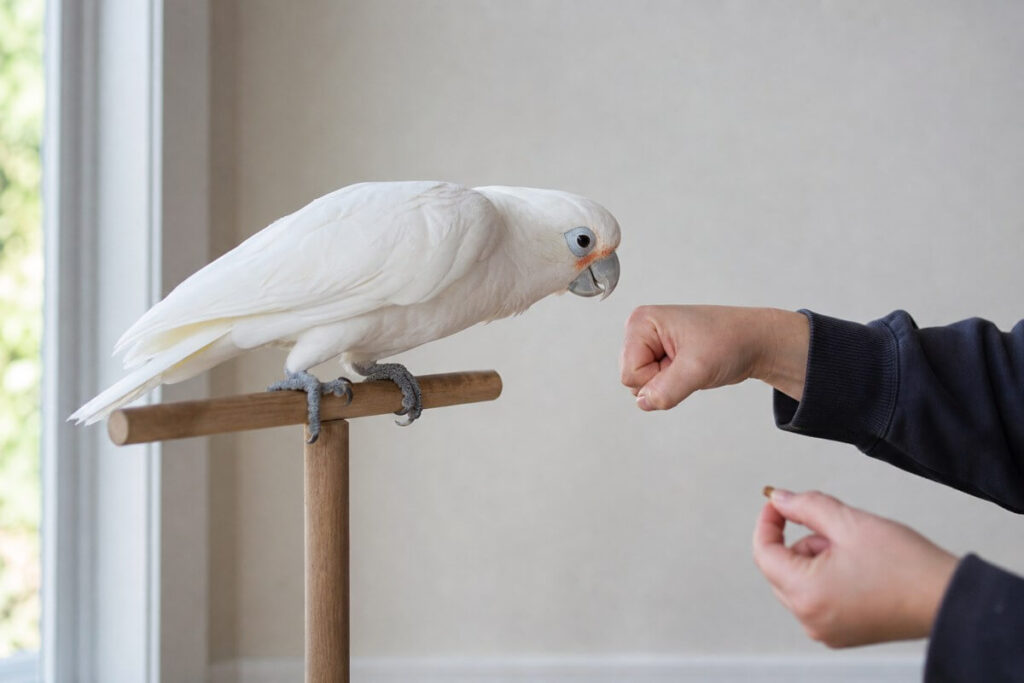
This method is called shaping. Shaping means breaking a behavior into very small steps and rewarding each step until the full behavior appears on its own. You are not teaching a step up. You are teaching seven tiny behaviors in a row, and the step up shows up at the end almost by accident.
First, pick your marker. A marker is a short sound that means “yes, that, the treat is coming.” A clicker works. So does the word “yes,” as long as you say it the same way every time and say it the instant your bird does the right thing.
Timing matters more than anything else here. If your marker comes late, you reward whatever your bird was doing a second later instead.
Sit at your bird’s eye level. Treats in the hand you are not offering.
1. Bird looks at your hand. Rest your closed fist farther away than you think you need to. The instant your bird turns its head toward it, mark and reward. Repeat five or six times.
2. Bird turns its body toward your hand. Not just the head. Shoulders and feet. Mark and reward.
3. Bird takes a step toward you. Now you can bring your fist closer, about an inch per session. If your bird freezes or leans back, you moved too fast. Go back to the last distance that worked.
4. Bird leans forward. A weight shift counts. Mark and reward.
5. Bird lifts one foot. This is the big one, and it usually comes with a pause. Mark the instant the foot leaves the perch, even if it goes straight back down. Do not hold out for a perfect step.
6. One foot lands on your hand. Mark and reward with your hand completely still. Do not lift. Do not move. Do not cheer. A hand that moves the second a foot touches it teaches your bird that hands are wobbly.
7. Both feet land. Mark, reward, then let your bird step straight back onto the perch.
Only the newest step earns a treat. Once your bird reliably turns its body, looking no longer earns a treat.
If your bird gets stuck, drop back to the last thing it did easily and break the gap into a smaller step.
End on a success. End early. Every session.
Always let your bird step off again
This is the piece most guides skip, and it is the one that prevents bites.
Think about it from your bird’s side. If every step up ends with being carried somewhere it did not choose, or dumped back in the cage, then stepping up predicts losing its freedom. Parrots spot that pattern fast. The step up gets slower, then reluctant, then refused, then defended with a beak.
So for the first two weeks, stepping up should mean nothing except a treat and instant permission to leave. Your bird stays in control. That is not spoiling it. That is what makes the behavior stick.
Later, once you start carrying, build rewards into the trip. Detour past the window. Stop for a head scratch. Put a new foraging toy in the cage so arriving is worth it. Never let “step up” become a phrase that only ever means playtime is over.
If your bird is scared of hands, start with target training
Some birds never get past step one. The fear of hands is too strong. For those birds, teach targeting first.
Take a chopstick or a wooden dowel. Hold it a few inches from the beak. The moment your bird touches it, even by accident, mark and reward. Most cockatoos work this out in one or two sessions, because they investigate everything with their beaks anyway.
Targeting is worth far more than the trick itself. It teaches cause and effect: what I do makes something good happen, and I decide when. Once a bird understands that, everything else goes faster, including the step up, recall, and later harness training.
When your bird follows the target reliably, use it to build the step up. Hold the target just past your hand so the bird has to put one foot on the hand to reach it. Then two. Keep the hand still and let your bird leave whenever it likes.
The perch method for birds that have already bitten
If you have a rescue cockatoo, a bird that has been toweled repeatedly, or one that has already drawn blood, do not start with your hand. Start with a perch you hold.
Pick something your bird already knows and does not fear. A spare wooden perch. A rope perch folded double. Even a basket handle.
If the object worries your bird, introduce it slowly. Leave it across the room and move it closer over several days, pairing each new distance with a treat. Trainers call this desensitizing. It just means going slow enough that the fear never fires.
Then shape the step up onto that perch using the same seven steps. Your hand stays out of range the whole time, so a misread signal costs you nothing.
This is not a lesser version of the training. Experienced keepers use a hand-held perch permanently for emergencies, carriers, and vet trips. VCA Animal Hospitals recommends the same thing, noting that many birds are more comfortable stepping onto a wooden dowel than onto fingers, and that gloves are a bad idea because most birds are frightened of them.
When should you add the verbal cue “step up”?
Most people say “step up” before the bird has any idea what it means, repeat it eight times while nothing happens, then wonder why the cue does not work.
The words go on last. Once your bird is reliably lifting its foot, start saying “step up” in a calm, level voice at the moment you see the foot begin to move. After a few dozen repeats the phrase starts to predict the behavior. Then you can say it slightly earlier.
If you have already worn the phrase out, pick a new one. “Up please.” “Hop up.” Your bird does not care about the words, only about what follows them.
One rule. If you say the cue and nothing happens within a couple of seconds, do not repeat it. Walk away and come back in a minute. Repeating a cue that produces nothing teaches your bird that the cue is background noise.
Step down and laddering
Stepping down is a different behavior and needs its own training. Birds naturally prefer moving upward, so going down to a lower perch takes separate work. Same process: reward the lean, then the foot lift, then the landing.
Laddering means asking for repeated step ups between two hands, or between a hand and a perch. It has a bad reputation and some of that is fair. Used as a drill to make a bird obey, it is just repeated forced handling and it creates biters. Used as a short, well-rewarded game with a clear end, it is something birds enjoy.
The difference is simple. Can your bird stop? If yes, you are training. If no, you are drilling.
How long does it take to train a cockatoo to step up?
Nobody can tell you exactly how long it takes to train a cockatoo to step up, because it depends on what has already happened to the bird.
| Your bird | Rough timeline |
|---|---|
| Hand-raised baby, no bad history | A few sessions to one week |
| Settled adult, no bite history | Two to four weeks |
| Newly rehomed or nervous | Four to eight weeks |
| Rescue bird, afraid of hands | Several months, sometimes longer |
Do not rush the settling-in period with a new bird either. Many keepers give a cockatoo a full month with no handling demands at all. Just food, routine, and a calm person in the room.
The most common reason training stalls is not the bird. It is the person jumping to the next step because the last one looked easy.
What mistakes turn a step up into a bite?
Pressing your hand into the chest. Works once. Costs you months.
Prying the toes off the perch. Same idea, worse. Feet are how a bird feels safe.
Punishing the bite. Shouting, flicking the beak, dropping the bird, the old wobble-your-hand trick. Every one of these teaches your bird that hands are dangerous and unpredictable, and every one of them reliably produces more fear and more biting.
Grabbing a towel when your bird refuses. One bad toweling can undo six weeks. If you need towel handling for vet visits, train it separately, calmly, with food.
Starting in the cage doorway on day one. Territory, plus a tight space, plus an incoming hand. That is the riskiest setup there is.
Believing in height dominance. The idea that a bird on your shoulder is dominating you has no support in behavioral science. Birds go high because high feels safe. If yours bites on your shoulder, the real reason is that you cannot see its face up there, so you cannot read the warnings.
Only asking when you need something. If your hand only shows up at cage time before work, your bird will learn to avoid your hand at cage time. Practice when you want nothing.
Troubleshooting
Steps up everywhere except in the cage. Stop asking inside the cage. Open the door and let your bird come out, or fit a perch inside the door so there is somewhere to climb to.
Takes the treat, then bites. Your treat is too big and your hand is too close. Use smaller pieces, offer them from farther away so your bird has to reach rather than lunge, and drop back two steps.
Lunges the moment your hand appears. You are starting too close. Increase the distance until you find the point where your bird stays relaxed, even if that is across the room.
Steps up fine, then bites once it is on your hand. Something about being on the hand is unpleasant or predicts something unpleasant. Cut the time on your hand to zero. Reward the landing, let your bird step straight off, then rebuild one second at a time.
Was fine, suddenly refuses. Look for a change. New furniture, a new person, a house move, the cage shifted, a wing clip, a scare. Then think about health. Birds hide illness, and a bird in pain refuses handling. Any sudden unexplained change deserves a call to an avian vet before you treat it as a training problem.
Only bites one person in the house. Very common in cockatoos, and usually hormonal. That person should do all the training and give all the treats, while the favorite person stops handling the bird for a while.
Bites on your shoulder. Take shoulder access off the table during training. You cannot read a face you cannot see.
Why does my cockatoo bite more in spring?
Adult cockatoos, roughly three to six years old depending on species, go through stretches where their tolerance for handling drops off a cliff. Longer daylight is the biggest trigger. The bird that was a cuddly, willing stepper in February can turn defensive by May.
What to change during that period:
- Pet the head and neck only. Stroking the back, under the wings, or near the tail reads as courtship to a bird, and that drives biting.
- Give twelve hours of solid darkness every night. Shortening the day length your bird perceives is one of the most effective tools you have, and it costs nothing.
- Take away nest sites: cardboard boxes, cage tents, dark spaces under furniture, covers that make a cave.
- Cut back warm soft foods, and make your bird work for what it does get using foraging toys.
- Keep training, but lower your standards. Ask for less, pay more, and accept a no without pushing.
The behavior comes back after the season, as long as you did not spend those months teaching your bird that biting works.
Which cockatoo do you have?
All cockatoos learn the same way. They do not all bring the same problems.
Umbrella and Moluccan cockatoos (Cacatua alba, Cacatua moluccensis) are the classic velcro birds. Willingness to step up is rarely the issue. The issue is intense attachment, early hormonal behavior, and a tendency to turn on anyone who is not the chosen person. They also have the most damaging bite of the group. If you are new to the species, our umbrella cockatoo care guide for beginners covers housing, diet, and daily routine.
Sulphur-crested and Triton cockatoos (Cacatua galerita) are more independent and more likely to nip during handling. They usually need a slower approach and a higher rate of reward. They take to target training very well.
Galahs, also called rose-breasted cockatoos (Eolophus roseicapilla), are generally the most forgiving for a first-time owner. Still smart, still fully capable of biting, but less prone to the extreme attachment problems.
Goffin’s and bare-eyed cockatoos (Cacatua goffiniana, Cacatua sanguinea) are exceptional problem solvers. Goffin’s have been studied in cognition labs for tool use, and it shows. They pick up shaping fast, get bored fast, and will invent their own game if yours is repetitive.
The method does not change by species. What changes is how fast you can move and how much your bird needs to be rewarded to stay interested.
What to do if your cockatoo bites you
It will happen eventually. Handle it in this order.
Do not pull your hand away. A cockatoo beak holding your skin will tear it if your hand moves fast. Stay still. The bird almost always lets go within a second or two.
Do not react loudly. Shouting is attention, and for some birds attention is a reward. It is also frightening, which makes the next attempt worse.
Put your bird down calmly on the nearest perch and end the session with no drama. No punishment. No shoving it in the cage as a consequence.
Then treat the wound properly. Cockatoo bites crush and puncture, and bacteria from the beak go into the wound, so infection is a real risk. Wash thoroughly under running water with soap and apply an antiseptic.
See a doctor if the bite is deep, if the bleeding will not stop, if your tetanus shot is out of date, or if you notice redness, swelling, heat, or discharge over the next few days. A large cockatoo can break a finger. Do not treat a serious bite like a scratch.
Afterward, work out what you missed. There is nearly always a signal you walked past. That is not self-blame. It is information, and it makes the same bite far less likely next time.
When should you call an avian vet or behavior consultant?
Call a certified avian veterinarian if the biting is new and sudden, if your bird is plucking its feathers, or if you cannot rule out pain. Call one too if the biting comes with any change in droppings, posture, appetite, weight, or activity. Behavior and medicine overlap constantly in birds, and no amount of training fixes a bird that hurts. Look for a vet with ABVP avian board certification if you can find one.
For ongoing aggression in a healthy bird, an avian behavior consultant who uses reward-based methods is worth the money. A good one talks about triggers, rewards, and body language. Be wary of anyone who talks about dominance, showing your bird who is boss, or breaking a bird’s will.
For a plain-English veterinary reference on why birds bite and how to rebuild a step up, VCA Animal Hospitals’ guide to biting and screaming in birds is the best free resource available.
Frequently asked questions
How long does it take to train a cockatoo to step up?
Anywhere from a few days to several months. A young hand-raised bird often manages it in under a week. A settled adult usually takes two to four weeks of short daily sessions. A rescue cockatoo that is afraid of hands can take several months, which is normal.
Why does my cockatoo bite when I ask it to step up?
Usually because an earlier step up was forced, or because your bird gave a warning that was ignored and learned that biting is what finally makes the hand go away. The other common causes are pain, hormones during breeding season, and territorial behavior around the cage.
Should I wear gloves to train a cockatoo to step up?
No. Gloves frighten most parrots, they stop you from feeling how much pressure you are using, and rescue birds often link them to being grabbed. Use a hand-held wooden perch instead.
What is the best treat for cockatoo step up training?
Whatever your bird loves most and never gets otherwise. Small pieces of cashew, pine nut, walnut, almond, or sunflower seed suit most cockatoos. Break them small so the same amount of food gives you more repetitions.
Is it too late to train a cockatoo to step up if the bird is already an adult?
No. Age is not the barrier. History is. An older bird with years of forced handling behind it needs longer on the early steps, but the process works the same at thirty years old as it does at one.
Can I train the step up inside the cage?
It is harder and riskier because of cage territory. Train on a neutral perch first, then bring the behavior back to the cage later, starting at the open doorway rather than deep inside.
My cockatoo steps up but screams to be picked up. Is that connected?
It is a separate behavior with its own history, usually attention. Reward quiet, avoid appearing the moment the screaming starts, and make sure your bird has enough foraging and enrichment.
Do I need a clicker?
No, but you do need a marker. A short word said at exactly the right instant works fine. Timing is what matters, not the device.
Still stuck? If the biting is new and sudden, or comes with any change in droppings, posture, appetite, or activity, talk to a certified avian veterinarian before treating it as a training problem.
Bottom line
Everything about how to train a cockatoo to step up without bites comes down to one idea. Biting is communication, not character.
Set things up so your bird never has to escalate to a bite. Break the behavior into pieces small enough that it always succeeds. Reward well and reward instantly. Let it leave whenever it wants. Watch the crest, not the clock. Stop early, every time.
Do that consistently and the step up stops being something you ask for. It becomes something your cockatoo offers.
This guide is part of the cockatoo training series at Wild Birds USA.
Sources consulted
- VCA Animal Hospitals, Biting and Screaming in Birds, Gregory Rich DVM, Laurie Hess DVM, and Rick Axelson DVM
- LafeberVet, Psittacine Behavior, Handling and Restraint, Brian Speer DVM, DABVP (Avian Practice)
- Susan G. Friedman PhD, Behavior Works teaching materials on least-intrusive behavior change
- Barbara Heidenreich, Good Bird Inc, parrot handling and training guidelines
- Steve Martin, The Anatomy of Parrot Behavior, Association of Avian Veterinarians conference proceedings
- Merck Veterinary Manual, sections on pet bird behavior and reproductive behavior
Disclaimer: This guide is educational and does not replace veterinary advice. If your cockatoo shows a sudden change in behavior, appetite, droppings, or posture, contact a qualified avian veterinarian.