

The bald eagle has been on the Great Seal of the United States since 1782. It appears on currency, on military insignia, and on the presidential podium.
Most Americans have assumed their whole lives that it was the national bird. It wasn’t. Not officially.
The bald eagle only became the official national bird of the United States on December 24, 2024, when President Biden signed a bill making it official after 242 years.
That is the first thing most articles about this bird get wrong, and it is not the only one. The famous eagle scream in films belongs to a different species. Benjamin Franklin never proposed the turkey. And the bird that recovered from 417 nesting pairs is now facing threats most people have never heard of.
Here are 25 facts, each checked against federal wildlife data, published research, or the original historical documents.
The short answer
The bald eagle (Haliaeetus leucocephalus) is a large sea eagle found only in North America, with a 6 to 7.5 foot wingspan, a body length of 28 to 38 inches, and a weight of 6 to 14 pounds.
It dives at over 100 mph, sees far more sharply than a human, and builds the largest tree nest of any bird on Earth.
It is not bald. The name comes from an old word meaning white-headed, not hairless.
It came back from 417 known nesting pairs in 1963 to roughly 316,708 birds in the lower 48 states — one of the great conservation successes.
Bald Eagle at a Glance
| Scientific name | Haliaeetus leucocephalus |
| Bird group | Sea and fish eagles |
| Length | 28–38 inches (70–102 cm) |
| Wingspan | 6–7.5 feet (1.8–2.3 m) |
| Weight | Males 6–9 lbs; females 10–14 lbs |
| Cruising speed | 30–40 mph |
| Dive speed | Over 100 mph |
| Lifespan | 20–30 years wild; oldest banded bird 38 years |
| White head appears | At 4–5 years old |
| Eggs per nest | 1–3; they hatch after 34–36 days |
| Range | Alaska, Canada, lower 48 states, northern Mexico |
| Population | About 316,708 in the lower 48 states |
| Federal status | Off the endangered list since 2007; still legally protected |
Identity and Naming
1. It only became the official national bird in December 2024
The bald eagle went on the Great Seal of the United States on June 20, 1782. For the next 242 years it acted as a national symbol without ever officially being one.
Congress fixed that with a bill signed into law on December 24, 2024.
The country already had a national mammal (the bison), a national flower (the rose), and a national tree (the oak). The one animal everyone assumed held the title did not.
2. It is not bald, and never was
The name comes from Middle English. “Balde” and the related word “piebald” meant white-headed, or patched with white. It never meant hairless.
The scientific name says the same thing. Haliaeetus means sea eagle, and leucocephalus comes from the Greek words for white and head.
3. It is a sea eagle, not a true eagle
The bald eagle belongs to a group called the sea and fish eagles. Its closest relative is the white-tailed eagle of Europe and Asia, not the golden eagle it gets compared to in North America.
You can see the difference on the bird itself. Bald eagles have bare legs built for gripping fish out of water. Golden eagles have feathers all the way down to the toes, suited to catching land mammals.
4. Benjamin Franklin never proposed the turkey
This is the most persistent myth in American ornithology, and it is false.
Franklin did criticize the eagle. He wrote to his daughter Sarah Bache on January 26, 1784, two years after the seal had already been adopted.
In that letter he called the bald eagle “a bird of bad moral character” that “does not get his living honestly,” and described how it robs ospreys of their catch.
He also praised the turkey as “a much more respectable bird” and “a true original native of America.”
But he never proposed the turkey as a national symbol. The letter was private and was not published until a century later, and the turkey was never among the designs considered.
The Franklin Institute, Snopes, and Harvard’s Declaration Resources Project have all independently corrected the record.
The modern version of the myth traces largely to a 1962 New Yorker cover showing a turkey on the Great Seal, and to the 1969 musical 1776.
5. The famous eagle scream is a red-tailed hawk
Every film, commercial, and patriotic montage featuring a soaring eagle uses the same piercing cry. It does not come from an eagle.
That sound is the scream of a red-tailed hawk, dubbed over eagle footage because the real thing is not impressive.
Researchers have recorded three kinds of bald eagle call:
- Peal call — high-pitched, prolonged and gull-like
- Chatter call — three or four introductory notes, then a rapid descending sequence
- Kuk-kuk-kuk call — a short repeated note
Females call at a lower pitch than males.
Ornithologists describe the overall effect as almost songbird-like. Less charitable listeners have compared it to a seagull with a grievance.
Size, Speed and Senses
6. Females are significantly larger than males
Female bald eagles are roughly 25% larger than males. Females weigh 10 to 14 pounds; males weigh 6 to 9 pounds.
Bigger females is the normal pattern in birds of prey, and biologists call it reverse sexual size dimorphism. Apart from size, the two sexes look identical, so telling them apart is nearly impossible unless you see a pair together.
7. Size varies dramatically by latitude
Bald eagles get bigger the further north they live, a pattern biologists call Bergmann’s rule. The largest birds are in Alaska, where they reach 7 kg with wingspans approaching 8 feet. Florida birds are noticeably smaller.
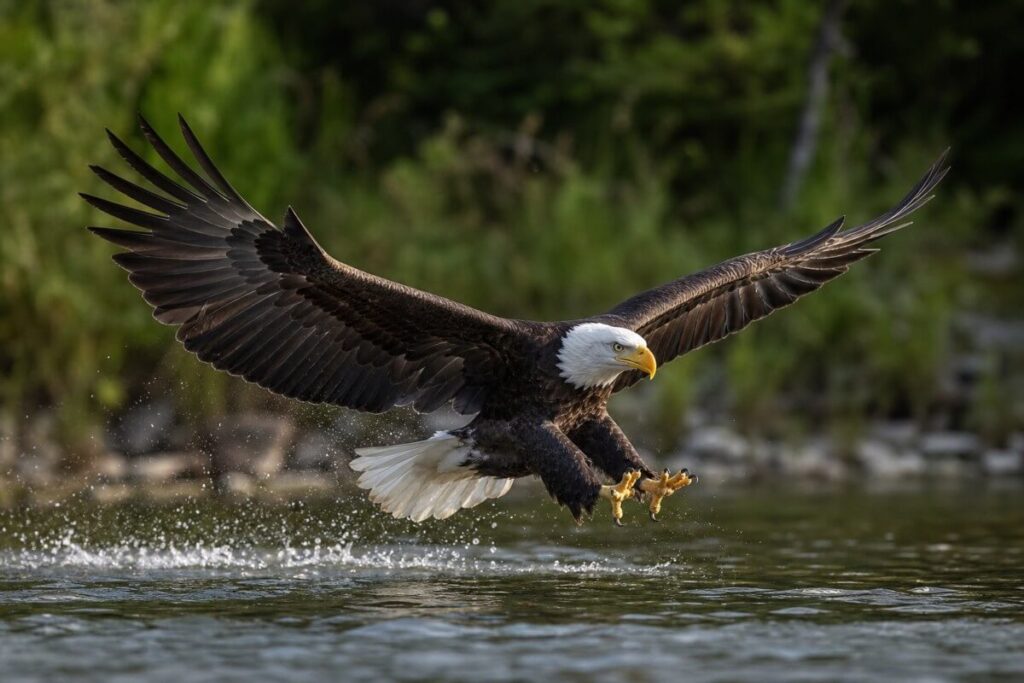
8. They dive at over 100 miles per hour
Normal cruising flight runs 30 to 40 mph. In a dive, or stoop, a bald eagle exceeds 100 mph.
For context, golden eagles are faster still in a dive, reaching around 150 mph, and peregrine falcons exceed 200 mph. The bald eagle’s advantage is not raw speed but the combination of speed and grip strength.
9. Their eyesight is several times sharper than ours
Eagle vision is genuinely exceptional, though the popular multipliers vary between sources and are often exaggerated.
Bald eagles see a wider field of view than we do, distinguish more colors, and can see ultraviolet light, which is invisible to humans. Estimates suggest they can spot a moving tadpole from over 100 meters, and a fish from roughly a mile away.
Each eye also has two zones of sharpest focus, where a human eye has only one. That lets an eagle see clearly straight ahead and off to the side at the same time.
10. They have a third eyelid
Bald eagles have a see-through third eyelid that sweeps sideways across the eye. Biologists call it a nictitating membrane, and most birds have one.
It cleans and protects the eye without blocking the bird’s view, which matters at 100 mph and matters again on impact with water.
11. Their grip is one of the strongest of any bird
A bald eagle’s talon grip has been estimated at several hundred pounds per square inch, roughly ten times the strength of a human hand grip. The rear talon, or hallux, is the killing tool. It pierces while the front three hold.
The underside of each toe is covered in rough scaly bumps called spicules. They bite into slippery fish that would otherwise slide straight out.
Hunting and Diet
12. About 90 percent of the diet is fish
Bald eagles are fish specialists. Salmon, trout, herring, catfish and shad make up the bulk of the diet across most of the range.
They usually do not dive into the water. They swoop low and snatch fish from near the surface with their feet, or wade in shallow water and wait.
13. They will absolutely steal
Franklin was not wrong about this part. Bald eagles rob other birds. They harass ospreys and smaller raptors until the victim drops its catch, a behavior biologists call kleptoparasitism.
They also scavenge freely. Roadkill, winter-killed deer, and washed-up fish are all fair game. Being a national symbol carries no obligation to hunt honestly.
14. They can swim
If a bald eagle grabs a fish too heavy to lift, it does not always let go. It will swim to shore using an overhand stroke of the wings that closely resembles the butterfly.
The technique is ungainly, occasionally fatal in cold water, and remarkable to watch.
15. They cannot carry off a child or a dog
The old claim that eagles snatch lambs, small dogs and babies is folklore. It also got a lot of eagles shot.
A bald eagle can lift roughly half its own weight in good conditions, which works out to four or five pounds. Early American farmers believed otherwise and shot eagles on sight well into the twentieth century.
Nests, Mating and Young
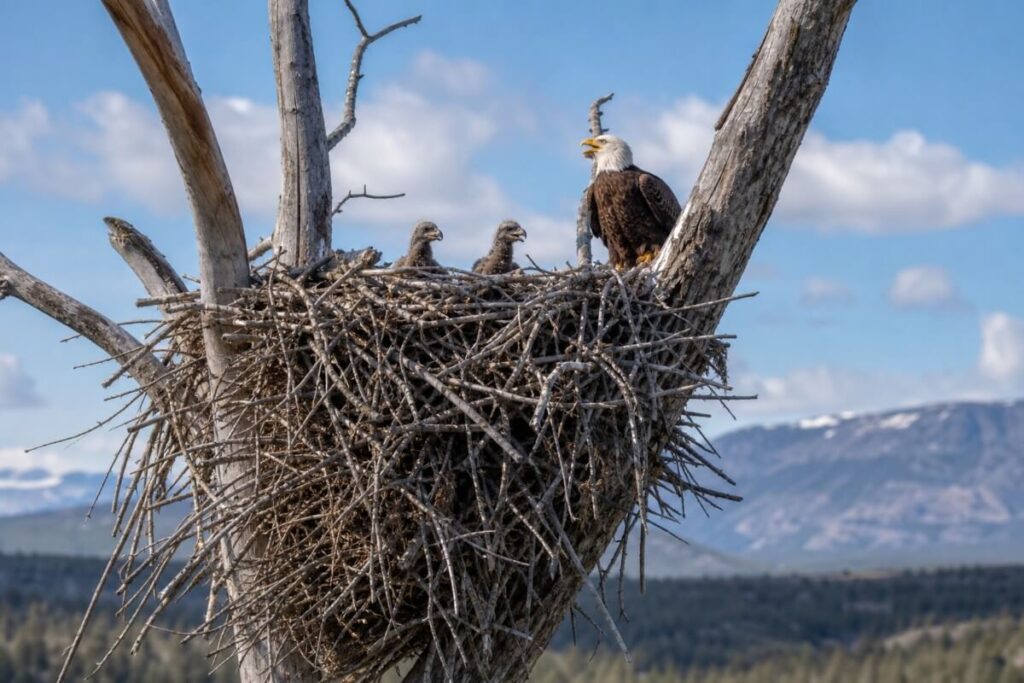
16. They build the largest tree nest of any bird on Earth
Bald eagle nests, called aeries, are added to year after year. A typical established nest measures 5 to 6 feet across and 2 to 4 feet deep.
The record is extraordinary. A nest near St. Petersburg, Florida, documented in 1963 and recognized by Guinness World Records, measured 9 feet 6 inches wide and 20 feet deep and weighed more than two tons.
Another Ohio nest was used for 34 years before the tree finally gave way.
17. The tree has to hold two tons
A two-ton nest needs a tree that can hold it. Eagles pick tall living trees with thick, strong branches, usually within easy flight of water and away from people.
Nests do sometimes come down. The tree fails, and the nest and everything in it falls with it.
18. They mate for life, mostly
Bald eagles pair up for the long term. The same two birds usually reunite each breeding season, returning to the same territory and often the same nest.
“For life” comes with caveats. If one bird dies, the survivor finds a new mate, and pairs that repeatedly fail to breed sometimes separate.
Tracking data also suggests pairs often migrate separately, meeting again at the nest.
19. Courtship involves falling out of the sky
The cartwheel display is one of the most dramatic courtship behaviors in the bird world. Two eagles fly to altitude, lock talons, and tumble toward the ground spinning together.
They separate at the last moment. Occasionally they do not, and both birds hit the ground.
20. Chicks take five years to look like adults
Eaglets hatch after 34 to 36 days of incubation and fledge at roughly 10 to 12 weeks. They leave the nest entirely brown, mottled with irregular white patches.
The white head and tail come in gradually. Full adult plumage appears at four to five years, which is also when the bird becomes old enough to breed.
This is why bald eagle sightings are so often missed. A juvenile looks nothing like the bird on the currency, and gets reported as a golden eagle or a large hawk instead.
21. The older chick sometimes kills the younger one
When two or three eaglets hatch, the first one out is bigger and stronger. It sometimes kills its younger sibling, especially when food is short. Biologists call this siblicide, and in eagles it is common rather than rare.
Roughly 50 percent of eaglets die in their first year, and another 20 to 30 percent die before reaching adulthood at five.
Any eagle you see with a white head has survived all of that.
Recovery and Modern Threats
22. They fell to 417 nesting pairs, then came back
This is the story that matters most.
The collapse. Bald eagles were shot for their feathers and for the false belief that they took livestock. Congress passed the Bald Eagle Protection Act in 1940, but a worse threat arrived after the war.
DDT was applied widely as a pesticide after World War II. It leached into watersheds, was absorbed by aquatic plants, concentrated up the food chain into fish, and accumulated in the eagles that ate them.
The chemical interfered with calcium metabolism, producing eggshells so thin they collapsed under the weight of the incubating parent.
By 1963, only 417 known nesting pairs remained in the lower 48 states.
The turnaround. The United States banned DDT in 1972, and the Endangered Species Act followed in 1973. Habitat protection, captive breeding and release programs then ran for decades.
The result. The bald eagle moved from Endangered to Threatened in 1995, then came off the endangered species list entirely in 2007.
The latest US Fish and Wildlife Service estimate puts the population at 316,708 birds across the lower 48 states. It was built using eBird data from the Cornell Lab of Ornithology.
That is more than four times the 2009 estimate of 72,434.
23. Nearly half of American bald eagles show lead poisoning
The recovery is real. It is also incomplete.
A study published in the journal Science in February 2022 examined bald eagles across 38 states and found harmful levels of lead in the bones of 46 percent of the birds sampled.
The source is ammunition. Eagles scavenge gut piles and carcasses left by hunters, and lead bullet fragments come with the meal.
One raptor center veterinarian reported that 85 to 90 percent of eagles admitted to their hospital carry some level of lead in their blood. No level is considered safe.
Michigan’s state wildlife lab reviewed eagle deaths from 1987 to 2024 and traced roughly 13 percent of them to lead poisoning.
24. Vehicles kill more eagles than almost anything else
The same Michigan dataset found 34 percent of documented eagle deaths came from vehicle strikes, with a further 26 percent from other trauma.
The reason is grimly simple. Eagles feed on roadkill. A feeding bird is slow to lift off. Cars do not slow down.
Power line electrocution and illegal shooting remain significant causes as well.
25. Avian influenza is the newest threat
Bird flu — highly pathogenic avian influenza — reached North American wild birds in 2022 and hit eagles hard.
Michigan’s lab documented 64 eagle deaths in the initial outbreak between April 2022 and January 2023, with about 70 percent involving adult birds. Those are the breeding-age individuals a population can least afford to lose.
Nationwide, avian flu has killed at least 600 bald eagles across 45 states.
Losing adults hurts far more than losing chicks. A five-year-old breeding female has already survived the years that kill most eagles, and she cannot be replaced quickly.
Where to See Them
Bald eagles occur across Alaska, Canada, the lower 48 states, and northern Mexico, and nowhere else on Earth.
The highest densities are in Alaska, which holds tens of thousands of birds. Outside Alaska, the Chesapeake Bay region has the greatest concentration in the country.
Maryland alone went from 62 breeding pairs in 1985 to an estimated 1,400 breeding pairs in 2025.
More than 80 percent of the southeastern US population is concentrated in Florida.
What to look for: large trees near open water — rivers, lakes, estuaries and coastlines. Winter is often the best season, since eagles congregate where water stays open and fish and waterfowl remain available.
Legal note: it is illegal to disturb a bald eagle, its nest, or its eggs without a federal permit. Penalties under the Bald and Golden Eagle Protection Act reach $250,000 in fines and up to two years imprisonment.
Even collecting a shed feather from the ground is prohibited without authorization.
Federal guidelines recommend staying at least 200 meters (about 650 feet) away from an active nest.
Frequently Asked Questions
How fast can a bald eagle fly? Bald eagles cruise at 30 to 40 mph in normal flight and exceed 100 mph in a dive. Golden eagles are faster in a stoop at around 150 mph, and peregrine falcons exceed 200 mph.
What is a bald eagle’s wingspan? Bald eagle wingspan ranges from 6 to 7.5 feet, with the largest Alaskan birds approaching 8 feet. Females are roughly 25 percent larger than males.
How long do bald eagles live? Wild bald eagles typically live 20 to 30 years. The oldest wild bird on record, documented by the US Geological Survey’s Bird Banding Laboratory, reached 38 years. Captive birds can pass 30. Roughly half of all eaglets die in their first year.
How big is a bald eagle nest? A typical established nest measures 5 to 6 feet across and 2 to 4 feet deep. The record nest, near St. Petersburg, Florida, measured 9 feet 6 inches wide and 20 feet deep and weighed over two tons. Bald eagles build the largest tree nest of any bird in the world.
What do bald eagles eat? About 90 percent of the diet is fish, including salmon, trout, herring and catfish. They also take waterfowl and small mammals, scavenge carrion, and steal catches from ospreys and other raptors.
Why is the bald eagle America’s symbol? The bald eagle was placed on the Great Seal of the United States on June 20, 1782. It was chosen partly because it is native to North America and was thought to live only on this continent. It did not become the official national bird until December 24, 2024, when the designation was signed into law.
What is the difference between a bald eagle and a golden eagle? Bald eagles are sea eagles with bare, unfeathered legs, adapted for catching fish. Golden eagles have feathered legs down to the toes and hunt land mammals such as jackrabbits and squirrels. Adult bald eagles have a white head and tail; golden eagles are uniformly brown with golden nape feathers. Juveniles of both species are brown and are easily confused.
Are bald eagles endangered in 2026? No. Bald eagles were removed from the endangered species list in 2007, and the population in the contiguous United States is estimated at 316,708 individuals. They remain federally protected under the Bald and Golden Eagle Protection Act, and face ongoing threats from lead poisoning, vehicle strikes and avian influenza.
Do bald eagles really scream like in the movies? No. The famous scream is a red-tailed hawk, dubbed over eagle footage. Real bald eagles produce high-pitched, gull-like peal calls, a chattering sequence, and a kuk-kuk-kuk call. Their vocalizations are often described as songbird-like.
Did Benjamin Franklin want the turkey as the national bird? No. Franklin criticized the eagle’s character in a private 1784 letter to his daughter, written two years after the seal was adopted, and praised the turkey in the same letter. He never proposed the turkey as a national symbol, and it was never among the designs considered.
The Recovery Is Not Finished
The bald eagle is held up as the great American conservation success, and the numbers justify it. Going from 417 nesting pairs to 316,708 individuals in sixty years is an extraordinary achievement.
But recovery is not the same as safety.
Nearly half of American bald eagles carry harmful lead levels. Vehicle strikes remain the single largest documented cause of death in some states. Avian influenza has killed hundreds of adults and is not finished.
The DDT crisis was fixable because it was visible, measurable, and traced back to one chemical. Today’s threats are scattered across highways, hunting seasons and migration routes, which makes them much harder to solve.
For current population data, management guidelines and permit requirements, the U.S. Fish and Wildlife Service bald eagle species profile is the authoritative federal source.