
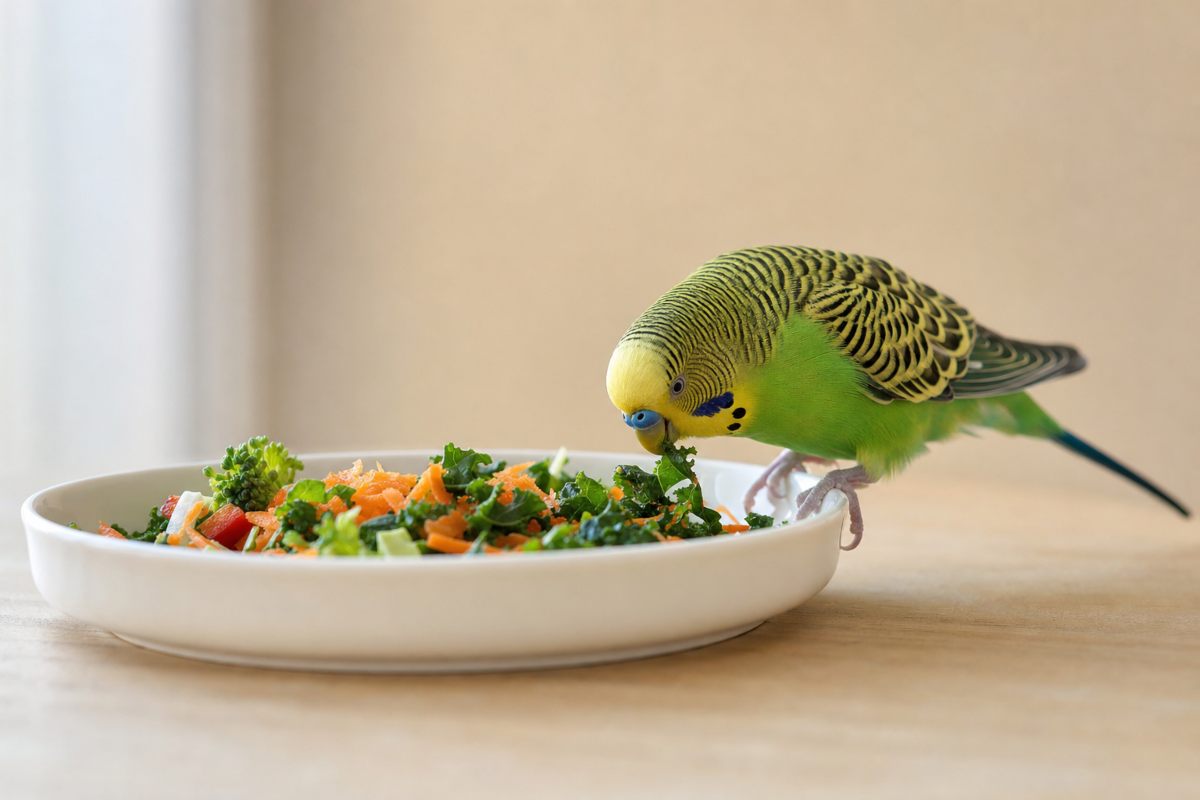
Budgies can safely eat formulated pellets, dark leafy greens, carrots, broccoli, bell pepper, peas, cooked sweet potato, and small amounts of apple, berries, melon and mango. They must never eat avocado, chocolate, caffeine, alcohol, onion, garlic, fruit pits or apple seeds. The harder question is not what is safe. It is how much, because a budgie weighs about 35 grams.
| Food group | How often | What it looks like for one budgie |
|---|---|---|
| Formulated pellets | Daily, available most of the day | The base of the diet |
| Dark leafy greens and vegetables | Daily, fresh each morning | A small handful, finely chopped |
| Seed mix | Measured, not left topped up | Roughly a level teaspoon a day |
| Fruit | Two or three times a week | One or two small pieces, not a whole grape |
| Millet spray | Treat only | A short piece, once or twice a week |
| Cuttlebone or mineral block | Always in the cage | Clipped to the bars, replaced when worn |
| Fresh water | Changed every day | Bowl washed daily, no vitamin drops added |
Are Budgies and Parakeets the Same Bird?
Yes. In the United States they are the same bird.
The budgerigar (Melopsittacus undulatus) is a small parrot from the Australian grasslands. American pet stores usually sell it under the name “parakeet.” In the UK and Australia the same bird is called a budgie, and “parakeet” means a much wider group of long-tailed parrots.
This matters when you look up feeding advice. Some articles written for “parakeets” are really about Indian ringnecks, which weigh around 120 grams. That is more than three times a budgie’s weight. Portion advice written for a ringneck is far too much food for a budgie.
If your bird is about 7 to 8 inches long including the tail and came from a US pet store labeled parakeet, this article is about your bird.
What Should a Budgie’s Daily Diet Look Like?
A budgie’s daily diet should be built on formulated pellets, with fresh vegetables every morning, a measured teaspoon of seed, and fruit two or three times a week. The exact split is where the major veterinary sources stop agreeing with each other, and the gap between them is wide.
| Source | Pellets | Seed | Vegetables | Fruit |
|---|---|---|---|---|
| Merck Veterinary Manual, small birds | 40 to 50% | 30 to 40% | 10 to 15% | 5 to 10% |
| VCA Animal Hospitals | Most of the diet | Sparingly | Produce combined at 20 to 25% max | Part of the produce share |
Both are real veterinary sources. So why the difference?
Because budgie nutrition has surprisingly little research behind it. Eggleston and colleagues said so plainly in the Journal of Avian Medicine and Surgery in 2019. Most of what we know about bird nutrition comes from studies on chickens, and that chicken data is the main basis for pet bird feeding advice. Their worry was that applying chicken numbers to a budgie could cause malnutrition rather than prevent it.
So treat the percentages as a rough guide, not a rule. Every source agrees on the same three things: less seed, more vegetables, and pellets actually being eaten instead of sitting untouched in the bowl.
What Vegetables Can Budgies Eat?
Budgies can eat kale, romaine, chard, dandelion greens, carrots and carrot tops, broccoli, bell pepper, peas, cooked sweet potato, zucchini, cucumber and fresh herbs. Vegetables are the part of the diet most budgies are missing, so offer them fresh every morning.
| Vegetable | Notes |
|---|---|
| Kale, romaine, chard, dandelion greens | Best daily choice, high in vitamin A |
| Carrot and carrot tops | Grate or slice thin, a whole chunk is a choking risk |
| Broccoli florets | Chop small, serve raw |
| Bell pepper, any color | The seeds are safe for birds, unlike apple seeds |
| Peas and pea pods | Popular with most budgies |
| Cooked sweet potato | Cooked and cooled, never raw |
| Zucchini and cucumber | Mild, useful for a bird that refuses everything else |
| Cilantro, parsley, basil | Small amounts, good for foraging |
| Sprouted seeds | Closest thing to the wild diet, but see the warning below |
Skip iceberg lettuce. It is not toxic, but it is almost all water. It fills a small bird up without feeding it.
If you sprout seeds at home, rinse them twice a day and throw them out at the first sour smell. Warm damp seed grows bacteria fast, and a budgie has very little margin for a stomach infection.
Chop everything finely. A budgie’s beak is built for small grass seeds, not for tearing chunks. If the pieces are too big the bird will ignore them, and you will decide it “does not like vegetables” when the real problem was the knife.
What Fruits Can Budgies Eat?
Budgies can eat apple, berries, melon, banana, mango, pear and peach, with all seeds and pits removed first. Fruit is safe. Portion size is where people go wrong.
A budgie weighs 30 to 40 grams. Compare that to the food you are about to hand it.
| Fruit | Piece weighs about | Share of a 35 g budgie | Sensible portion |
|---|---|---|---|
| One grape | 5 g | 14% | A quarter of a grape |
| One blueberry | 1.5 g | 4% | One berry |
| One apple slice | 10 g | 29% | A thumbnail-sized piece, no seeds |
| One strawberry | 12 g | 34% | A thin slice |
| Cube of melon | 8 g | 23% | Half a cube |
| Slice of banana | 10 g | 29% | A thin round |

Handing a budgie a whole grape is like handing an adult person a 22 pound meal. The bird will not finish it, but it will fill up on sugar and skip the vegetables it actually needs.
Fruit two or three times a week is plenty. Always remove apple seeds and any stone fruit pits. Both contain compounds that turn into cyanide during digestion. Our grape guide covers sugar load and washing in more detail: Can Parrots Eat Grapes?
How Much Food Does a Budgie Need Each Day?
Roughly a level teaspoon of seed mix, pellets available through the day, and a small handful of chopped vegetables. Relative to its size that is more food than most owners expect, and it is why crash diets kill budgies.
Earle and Clarke measured this at the Waltham Centre for Pet Nutrition and published it in the Journal of Nutrition in 1991. An adult budgie needs 48 to 128 kilojoules a day depending on its weight, which works out to roughly 11 to 31 calories.
That sounds tiny until you scale it. A 35 gram budgie running on about 20 calories burns roughly twenty times more energy per gram of body weight than an adult human running on 2,000.
Two things follow from that.
A budgie cannot skip meals. A bird this small runs through its reserves in a day or two, not a week. An empty bowl overnight is a real danger, not a small oversight.
Seed is not failing because the bird cannot digest it. The same study found budgies absorb more than 80 percent of the main nutrients in a seed diet. Seed fails because of what is not in it. VCA Animal Hospitals notes that a commercial mix usually holds only two to eight seed types, and tends to be high in fat and carbohydrate while low in protein and short on essential vitamins and minerals.
The problem is not absorption. It is the ingredient list.
Can Budgies Eat Seeds Every Day?
Yes, in a measured amount. No, as the whole diet.
The evidence here is more interesting than most articles admit.
Eggleston, Schultz and Reichard split 36 budgies into three groups for eight weeks. One group got formulated pellets, one got a commercial seed mix, and one got a natural seed diet of canary grass, flax, nyjer, oat groats and white millet. The researchers tracked body weight, how well the birds’ blood fought off bacteria, and white blood cell counts. Across all three groups they found no meaningful difference.
That result cuts both ways, so be careful with it.
It does not mean seed diets are fine. Eight weeks is short. The study looked at immune markers, not at the liver, body weight over years, or lifespan, and the damage from seed-only feeding builds slowly.
What it does mean is that you have time. If your budgie eats seed today and the switch to pellets takes three months, your bird is not in danger tonight. That matters, because rushing the switch is the far more dangerous mistake.
Give seed as a measured portion, roughly a level teaspoon a day, in its own dish rather than a bowl you keep topping up.
Is Millet Spray Safe for Budgies?
Millet spray is safe. It is also the fastest way to make a budgie fat.
Treat it like candy. A short piece once or twice a week, or a few seeds at a time as a reward while taming. Not a permanent fixture clipped to the cage bars.
Millet has one use that goes beyond treats. If a budgie stops eating during illness or a diet change, millet is often the one food it will still accept. That can buy you the hours you need to reach a vet.
What About Water and Cuttlebone?
Change the water every day and wash the bowl while you do it. Budgies dunk food and drop droppings into water, and a small bowl turns dirty within hours.
Do not put vitamin drops in the drinking water. The sugars in most vitamin products feed bacteria in a warm bowl. And you cannot tell how much your bird drank, so the dose is a guess either way.
Keep a cuttlebone or a mineral block clipped to the cage at all times. It supplies calcium and gives the beak something to work on. Replace it when it gets worn down or soiled. If your budgie ignores it, scrape the surface with a knife to expose fresh material, or rub a little millet on it.
What Can Budgies Not Eat?
Budgies must never eat avocado, chocolate, caffeine, alcohol, onion, garlic, apple seeds, fruit pits, xylitol, rhubarb leaves, green potato, dairy or salted human food. Some of these kill in small amounts. Others cause damage slowly.
| Never feed | Why |
|---|---|
| Avocado | Persin damages the heart, and small birds are the most vulnerable |
| Chocolate | Theobromine and caffeine, which birds cannot clear safely |
| Coffee, tea, energy drinks, cola | Caffeine causes an irregular heartbeat and heart failure |
| Alcohol | Shuts down the organs |
| Onion and garlic | Break apart red blood cells and burn the crop lining |
| Apple seeds and fruit pits | Turn into cyanide during digestion |
| Xylitol, the sugar-free sweetener | Blood sugar crashes within minutes |
| Rhubarb leaves | Oxalic acid, which damages the kidneys |
| Green or sprouted potato | Solanine |
| Milk, cheese, yogurt | Birds cannot digest lactose |
| Salted or fried human food | Dehydration, kidney strain, fatty liver |
One warning applies specifically to small birds. Because a budgie weighs so little, a crumb you would not notice dropping is a serious dose. A budgie takes in more than thirty times the dose a macaw does from the same fragment.
For the full list with the veterinary evidence behind each food, see 27 Human Foods Toxic to Parrots and Pet Birds
How Do You Get a Fussy Budgie to Eat Vegetables?
Hang the greens instead of putting them in a bowl, chop them close to seed size, mix a little seed through them, and eat some yourself where the bird can see. This is the most common complaint budgie owners have, and it is almost always a presentation problem rather than a taste problem.
A budgie decides what counts as food in its first few months. Anything that arrives later is treated as a strange object, not a meal. So your job is to make the vegetable look like something familiar.
Hang greens like a millet spray. Clip a leaf of kale or chard to the cage bars at perch height. Budgies chew at things that hang. They ignore things sitting in a bowl on the floor.
Chop finer than feels necessary. Aim for pieces close to seed size. Grated carrot works better than sliced.
Mix a little seed through the chopped vegetables. The bird digs for the seed and tastes the vegetable by accident.
Eat it in front of your bird. Budgies are flock birds and copy what they see being eaten. It sounds silly. It works.
Offer at the same time each morning, when the bird is hungriest, and take it out after two hours before it spoils.
Expect it to take weeks. Some birds try a new food on day three. Others need forty attempts. Keep offering the same vegetable rather than switching to a new one every day, because familiarity is the thing that eventually wins.
How Do You Switch a Budgie From Seeds to Pellets?
Slowly, and with a scale. This is the most dangerous part of budgie care and most articles cover it in two sentences.
A budgie will not eat something it does not recognize as food. Earle and Clarke named this as one of the two main obstacles to improving budgie diets, along with the bird’s high energy demand. A budgie can sit beside a full bowl of pellets and starve, simply because it does not know they are food.
The safety rule is a number. Weigh your bird on a gram scale several times a week during any diet change. If it drops more than about 10 percent of its body weight, stop and call an avian vet. For a 35 gram budgie, that is 3.5 grams. You cannot see 3.5 grams by looking at a bird.
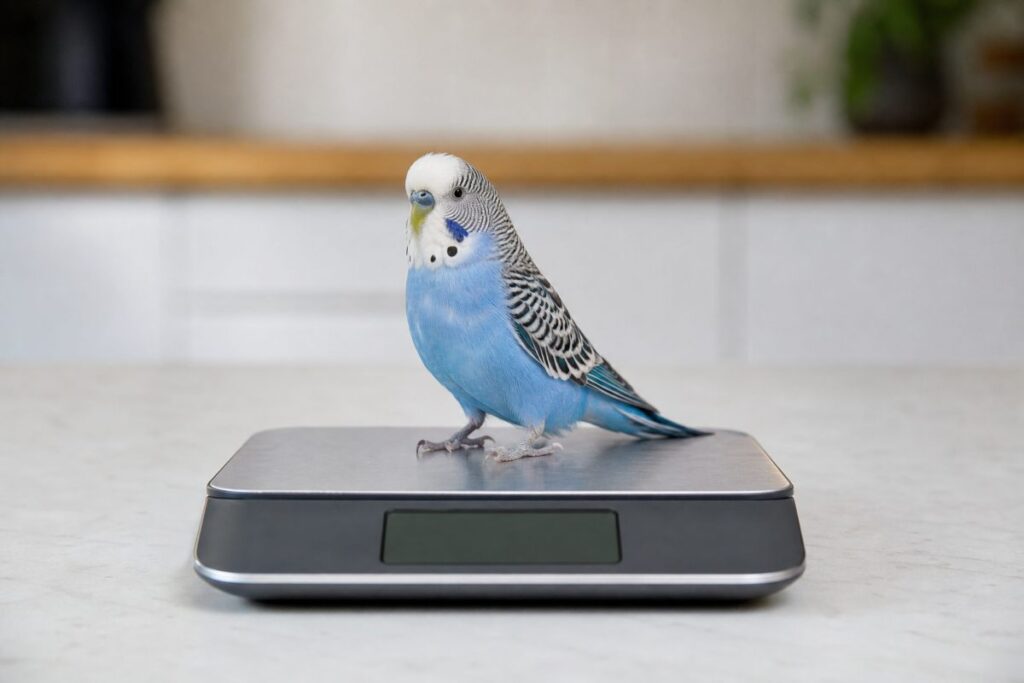
Here is a schedule that works.
Weeks 1 and 2. Keep the seed portion exactly as it is. Add a separate dish of pellets next to it. Change nothing else. The bird just needs to see pellets in its world.
Weeks 3 and 4. Crush a few pellets over the seed so the taste and smell become familiar.
Weeks 5 to 8. Reduce the seed portion a little at a time while pellets stay available all day. Weigh the bird twice a week and write the numbers down.
Throughout. Keep vegetables in the cage every morning, not just at the end.
Never take the seed away entirely and let hunger do the work. That advice shows up on forums and it kills birds.
Are Pellets Always Safe?
Almost always, but not automatically. Pellets remain the best base available for a captive budgie, and there is one documented failure worth knowing about.
Olds and colleagues documented what happened to a flock of 229 budgies at Blank Park Zoo, published in the Journal of Zoo and Wildlife Medicine in 2015. Birds started dying in spring 2012 with weakness, an inability to fly, and sudden death. The cause was an overdose of vitamin D3. Testing found the formulated diet contained vitamin D3 at 22.5 times the amount printed on the manufacturer’s label. The finding led to a recall of more than 100 formulated diets in the United States and internationally.
This is not a reason to avoid pellets. Pellets are still the best base available for a captive budgie, and a manufacturing fault like this is rare.
It is a reason to do two things. Buy from established brands with a long track record. And do not add vitamin supplements on top of a pellet diet, because pellets are already fortified. Adding a vitamin powder to a fortified food is how a deficiency problem turns into an overdose problem.
What Are the Signs of a Poor Diet in a Budgie?
Watch for weight loss on the scale, a sharp breastbone, dull or lined feathers, an overgrown beak, fatty lumps under the skin, changed droppings and crusty nostrils. Budgies hide illness, because in the wild a sick bird gets eaten, so by the time you can see something it has usually been building for a while.
| Sign | What it suggests |
|---|---|
| Weight dropping on the scale with no visible change | The earliest and most reliable warning |
| A sharp, prominent breastbone | Muscle loss across the chest |
| Sitting fluffed up and doing less | General illness, needs a vet |
| Faint lines across the feathers | Nutritional gaps during feather growth |
| Overgrown beak or nails | Often linked to liver disease |
| Fatty lumps under the skin | Obesity from a high-fat seed diet |
| Droppings change | Color, amount or consistency shifting with no food change |
| Sneezing, eye discharge, crusty nostrils | Often connected to vitamin A deficiency |
The most useful thing you can own for a budgie is a kitchen gram scale. It costs very little and it catches problems weeks before your eyes will.
What Does a Wild Budgie Eat?
Wild budgies come from the Australian grasslands. According to VCA Animal Hospitals, they eat a range of seeds as those seeds come into season, along with fruit, berries and other plant material. They feed on or near the ground, and the mix changes through the year with whatever happens to be available.
Two things about that explain why captive feeding goes wrong.
The wild diet never stops changing. A bowl of the same eight seeds every day for ten years is nothing like it.
And a wild budgie flies long distances between feeding sites. The same fat that fuels those flights simply accumulates in a bird that moves a few feet between perches.
For the wider picture across all parrot species, see What Do Parrots Eat?
Key Takeaways
A budgie weighs 30 to 40 grams, so portion size matters more than food choice. One grape is about 14 percent of its body weight.
Veterinary sources genuinely disagree on the exact pellet-to-seed ratio, because budgie nutrition research is thin and much of it comes from studies on chickens.
Seed is not indigestible. Budgies absorb over 80 percent of its main nutrients. The problem is what seed does not contain.
Never starve a budgie onto pellets. Weigh it on a gram scale, and if it loses more than about 10 percent of its body weight, stop and call an avian vet.
Do not add vitamin supplements to a pellet diet or drops to the drinking water. Pellets are already fortified and water doses cannot be measured.
Vegetables every morning, fruit two or three times a week, seed measured rather than free-fed, and millet as a treat rather than a fixture.
Frequently Asked Questions
Can budgies eat grapes?
Yes, but portion is the issue. One grape weighs about 5 grams and a budgie weighs about 35 grams, so a whole grape is roughly 14 percent of the bird’s body weight. Offer a quarter of a grape at most, a few times a week, and wash it well since grapes carry heavy pesticide residue.
Can budgies eat carrots?
Yes. Carrots are one of the best vegetables for a budgie because of their vitamin A, which seed diets lack. Grate them or slice them thin rather than offering a whole chunk, since a large piece is a choking risk for a bird this size. Carrot tops are safe too and many budgies prefer them.
Can budgies eat broccoli?
Yes, raw and finely chopped. Broccoli works well as a daily vegetable and most budgies accept the small florets once they get used to the texture. Wash it well and remove anything left in the cage after a couple of hours so it does not spoil.
How much should a budgie eat per day?
Roughly a level teaspoon of seed mix, pellets available for most of the day, and a small handful of finely chopped vegetables each morning. The more useful measure is body weight. Weigh your bird on a gram scale weekly and watch for change rather than counting pieces of food.
Do budgies need grit?
No. Budgies strip the husk off a seed before swallowing it, so they do not need grit to grind food. Veterinary sources note that unwell birds sometimes eat too much grit, which risks a blockage. If you offer it at all, put a tiny amount in a separate dish and never spread it on the cage floor.
Can budgies eat bread?
Not as a regular food. Bread is not toxic, but it fills a very small stomach with calories that carry almost no nutrition. An occasional crumb of plain wholegrain bread will not hurt. Anything salted, buttered or sweetened should not be offered at all.
How long do budgies live?
Most references list 5 to 10 years for pet budgies, and well-cared-for birds sometimes reach 12 to 15. Diet is one of the biggest factors you control. Obesity, fatty liver disease and vitamin A deficiency from long-term seed-only feeding are among the most common reasons a budgie’s life is cut short.
Sources
Earle, K. E., and Clarke, N. R. (1991). The nutrition of the budgerigar (Melopsittacus undulatus). The Journal of Nutrition, 121(11 Suppl), S186 to S192. https://doi.org/10.1093/jn/121.suppl_11.S186
Eggleston, K. A., Schultz, E. M., and Reichard, D. G. (2019). Assessment of three diet types on constitutive immune parameters in captive budgerigar. Journal of Avian Medicine and Surgery, 33(4), 398 to 405. https://doi.org/10.1647/2018-395
Olds, J. E., et al. (2015). Clinical investigation into feed-related hypervitaminosis D in a captive flock of budgerigars (Melopsittacus undulatus). Journal of Zoo and Wildlife Medicine, 46(1), 9 to 17. https://doi.org/10.1638/2013-0062R2.1
VCA Animal Hospitals, Feeding Budgies
This article is general guidance and does not replace veterinary care. If your budgie is losing weight, refusing food, or showing any of the warning signs above, contact an avian veterinarian.