
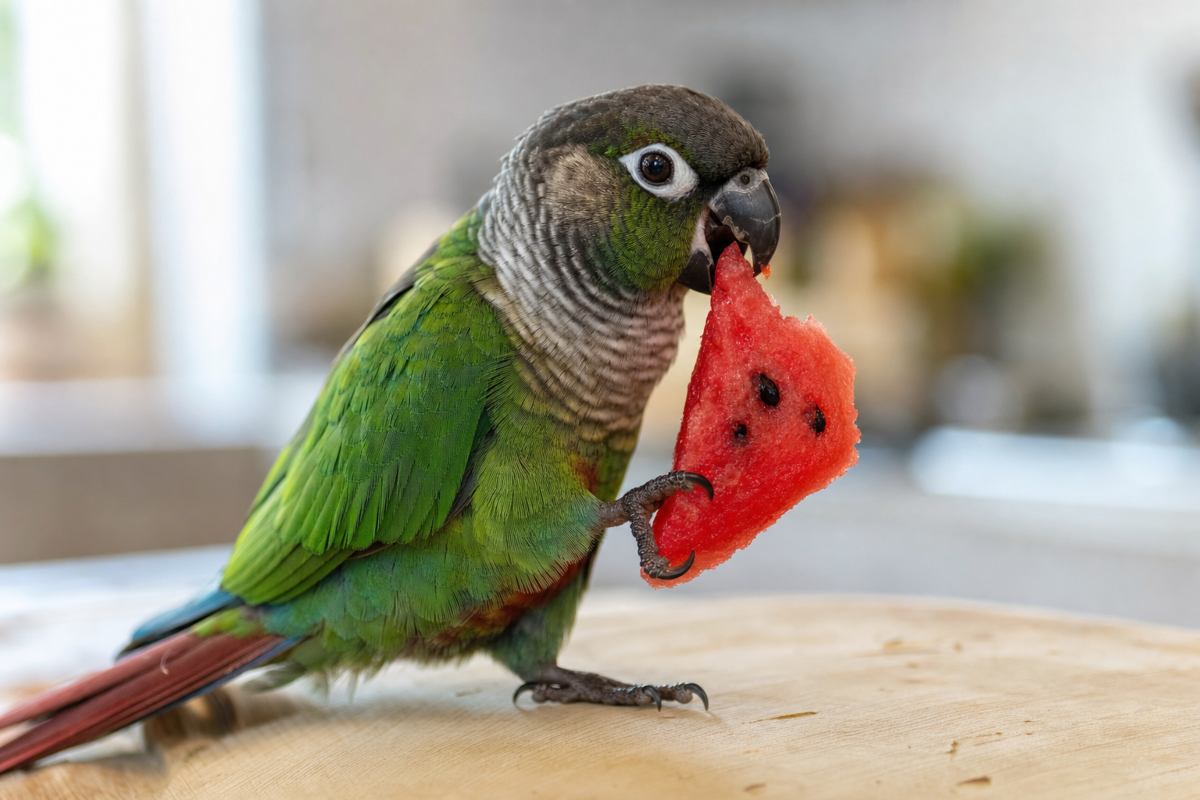
Yes. Watermelon is among the safest fruits you can give a parrot, and every part of it is edible: the flesh, the black seeds and the rind.
That disagrees with most of what you will read about it, and one widely shared article is telling people something that is simply not true.
It warns that watermelon seeds contain cyanide compounds. They do not. Those compounds belong to a completely different group of fruits.
The mix-up matters, because it has owners picking seeds out of a fruit their bird could have eaten whole.
Key facts at a glance
| Question | Answer |
|---|---|
| Can parrots eat watermelon? | Yes, and most birds love it |
| Can parrots eat watermelon seeds? | Yes. They contain no cyanide compounds |
| Can parrots eat watermelon rind or skin? | Yes, washed. It is the most nutritious part |
| Is watermelon high in pesticides? | No. It ranks among the lowest-residue produce |
| How much water is in it? | About 92 percent |
| Will it give my bird diarrhea? | No, but droppings will get watery for a few hours |
| Is it high in sugar? | Low, for a fruit. About 6 g per 100 g |
| How often? | Two or three times a week as a treat |
| Seedless watermelon? | Fine, but you lose the best part |
| Never serve with | Salt, sugar, syrup, chili, or anything from a fruit salad |
Can parrots eat watermelon?
Yes. Watermelon (Citrullus lanatus) is safe for every parrot species, from a 30 gram budgie to a macaw. It is also one of the easiest fruits to get a bird to accept, because the sweetness and the water do most of the persuading for you.
It carries vitamin C, potassium, magnesium, and the building blocks the bird turns into vitamin A. The red color comes from lycopene, the same pigment that colors tomatoes. At about 92 percent water, a slice on a hot day is genuinely useful rather than just enjoyable.
The catch is the same one that applies to every fruit. Sugar. Fruit sits in the small treat share of the diet, not the large vegetable share, and watermelon is no exception.
Can parrots eat watermelon seeds?
Yes. The black seeds are safe, and there is nothing in them that needs removing, soaking or picking out. Most parrots go for the seeds first and treat the flesh as the wrapper.
This is where the internet goes wrong, so it is worth being precise.
A widely shared article claims watermelon seeds hold compounds that release cyanide. Those compounds are real, and they do cause real poisoning. They are simply not in watermelon.
Here is where the confusion comes from.
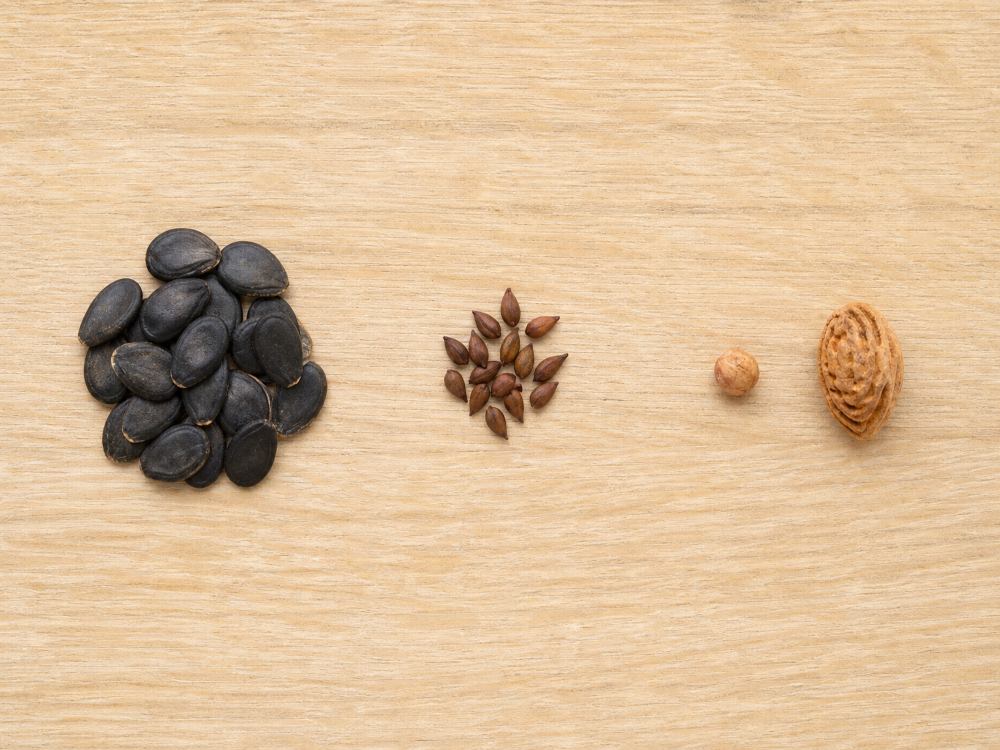
One family of fruit trees, the rose family or Rosaceae, puts a chemical called amygdalin in its seeds. When the seed is crushed or chewed, that chemical releases cyanide. The family covers apples, pears, cherries, apricots, peaches and plums.
Watermelon is not in that family. It belongs to the gourds, the Cucurbitaceae, alongside cucumber, pumpkin and squash. Nothing in that group carries amygdalin, and neither do grape seeds or strawberry seeds.
So the seeds stay in. They are protein, healthy fat and a genuine foraging challenge for a bird that likes to work at its food.
You will also see advice to soak the seeds overnight to soften them and prevent choking. There is no need. A parrot beak is a seed-cracking tool, and a watermelon seed is smaller and softer than half the things in a standard seed mix.
What seeds can parrots not eat?
The seed question is the one most owners actually came to ask, so here is the whole picture in one place.
| Fruit | Seeds or pit | Why |
|---|---|---|
| Watermelon | Safe | No cyanogenic compounds. Cucurbitaceae family |
| Grapes | Safe | Same. Nothing to remove |
| Strawberries, raspberries | Safe | Tiny and harmless |
| Melon, cantaloupe, honeydew | Safe | Same family as watermelon |
| Pumpkin, squash | Safe | Same family. Often fed deliberately |
| Papaya | Safe in small amounts | Peppery, and some birds enjoy that |
| Pomegranate | Safe | Fine to feed whole |
| Citrus | Safe but bitter | Most birds spit them out |
| Apple | Remove | Seeds contain amygdalin |
| Pear | Remove | Same as apple |
| Cherry | Remove | Pit contains amygdalin |
| Peach, nectarine, plum, apricot | Remove | Pits carry the highest levels |
The rule is simple enough to remember. If the fruit grows on a tree in the rose family, take the seed out. If it grows on a vine or a bush, the seed is almost always fine.
That is why apples need their seeds removed while watermelon does not. The flesh of both is perfectly safe. The difference sits entirely in the seed.
Can parrots eat watermelon rind or skin?
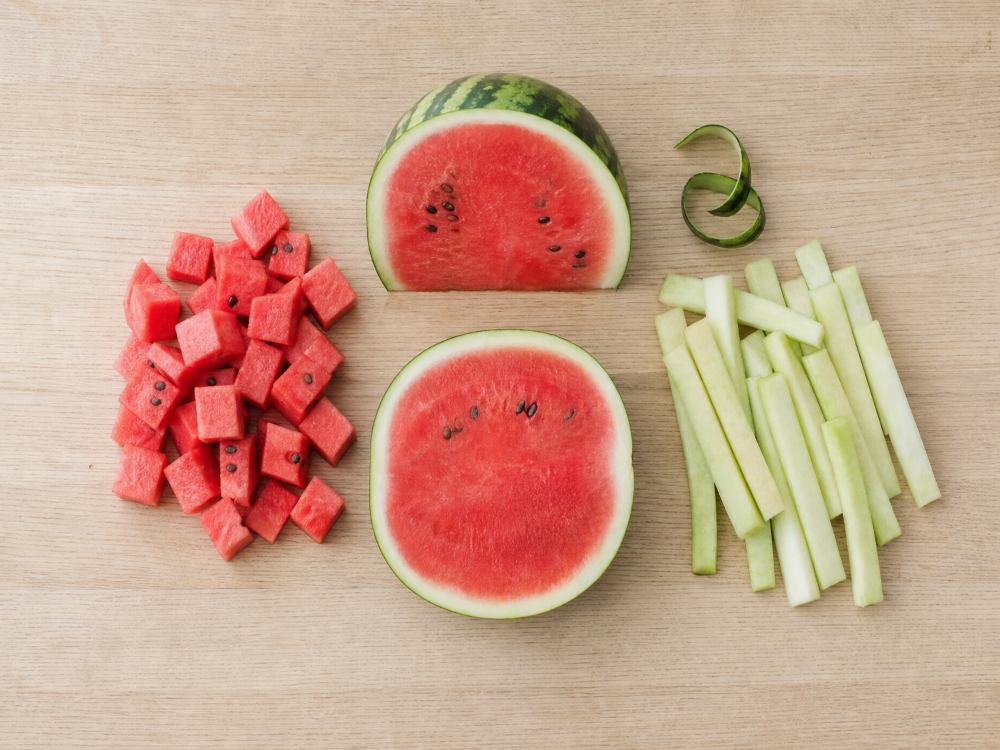
Yes, washed and cut into strips. The rind is the part almost everyone throws away, and it carries more fiber than the flesh. It also holds citrulline, an amino acid that sits in the white layer just inside the green skin.
You will read almost everywhere that the rind should be avoided because it is loaded with pesticides. That claim is worth checking rather than repeating.
The Environmental Working Group publishes an annual ranking of produce by pesticide residue. Watermelon appears on the Clean Fifteen, the fifteen lowest-residue items out of forty-seven tested. The reason given is the thick rind, which blocks pesticides from reaching the flesh. Nearly 60 percent of Clean Fifteen samples carried no detectable pesticide residue at all.
One honest caveat goes with that. The testing measures the part people eat, which is the flesh, so it never measures the rind itself. What it does tell you is that watermelon is not a heavily sprayed crop. That is a long way from the claim that the rind is full of pesticides.
The practical answer sits between the two extremes.
- Wash the outside of the whole melon before you cut it. You should do this anyway, because a knife drags whatever is on the skin straight into the flesh
- Feed the pale inner rind, the white and light green part
- Trim off the dark green outer skin, which is tough rather than dangerous
- Buy organic if it is available and affordable, though this is a fruit where it matters least
The rind also gives a bird something to chew, which the flesh does not. Cut it into thick strips and let the bird work at it.
This is the same pattern as carrots, where the green tops get thrown away despite being the more nutritious half of the plant.
Why does watermelon make droppings watery?
Because it is 92 percent water, and that water has to go somewhere. What you will see in the cage tray afterwards is more liquid, and it is normal.
This is worth explaining properly, because owners see it and panic, and several articles on this topic call it diarrhea. It is not diarrhea, and the difference matters.
A bird dropping has three parts.
| Part | What it is | What watermelon does to it |
|---|---|---|
| Feces | The solid green or brown coil | No change. Still formed |
| Urates | The chalky white portion | No change |
| Urine | The clear liquid around the outside | More of it, for a few hours |
More clear liquid with the solid part still holding its shape is polyuria, which simply means passing more urine. It follows any watery food and it clears up on its own.
This is not a guess. VCA Animal Hospitals publishes a guide to abnormal droppings in birds, written by three avian veterinarians, and it names watermelon directly.
A bird eating plenty of fresh fruit, apples and watermelon and peaches and grapes among them, passes a large amount of urine. That is expected. It is not a symptom.
Diarrhea is a different thing. There the fecal portion itself turns mushy or semi-liquid and loses its shape. If that is what you are seeing, watermelon is not the cause.
The rule the same guide gives is a clean one to remember. Anything that stays abnormal for longer than 24 hours needs an avian vet, meaning a vet who specializes in birds. A watery ring around a normal dropping for an afternoon does not.
Serve watermelon earlier in the day rather than in the evening if the mess bothers you, and put paper down.
How much watermelon can a parrot eat?
Fruit belongs in the treat share of the diet. Most avian vets put fruit, seeds and nuts together at no more than 10 to 20 percent of what a bird eats. Pellets and vegetables make up the rest.
| Bird | Typical weight | Watermelon per serving | How often |
|---|---|---|---|
| Budgie, parrotlet | 25 to 45 g | 1 teaspoon, diced small | 2 x per week |
| Cockatiel, lovebird | 80 to 110 g | 1 to 2 teaspoons | 2 to 3 x per week |
| Conure, caique | 60 to 170 g | 1 tablespoon | 2 to 3 x per week |
| Senegal, Pionus, Quaker | 120 to 300 g | 1 to 2 tablespoons | 2 to 3 x per week |
| African Grey, Amazon | 400 to 550 g | 2 tablespoons, or a small wedge | 2 to 3 x per week |
| Cockatoo | 550 to 900 g | 3 tablespoons, or a wedge | 2 to 3 x per week |
| Macaw | 900 to 1,300 g | ¼ cup, or a large wedge | 2 to 3 x per week |
Watermelon carries around 6 grams of sugar per 100 grams. That is more than a vegetable and less than most fruit. A grape holds roughly 16 grams and a banana around 12. That makes watermelon one of the gentler fruits for sugar.
Watch the portion size, though. All that water makes a serving look enormous for very few calories, so it is easy to hand over far more than you meant to. Weigh your bird on a gram scale and measure the fruit rather than judging by the size of the slice.
Fruit shares one allowance. If your bird has already had grapes or banana today, the watermelon comes out of the same budget rather than being added on top.
Can budgies and parakeets eat watermelon?
Yes, and the answer is the same for both, because in the United States parakeet almost always means budgie. Every budgerigar is a parakeet, but not every parakeet is a budgerigar.
Size changes how you serve it. A budgie weighs about 30 grams, and a chunk of melon larger than its head is not useful to it.
- Dice the flesh into pieces no bigger than a pea
- Leave the seeds in. A budgie cracks them easily and they are the part it will want
- Offer a thin sliver of pale rind rather than a thick strip
- Serve about a teaspoon, twice a week
- Put it in a shallow dish rather than the main bowl, since wet food soaks the seed mix underneath
Budgies that have never seen wet food sometimes refuse it at first. Try a piece pressed against the cage bars at eye level, where it looks less like something on the floor and more like something worth investigating.
How do you prepare watermelon for a parrot?
- Wash the whole melon under running water before cutting. Scrub the skin.
- Cut it into slices, then cut the flesh into pieces sized for your bird.
- Leave the seeds in. They are safe and most birds prefer them.
- Cut a few strips of the pale inner rind if you want to offer it.
- Trim off the dark green outer skin.
- Add nothing at all. No salt, no sugar, no honey, no lime, no chili.
- Serve in a shallow dish so it does not soak the dry food.
- Take it out within two hours. Cut fruit spoils fast and grows mold in a warm cage.
Chilled watermelon straight from the fridge is fine on a hot day and many birds prefer it, but let it lose the worst of the chill first. Frozen chunks are also safe, and they keep a bird busy on a hot afternoon.
Watermelon does not mix well into chop, the batch of chopped vegetables over a cooked grain that many owners freeze in daily portions. Too wet. It turns the whole mix to slush, so serve it separately.
What should never go with it?
Plain fruit is the whole rule. Everything people add to watermelon is a problem for a bird.
| Never add | Why |
|---|---|
| Salt | A common addition for people, and a bird’s kidneys cannot handle it |
| Sugar, honey or syrup | The fruit is sweet enough already |
| Chili, tajin or lime | Fine for you, unnecessary irritation for a bird |
| Feta or any cheese | Birds cannot digest lactose, and the salt load is high |
| Avocado in a fruit salad | Toxic to parrots with no safe amount |
| Mint or herb syrups | Sugar with a garnish |
| Alcohol of any kind | Never, in any quantity |
| Anything from a shared fruit platter | Assume salt, syrup or dressing unless you cut it yourself |
| Watermelon that smells sour | Cut melon spoils quickly. When in doubt, throw it out |
Is watermelon a good fruit for parrots?
It is a good one, though papaya and berries beat it on nutrition alone. Watermelon’s strength is that birds actually eat it, which is worth more than a strong nutrient chart on a fruit your bird refuses.
| Fruit | Sugar per 100 g | Standout nutrient | Notes |
|---|---|---|---|
| Berries | 5 to 10 g | Antioxidants, fiber | Excellent, and small enough for tiny birds |
| Watermelon | About 6 g | Lycopene, potassium, water | Among the lowest sugar of the common fruits |
| Papaya | About 8 g | Vitamin A, enzymes | The best all-round choice on nutrition |
| Apple | About 10 g | Fiber | Remove the seeds |
| Banana | About 12 g | Potassium | Easy to overfeed |
| Mango | About 14 g | Vitamin A | High in sugar, so keep portions small |
| Grape | About 16 g | Antioxidants | Highest sugar of the group |
No single fruit is the favorite of every parrot. Species differ, and so do individual birds. Papaya, mango, banana and grapes are the ones most commonly reported as favorites, and watermelon sits close behind because of the water and the seeds.
Variety beats any one fruit. A bird eating four fruits in rotation is better fed than a bird eating the theoretically best one every day.
Can wild birds eat watermelon too?
Yes, and it is one of the easiest things you can put out in summer.
Cut a melon in half, set it rind-down on a platform feeder, and leave it. Orioles, catbirds, mockingbirds, tanagers, house finches and jays all take it. So do squirrels, which is either a feature or a problem depending on your view.
The rules are slightly different outdoors than in a cage.
| In the cage | On the feeder |
|---|---|
| Dice to the bird’s size | Leave it in the half, birds work at it themselves |
| Remove after two hours | Remove at the end of the day |
| Seeds left in | Seeds left in |
| Rind trimmed and offered | Rind acts as the bowl |
| Wash before cutting | Wash before cutting |
Take it out before dark. Overnight it draws wasps, ants and raccoons, and by the second day in the sun it grows mold.
Watermelon will not replace a proper seed mix or a nectar feeder. It is a summer extra that happens to be popular, and the water in it matters during a heat wave more than the nutrition does.
When should you hold back on watermelon?
- Overweight birds: the sugar counts even though the calories per gram look low
- Birds already refusing pellets: sweet wet fruit is exactly what a fussy bird will hold out for
- Birds with diagnosed diabetes or liver disease: talk to your vet before adding sweet fruit
- Chicks still being hand-fed: hand-rearing formula only until fully weaned
- Birds with formless, smeared droppings: find the cause before adding a watery food
- Hot weather: watermelon is useful here, but cut fruit spoils faster. One hour in the cage, not two
Frequently asked questions
Can parrots eat watermelon?
Yes. Watermelon is safe for parrots and one of the easiest fruits to get a bird to accept. The flesh, the seeds and the pale inner rind are all edible. Serve it plain, in a measured portion, two or three times a week.
Can I feed my parrot watermelon seeds?
Yes. Watermelon seeds are completely safe and most parrots eat them first. Unlike apple seeds or cherry pits, they hold nothing that releases cyanide. There is no need to remove them, soak them or grind them.
What seeds can parrots not eat?
Apple seeds, pear seeds, and the pits of cherries, peaches, plums, nectarines and apricots. All of those come from the rose family and hold a compound called amygdalin, which releases cyanide when the seed is crushed.
Seeds from watermelon, melon, grapes, berries, pumpkin, squash and pomegranate are all safe and need no removing.
Can parrots eat watermelon skin or rind?
The pale inner rind, yes. Wash the melon first and cut the rind into strips. It carries more fiber than the flesh and gives the bird something to chew. Trim off the tough dark green outer skin, which is not dangerous, just unappealing.
Is watermelon high in pesticides?
No. Watermelon sits on the Environmental Working Group’s Clean Fifteen, the list of produce with the lowest pesticide residues, because the thick rind blocks pesticides from reaching the flesh. Wash the outside before cutting, as you would with any fruit.
Will watermelon give my parrot diarrhea?
No. It will make droppings look watery for a few hours, which is polyuria rather than diarrhea. The solid part should keep its shape and only the clear liquid around it should increase. Veterinary guidance names watermelon as one of the fruits that does this.
If the solid portion turns mushy and formless, that is diarrhea, and watermelon is not the cause. Anything abnormal that lasts longer than 24 hours needs an avian vet.
Can budgies eat watermelon?
Yes. Dice it small, no bigger than a pea, and leave the seeds in since a budgie can crack them easily. About a teaspoon twice a week is a sensible portion. Serve it in a shallow dish so it does not soak the seed mix.
Can parakeets eat watermelon?
Yes. In the United States, parakeet almost always means budgie, so the answer is the same. Small dice, seeds left in, a teaspoon twice a week.
Can cockatiels eat watermelon?
Yes. A cockatiel handles watermelon more easily than a budgie and can manage small cubes rather than pea-sized dice. One to two teaspoons, two or three times a week, is a reasonable portion. Leave the seeds in.
Can African Greys and macaws eat watermelon?
Yes, and larger parrots get the most out of it. An African Grey or Amazon can take a small wedge and work at it, and a macaw can handle a large wedge with the pale rind still attached. The rind is where the chewing value sits, so bigger birds benefit from it more than small ones do.
Can conures eat watermelon?
Yes. A conure or caique does well with about a tablespoon, two or three times a week. Conures tend to be enthusiastic about wet fruit and messy with it, so use a shallow dish and expect to clean up.
Can parrots eat seedless watermelon?
Yes, though you lose the part most birds enjoy most. Seedless varieties still carry small pale immature seeds, which are also safe. If you have a choice, buy the seeded kind for a bird.
Can parrots drink watermelon juice?
Skip it. Juicing strips out the fiber and leaves concentrated sugar in water. Whole fruit does the job better, and plain fresh drinking water is what a bird actually needs.
How long can watermelon stay in the cage?
Two hours, or one hour in hot weather. Cut fruit spoils quickly and a warm cage speeds it up. Mold on damp fruit is a genuine risk to birds.
What is the healthiest seed for parrots?
For a treat seed, hemp and chia rank highest on nutrition, with milk thistle and flax close behind. Sprouted seed of any kind beats dry seed, because sprouting raises the vitamin content and cuts the fat. Sunflower and safflower are the ones to limit, since birds pick those out first and they are the fattiest in the mix. Seeds from fruit, including watermelon, are a different thing entirely and are fine as an occasional extra.
What is a parrot’s favorite fruit?
No single answer fits, since it varies by species and by individual. Papaya, mango, banana and grapes come up most often, with watermelon close behind. What matters more is rotation. A bird offered several fruits through the week eats better than one given the same fruit every day.
Can wild birds eat watermelon?
Yes. Orioles, catbirds, mockingbirds, finches and jays all take watermelon readily, and a cut half left on a platform feeder in summer is a reliable draw. Take it out at the end of the day so it does not attract wasps and mold.
If you are unsure how much fruit suits your own bird, an avian vet can weigh it and work the answer out from its actual condition. That beats any general chart, including this one.
The short version
Watermelon is safe, and so is every part of it. Flesh, seeds and pale rind.
Three things are worth taking away.
First, the seeds. They contain no cyanide compounds, whatever you may have read. Those belong to apples, pears and stone fruit, which come from a different plant family. Leave watermelon seeds in and let the bird enjoy them.
Second, the rind. It is the most nutritious part and the only part with any chew to it. Watermelon is among the lowest-pesticide fruits you can buy, so wash the outside, feed the pale inner layer, and trim the dark green skin off.
Third, the droppings. Watery for a few hours is normal and not diarrhea. The solid part should still hold its shape. If it does not, the melon is not your problem.
Wash it, cut it to size, leave the seeds, add nothing, and take the bowl out after two hours.
Sources and notes
- Polyuria compared with diarrhea, the three parts of a normal dropping, the 24-hour rule, and fresh fruit including watermelon as a cause of increased urine: Gregory Rich DVM, Laurie Hess DVM and Rick Axelson DVM, Abnormal Droppings in Birds, VCA Animal Hospitals, linked above
- Cyanogenic glycosides are confined largely to Rosaceae seeds and pits, and watermelon, grape and strawberry seeds are harmless: published reviews of amygdalin distribution in fruit seeds
- Watermelon pesticide ranking: Environmental Working Group, Clean Fifteen, 2026 Shopper’s Guide to Pesticides in Produce
- Water content, sugar and nutrient composition of watermelon and other fruits: USDA FoodData Central
- Fruit, seed and nut proportions in parrot diets: Veterinary Partner (VIN), Diets for Healthy Parrots
- Citrulline content of watermelon rind: published food composition research on Citrullus lanatus
This article is for general information and does not replace veterinary advice. If your bird’s droppings stay formless, or it stops eating, contact an avian veterinarian rather than adjusting its diet on your own.