
Most people want two dates: when to put the feeder up in spring, and when to take it down in fall. Almost every guide gives you one or the other. This one gives you both, in a single table, for every part of the country.
It also answers a question that nearly every website gets wrong. Ask whether the same hummingbirds come back to your feeder each year and you will read a confident yes almost everywhere. The research says otherwise, and the numbers are further down.
When do hummingbirds migrate?
Hummingbirds fly north between late February and mid May, and south between late July and late October. The exact weeks depend on where you live and which species passes through.
Spring migration begins on the Gulf Coast in late February and reaches Canada by mid May. Fall migration starts earlier than most people expect. Some western birds head south in July, and the last stragglers cross the southern US border in late October.
| Season | Starts | Peaks | Ends |
|---|---|---|---|
| Spring, heading north | Late February, Gulf Coast | Mid April | Mid May, Canada and Alaska |
| Fall, heading south | Late July | Late August to mid September | Late October |
Males move first in both directions. In spring they show up about a week before the females, because the first male to claim a patch gets the best feeding ground. In fall the adult males leave weeks before the females and the young birds. That is why so many people think the season is over in midsummer when the females are still around.
Hummingbird migration dates by region
The table below gives the arrival and departure window for every part of the country in one place. These are typical windows, not fixed dates, and they move by a week or two from year to year.
| Region | States | Spring arrival | Fall departure |
|---|---|---|---|
| Gulf Coast | TX, LA, MS, AL, FL panhandle | Late February to mid March | Late September into November |
| Florida peninsula | FL | Late February to March | October, some birds stay all winter |
| Southeast | GA, SC, NC, TN, AR | Late March to early April | Late September to mid October |
| Mid Atlantic | VA, MD, DE, NJ, WV, KY | April | Late September to early October |
| Lower Midwest | MO, KS, OK, IL, IN, OH | April | Late September |
| Upper Midwest | MN, WI, MI, IA, NE, ND, SD | Late April to mid May | Early to late September |
| Northeast | NY, PA, CT, RI, MA, VT, NH, ME | Early to mid May | Mid September to early October |
| Southwest | AZ, NM, NV, southern CA | February to April, depends on species | July onward, some stay all year |
| Pacific Coast | CA, OR, WA | Anna’s are here all year | Anna’s do not migrate |
| Rocky Mountains | CO, UT, WY, MT, ID | April to May | July to September |
Two rows need a word of explanation.
The Gulf Coast runs into November because those states hold onto their hummingbirds far longer than anywhere else, and some birds never leave at all. Researchers who catch and record winter birds along the Gulf have found more rufous hummingbirds than ruby-throats among them. So a hummingbird at a Louisiana feeder in January is probably a western bird that flew in, not a local one that stayed behind.
The Pacific Coast has no departure date because Anna’s hummingbirds live there year round, from Vancouver down through Baja and into parts of Arizona. If that is your area, the migration calendar does not really apply to you. Leave your feeder up through the winter.
Where are hummingbirds in their migration right now?
Find the current month in the table below. It shows where hummingbirds are and what to expect at your feeder.
| Month | What is happening |
|---|---|
| February | First males reach the Gulf Coast |
| March | Movement across the Gulf Coast and into the Southeast |
| April | Peak spring movement. Birds spread across the eastern and central states |
| May | Arrivals in the Northeast, Upper Midwest, and Canada |
| June and July | Nesting season. Western birds begin heading south late in July |
| August | Fall migration builds. Adult males have already left the north |
| Late August to mid September | Peak movement. The busiest feeder activity of the year |
| Mid to late September | Most birds leave the Midwest and Northeast |
| Early to mid October | Eastern states empty out |
| Late October | Final stragglers cross the southern US border |
| November to January | Gulf Coast and Southwest wintering birds only |
If it is late August or early September as you read this, the birds crowding your feeder are mostly young ones born this summer, making their first trip south with no route to follow and no adult to follow it with.
For live sightings rather than typical dates, two projects collect reports from birdwatchers as they come in. Hummingbird Central runs spring and fall maps built from reader submitted first sightings. Journey North, run through the University of Wisconsin Madison Arboretum, keeps years of records so you can compare this year against past ones.
Those maps tell you where the birds are today. The table above tells you when to expect them at your house. Use both, because a sighting two states south does not tell you whether that means next week or next month.
Do the same hummingbirds come back to your feeder every year?
Sometimes, but far less often than most websites claim. The best evidence comes from bird banding, where researchers catch hummingbirds, fit a tiny numbered ring on one leg, and record any bird they catch again in later years.
At a long running banding site near York, South Carolina, researchers with Operation RubyThroat banded 3,614 ruby-throated hummingbirds. Of those, 437 were caught there again in a later year. That is 12.1 percent, or roughly one bird in eight. Two individuals came back five years in a row.
| What researchers found | Number |
|---|---|
| Ruby-throats banded at the York, South Carolina site | 3,614 |
| Birds caught there again in a later year | 437, or 12.1 percent |
| Longest run of returns by one bird | 5 years |
| Yearly survival rate for males, Powdermill Nature Reserve | 31.2 percent |
Those two numbers are worth putting side by side. About a third of adult males survive any given year, but only about one in eight banded birds ever turns up at the same site again. Some of that difference is birds that lived but settled somewhere else. Some is birds that did come back but were never caught a second time. Maine Audubon sums it up as possibly rather than probably, which is the most honest answer available.
What is much better established is the pattern rather than the individual bird. Hummingbirds have excellent memories for places. They follow the same routes year after year and pass through the same stopping points within a few days of the same date. Young birds tend to return to the area where they hatched. So the hummingbird at your feeder next May may well be one you saw before, and the odds are better than pure chance. It is simply not the near certainty you will read elsewhere.
There is something useful in this. Because hummingbirds check places where they found food before, it pays to have a clean feeder up a week or two before your region’s arrival window. A bird that finds nothing there may not come back to check again.
How long does it take a hummingbird to migrate from Canada to Mexico?
The full trip south from Canada to Mexico takes about four to eight weeks. The bird does not fly it in one go. It travels in short daily stages and stops to feed along the way.
A ruby-throat covers roughly 20 to 25 miles on an ordinary day of travel over land, and up to 60 miles when conditions are good. In level flight it moves at 20 to 30 miles an hour. Spread a 2,000 mile route over stops that can last anywhere from a few minutes to several days and you get a journey of a month or two.
One stretch is different from all the rest.
| The Gulf of Mexico crossing | Figure |
|---|---|
| Open water to cross | About 500 miles |
| Time in the air with no rest or food | 18 to 22 hours |
| Weight gained before setting off | 25 to 40 percent of body weight, sometimes close to double |
| Heart rate during migration | Up to 1,260 beats per minute |
| Wingbeats | 15 to 80 per second |
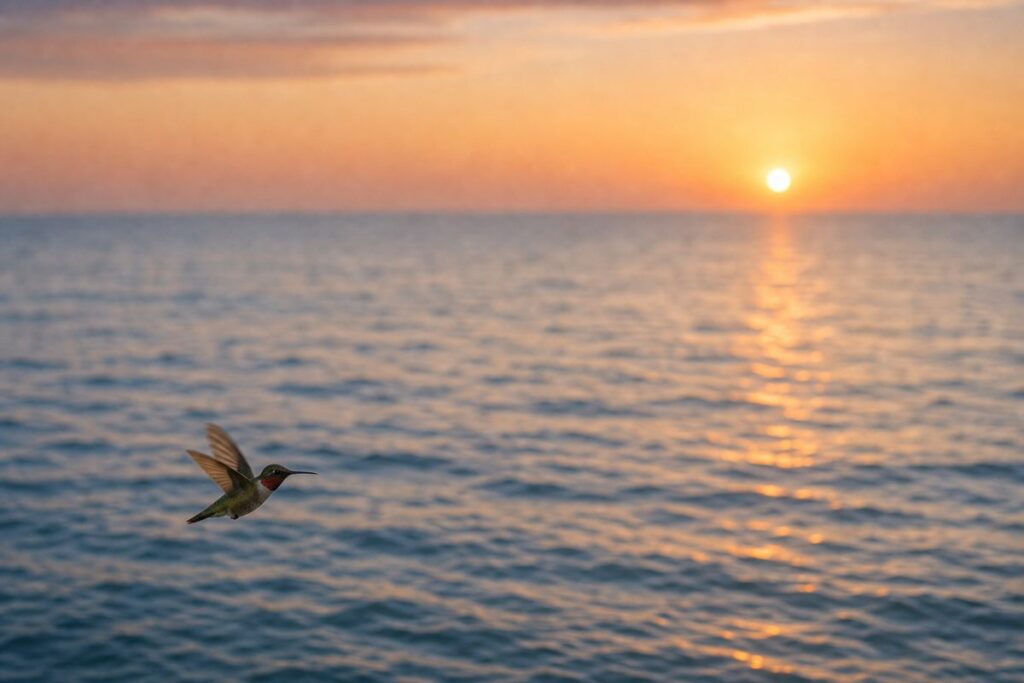
There is nowhere to land in the middle. No island, no food, no rest. A bird that runs out of fuel does not make it. Many wait on the coast for days until the wind is right before setting off, and some avoid the crossing altogether by taking the longer land route around the Gulf through Texas.
Not every hummingbird flies this route. The rufous hummingbird makes the longest journey of any North American species, about 3,900 miles one way from Alaska and the Pacific Northwest down to western Mexico. It travels in a loop: north along the Pacific Coast in spring, then south through the Rocky Mountains in fall, timing the mountain route to arrive when the high meadow wildflowers are at their best in July and August.
Are hummingbirds migrating early in 2026?
Spring arrivals have been getting earlier in the southern states, and 2026 followed that trend. The change is clear in the Southeast and much smaller further north.
Audubon reports that as winters get milder in Central America, ruby-throats are leaving their winter homes sooner and reaching the Gulf Coast earlier than they used to. University extension services across several southern states now put the first arrivals in Georgia and Tennessee in late March, while many longtime birdwatchers there still expect mid April.
| Region | How much the timing has moved |
|---|---|
| Gulf Coast and Southeast | Noticeably earlier. Move your feeder date up |
| Mid Atlantic and Midwest | Slightly earlier |
| Northeast and Upper Midwest | Little change. The old dates still work |
If you live in Georgia, Tennessee, South Carolina, or Arkansas and you have always hung your feeder in mid April, the evidence says move it to late March. If you live in Minnesota or Maine, your usual date is still fine.
Fall departure has barely shifted, because fall migration runs on day length, and day length does not change with the climate.
Which hummingbird species migrate through the United States?
There are more than 300 hummingbird species in the world, but only 12 to 15 regularly reach the United States, and they do not all keep the same schedule. Most migration guides cover only the ruby-throat, which leaves anyone in the western half of the country without an answer.
| Species | Where you find it | Migration pattern |
|---|---|---|
| Ruby-throated | Eastern US and Canada | The only hummingbird that nests in the East. Crosses the Gulf |
| Rufous | Alaska down to Mexico | The longest journey of any North American hummingbird, 3,900 miles |
| Anna’s | Pacific Coast, parts of Arizona | Lives there all year. Does not migrate |
| Black-chinned | Southwest and West | Winters in Mexico, arrives in spring |
| Broad-tailed | Rocky Mountains | Nests in the mountains, gone by September |
| Calliope | Northwest mountains | Smallest bird that nests in the US, with a long trip for its size |
| Allen’s | Coastal California | Migrates very early. Some groups stay all year |
| Costa’s | Desert Southwest | Desert bird. Some stay all year |
Two things follow from this table. If you are on the Pacific Coast, Anna’s hummingbirds are around all winter and there is no reason to take your feeder down at all. And if you spot a hummingbird in the eastern US in November or December, it is more likely a rufous that wandered east than a ruby-throat that stayed late.
What triggers hummingbird migration?
Day length triggers hummingbird migration. Not cold weather, and not running out of food. As the days shorten in late summer, hormonal changes push the bird to feed heavily, put on fat, and go.
This is the answer to the most stubborn myth about hummingbird feeders: that leaving one up in fall will keep the birds from migrating. It will not. Both the Cornell Lab of Ornithology and Audubon are clear that the timing is hormonal. A bird whose internal clock says leave on September 20 leaves on September 20, whether your feeder is full or empty.
Leaving a feeder up does not delay migration. It feeds birds that are already on their way. Those are two completely different things, and mixing them up causes people to take feeders down early every fall, right when late migrants need them most.
Three other things nudge the timing by a few days: when nectar plants bloom along the route, the weather including tailwinds and cold fronts, and how much fat the bird has managed to store. None of them override the day length signal.
When should you put up and take down your hummingbird feeder?
Put your feeder up one to two weeks before your region’s arrival window, and take it down two weeks after you see your last hummingbird of the year. Those two rules cover almost every situation in the country.
| Your situation | What to do |
|---|---|
| Spring, anywhere | Hang the feeder one to two weeks before your regional window |
| Fall, most states | Leave it up two full weeks after your last sighting |
| Gulf Coast | Leave it up through winter for the birds that stay |
| Pacific Coast | Leave it up all year for Anna’s |
| Eastern states, October and November | Worth leaving up for late rufous strays |
The two week rule exists because the last bird you see is rarely the last bird to pass through. Late hatchlings and older birds travel weeks behind the main wave, and birds coming down from further north are still moving after your local ones have gone.
If you keep a feeder up into late fall, the nectar still needs changing every three to five days even when nothing is drinking it. Nectar that has fermented or grown mold makes birds sick. A dirty feeder left out for a straggler does more harm than no feeder at all.
How do hummingbirds survive the journey?
Hummingbirds survive migration by putting on a huge amount of fat first and then burning through it. A bird may add a quarter to nearly half its body weight before a long crossing, and almost all of that is fuel.
They also travel alone. There is no flock, no leader, no shared route. A young bird making its first trip south has never seen where it is going and gets no help from adults. It finds its way using instinct, the position of the sun, and the Earth’s magnetic field. The old story about hummingbirds riding on the backs of geese is not true, though they do sometimes travel among mixed groups of other migrating birds.
Their metabolism is what makes all of this possible and also what makes it risky. The same body that can beat its wings 15 to 80 times a second has to feed almost constantly whenever it is not flying. Our guide to hummingbird facts explains how that works day to day, including torpor, the deep sleep they drop into on cold nights to slow their body down and save energy.
Hummingbirds are not the only North American birds that move with the seasons, though they are the most extreme for their size. Even bald eagles shift territory in the northern part of their range, following open water rather than day length.
Frequently asked questions
When do hummingbirds come back in spring?
Late February on the Gulf Coast, late March in the Southeast, April across the Mid Atlantic and Midwest, and early to mid May in the Northeast and Upper Midwest. Anna’s hummingbirds on the Pacific Coast never leave in the first place.
When do hummingbirds leave in fall?
Most leave the Northeast and Midwest between mid September and early October. Southeastern states empty out by mid October. Gulf Coast birds may stay into November, and some do not leave at all.
Do the same hummingbirds return to my feeder every year?
Sometimes. Banding research at one South Carolina site caught 12.1 percent of 3,614 ruby-throats again in a later year, so roughly one in eight. The species is very reliable about routes and dates, but individual birds return far less often than most websites suggest.
Will leaving my feeder up stop hummingbirds from migrating?
No. Migration is set off by day length and hormones, not by food. A feeder left up helps late migrants and delays nobody.
How long does the Gulf of Mexico crossing take?
18 to 22 hours of continuous flight across roughly 500 miles of open water, with no chance to rest or feed.
How far do hummingbirds migrate?
Ruby-throats cover 1,500 to 3,000 miles round trip. Rufous hummingbirds travel about 3,900 miles one way between Alaska and Mexico, the longest migration of any bird for its size.
Do hummingbirds migrate at night?
Mostly by day, feeding as they go. The Gulf crossing is the exception, since it is one continuous flight that carries on through the dark.
Which US states have hummingbirds year round?
The Pacific Coast from Washington down to southern California has Anna’s hummingbirds all year, as do parts of Arizona. Gulf Coast states and southern Florida hold winter birds, many of them rufous rather than ruby-throated.
Why did the hummingbirds disappear from my feeder in July?
The adult males leave weeks before the females and young birds. A sudden drop in midsummer usually means the males have gone, not that the season is over. Activity often picks up again in late August.
Migration windows in this article are typical ranges put together in August 2026 from Hummingbird Central, Journey North, Audubon, the American Bird Conservancy, and published banding research. Actual dates shift by a week or two each year with the weather. For live sightings in your area, check a tracking map alongside these dates.