

The first time I watched a ruby-throated hummingbird feed in slow motion, through a borrowed high-speed camera at a research station in southern Alabama, I realized that everything I thought I knew about these birds was incomplete. What looks like a blur at normal speed turns out to be an impossibly precise ballet: wings tracing a sideways figure-eight, the tongue lashing out fifteen times per second, the whole body adjusting its angle by fractions of a degree between licks.
Most articles about hummingbird facts will hand you a numbered list. Here, I want to do something different. I want to walk you through what makes these birds extraordinary, section by section, the way a field researcher would explain it over coffee. Some of these facts will surprise you. A few of them surprised the scientists who discovered them.
There are roughly 340 species of hummingbirds on Earth, and every one of them lives in the Western Hemisphere. Not a single species has ever been found in the wild in Europe, Asia, Africa, or Australia. The greatest concentration is in the tropical Andes; Ecuador alone has more than 130 species, Colombia even more. Here in North America, we see about 15 species regularly. East of the Mississippi, the ruby-throated hummingbird is the only breeding species, which means most eastern birders see just one kind at their feeders. Out west, the variety picks up fast. In southeastern Arizona, particularly around the Chiricahua Mountains and the canyons near Sierra Vista, birders have documented more than a dozen species in a single county.
But wherever you encounter them, hummingbirds share a set of physical traits so extreme that they border on the absurd.
How Small Are Hummingbirds?
The smallest bird alive today is the bee hummingbird (Mellisuga helenae), found only in Cuba. It measures 2.25 inches from bill to tail and weighs under 2 grams. That is lighter than a U.S. dime. The first time most people see one, they assume it’s a large beetle.
Its size is not a fluke. Biologists point to a process called island dwarfism. On islands with limited resources, species that compete against bigger animals for food tend to shrink over evolutionary time, generation after generation, until they carve out a niche that the larger species can’t fill. The bee hummingbird shares Cuba with the Cuban emerald hummingbird, which is more than twice its size. One went big, the other went small. Both survived.
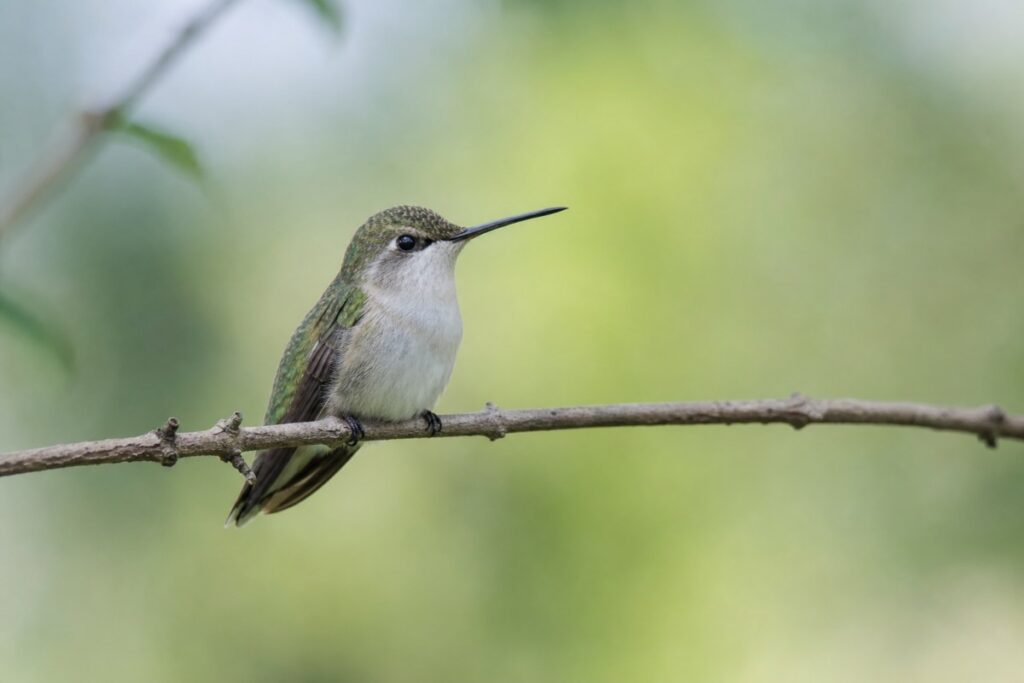
Most of the hummingbirds visiting North American backyards weigh between 3 and 4 grams. Hold a nickel between your fingers. A ruby-throated hummingbird weighs less than that. At the other extreme, the giant hummingbird (Patagona gigas) of the Andes tips the scales at 20 grams and stretches 8.5 inches long, which makes it about the size of a house sparrow. Even the “giant” of the family is still a small bird.
What makes their size remarkable isn’t the smallness itself. Plenty of insects are smaller. What’s remarkable is that a warm-blooded vertebrate can function at this scale without burning out. And the way they manage it has fascinated physiologists for over a century.
How Fast Do Hummingbird Wings Beat?
A ruby-throated hummingbird beats its wings roughly 50 times per second. The bee hummingbird manages about 80. During courtship display dives, males of several species push past 200 wingbeats per second. You will never see any of this at normal speed. The wings are just a gray smear and a faint hum.
And here’s what most backyard birding guides leave out: hummingbirds don’t flap. Not the way a robin or a hawk flaps. Their wings rotate in a figure-eight, producing lift on both the forward and the backward stroke. Mechanically, it’s more like how a bumblebee flies than how any other bird does. That figure-eight motion is what allows hummingbirds to hover dead still in the air, fly backward, fly sideways, and, for brief moments, fly upside down. No other bird species can do any of this.
The speed numbers get more extreme during courtship. Christopher James Clark, a researcher at UC Berkeley, used high-speed cameras to measure the courtship dive of a male Anna’s hummingbird. The bird reached approximately 90 feet per second. Relative to body length, that is faster than a peregrine falcon in a hunting stoop and faster than a fighter jet at full afterburner, when scaled for body size. At the bottom of the dive, when the bird flares its wings open and pulls up, its body absorbs roughly 9 G of force. Most fighter pilots black out between 7 and 8 G without a G-suit. The hummingbird does it, recovers instantly, and dives again.
In level cruising flight, hummingbirds are less dramatic but still quick: 25 to 30 mph on a normal trip between flowers, 40 mph or faster when chasing rivals off territory. Their flight muscles make up 25% of total body weight. In a human, the equivalent pectoral muscles are about 5%.
Hummingbird Heart Rate and Metabolism
This is where the biology starts to get hard to believe.
A hummingbird’s resting heart rate sits between 500 and 600 beats per minute. During flight, it accelerates to roughly 1,200 beats per minute. Your own heart, as you sit here reading this, is probably running around 65 to 80 beats per minute. A fit runner at full effort hits maybe 180. The hummingbird is at 1,200 while doing nothing more strenuous than flying between two flowers in your backyard.
The heart itself accounts for about 2.5% of the bird’s body weight, which is the largest heart-to-body ratio documented in any animal. Human hearts make up about 0.3% of our body mass. The hummingbird’s blood also carries a higher density of red blood cells than most other birds, which keeps oxygen delivery to the muscles constant during sustained flight.
All of this supports a metabolism that is, gram for gram, the fastest in the animal kingdom. Ruby-throated hummingbirds eat up to three times their own body weight in nectar and insects every day. The Journey North research team at the University of Wisconsin-Madison measured this and confirmed that the metabolic rate is the highest among not just birds, but all animals on the planet. I’ve seen the comparison worked out in human terms: if a 150-pound person ran a hummingbird’s metabolism, they would need to eat about 300 pounds of food per day just to stay alive. You would need to eat your body weight twice over before dinner.
Torpor: How Hummingbirds Survive the Night
Here is the problem with burning fuel that fast. You can’t stop eating for very long. And every hummingbird has to stop eating for eight to ten hours every night.
If a hummingbird tried to sleep at its normal body temperature, around 104°F, it would exhaust its stored energy and die before morning. So every night, most hummingbirds enter a state called torpor. It is not quite hibernation, and it is not quite sleep. It is a controlled emergency shutdown.
During torpor, heart rate crashes from 1,000-plus beats per minute to as low as 50. Body temperature drops to roughly 50°F. Metabolism falls by as much as 95%. Breathing slows to the point that the bird may go five minutes between breaths.
If you’ve ever found a hummingbird hanging motionless from a branch in early morning, maybe even upside down, looking completely dead, you were probably looking at a bird in torpor. Don’t disturb it.
About an hour before sunrise, the bird’s body begins rewarming through involuntary shivering. Temperature rises a few degrees per minute. Within about 20 minutes, the hummingbird is back to full function, and it flies off immediately. That first meal of the morning is urgent.
A 2023 study led by researchers at Washington University in St. Louis and Colombia’s Universidad Icesi found more flexibility in torpor than anyone expected. Some birds enter deep torpor for the full night. Others use shallow torpor for just a few hours. Smaller species use it more often. And birds in poor condition sometimes can’t rewarm on their own at all. They wait, barely alive, for direct sunlight to provide enough external heat to bring them back. Lead researcher Gustavo Londoño noted that for hummingbirds in poor condition, the line between surviving the night and not making it through is razor-thin.
What Do Hummingbirds Actually Eat?
I always ask this at birding talks, and almost everyone gets it wrong. They say nectar. Sugar water. Flower juice.
That’s 20% of the answer.
Entomologist Doug Tallamy at the University of Delaware has documented that roughly 80% of a hummingbird’s diet consists of small insects and spiders. Nectar provides sugar for quick energy. But protein, fat, amino acids, and minerals all come from prey. Without insects, a hummingbird cannot grow feathers, build muscle, or raise chicks. The nectar is fuel. The insects are food.
Watch a hummingbird near a flower bed on a warm afternoon. Not the one drinking from the blossoms. Watch the one hovering above the flowers, darting sideways, snapping at things you can barely see. It’s catching gnats, fruit flies, and aphids out of the air. Hummingbirds also pluck spiders off their webs and steal the silk for nest-building.
Their tongue alone is worth a paragraph. It’s grooved in a W-shape, with microscopic hair-like structures called lamellae at the tip. When the tongue enters a flower, the forked ends open, trap nectar through capillary action, and snap shut as the tongue retracts. This cycle repeats about 15 to 20 times per second. For decades, the assumption was that the tongue worked like a tiny straw, drawing nectar up by suction. In 2011, high-speed footage recorded at the University of Connecticut disproved that model entirely and demonstrated the capillary-trapping mechanism for the first time. It changed how biologists understand nectar feeding across multiple species.
Hummingbird Migration Distance
Ruby-throated hummingbirds migrate from the eastern United States and southern Canada to wintering grounds in southern Mexico and Central America. The one-way distance can exceed 1,500 miles. And many of these birds take the most direct route, which means flying straight across the Gulf of Mexico: 500 miles of open water with nowhere to land.
That crossing takes 18 to 22 hours of nonstop flight. The bird does it alone. Hummingbirds don’t migrate in flocks. There’s no group, no leader, no safety net. If conditions deteriorate mid-crossing, there is no Plan B.
To prepare, ruby-throats spend weeks gorging on nectar and insects, nearly doubling their body weight. A bird that normally weighs 3.25 grams bulks up to about 6 grams, with most of the extra weight stored as fat. Theodore Zenzal and Frank Moore at the University of Southern Mississippi published a study in The Auk: Ornithological Advances in 2016, calculating that a well-fed ruby-throat carries enough stored energy for about 1,200 miles of nonstop flight under favorable conditions. That margin is what separates the birds that reach the Yucatán from the ones that don’t.
Rufous hummingbirds go even farther. They fly roughly 4,000 miles from Mexico to breeding grounds in Alaska each spring, following wildflower blooms up the Pacific coast. For a bird lighter than a nickel, that’s one of the longest migrations relative to body size of any bird alive. If large-scale bird migrations interest you, our guide to bald eagle facts covers another American species built for long-distance endurance.
Hummingbird Brain, Memory, and Senses
Hummingbirds can’t smell anything. They have no functional sense of smell whatsoever.
They compensate with vision and a memory that borders on unsettling. A hummingbird’s brain makes up 4.2% of its body weight, the highest brain-to-body ratio among wild birds. That brain lets them remember the exact location of every flower and feeder they’ve visited and how long each one takes to refill. Controlled experiments have tested this directly: hummingbirds skip flowers they recently drained and return to the ones that have had enough time to produce fresh nectar. They maintain a spatial map and a time-based schedule simultaneously, and they update both in real time.
They also see ultraviolet light. Flowers that look solid red to human eyes often display vivid UV patterns that only hummingbirds and certain insects can perceive. And while hummingbirds clearly prefer red, orange, and pink blossoms, that preference is learned, not genetic. It’s reinforced by experience because red tubular flowers tend to offer the best nectar rewards. Put up a blue feeder full of sugar water. They’ll find it within a few days.
Nesting, Eggs, and Raising Chicks
A hummingbird nest is about the size of half a walnut shell, roughly 1.5 inches across. The female builds it alone from plant fibers, moss, and bits of lichen, all held together with spider silk that she pulls from webs. The silk does double duty: it binds the materials, and it stretches. As the chicks grow and push against the walls, the cup expands with them.

Nests sit on thin, downward-sloping twigs, typically 6 to 50 feet off the ground. They’re camouflaged with lichen and bark fragments so effectively that you can be standing directly below one and never know it’s there. I’ve missed them from two feet away and only found them by tracking where the female landed.
The eggs are white, smooth, and about the size of a jellybean. Each weighs under a gram. A typical clutch is two. Incubation runs 14 to 18 days, and the female does all of it. She also does all the feeding, delivering a slurry of regurgitated insects and nectar directly into the chicks’ mouths. The male is entirely absent after mating. Chicks leave the nest at 18 to 22 days, already full-sized and capable of flight on their first day out.
How Long Do Hummingbirds Live?
Shorter than you’d hope, but longer than you’d guess.
The average is 3 to 5 years, but that number is heavily skewed by a brutal first year. Between 80 and 90% of hummingbirds die before their first birthday. Cats, hawks, praying mantises, window strikes, cold snaps during migration, and simple starvation all cut young birds down before they learn the landscape well enough to survive reliably.
The birds that make it past year one do much better. The longevity record belongs to a female broad-tailed hummingbird banded in Colorado in 1976 and recaptured at the same site in 1987, making her at least 12 years and 2 months old. A black-chinned hummingbird was documented at over 11 years. At the Arizona-Sonora Desert Museum, two black-chinned hummingbirds in captive care reached 13 to 14 years.
Banding programs coordinated through the USGS Bird Banding Laboratory continue to push these records as more birds are individually tracked across their lifetimes. We still know almost nothing about the lifespans of the 300-plus tropical species that have never been studied at this level.
Best Flowers for Hummingbirds
If you want hummingbirds in your garden, skip the feeders and start with plants. Feeders are fine as a supplement, but native flowering plants do two things at once: they supply nectar and they support populations of small insects, which, as I mentioned earlier, make up the majority of the hummingbird diet.
Tubular flowers are the key. Hummingbird bills evolved to probe deep into narrow blooms, and flowers with that shape tend to produce the most nectar. The color matters less than people think. Red draws attention, but hummingbirds visit flowers of every color if the nectar reward is worth it.
Based on field observation and published pollinator research from the National Wildlife Federation, these native species consistently pull the most hummingbird activity across North America:
Trumpet vine (Campsis radicans) is the heavy hitter. It’s a vigorous climber with large orange-red tubular flowers, and it blooms from summer through early fall. It handles heat, drought, and neglect. Hummingbirds come back to established trumpet vines year after year.
Bee balm (Monarda didyma) produces dense flower clusters in red, pink, or purple. It grows in USDA zones 3 through 9, prefers moist soil, and attracts butterflies alongside the hummingbirds.
Cardinal flower (Lobelia cardinalis) is the one I’d plant first if I could only choose one. Tall spikes of bright red flowers from mid to late summer. In every eastern garden where I’ve seen it, it pulls hummingbirds consistently.
Coral honeysuckle (Lonicera sempervirens) is a native vine that blooms spring through fall and offers both nectar and perching cover.
Red columbine (Aquilegia canadensis) blooms early, right when the first spring migrants arrive and need reliable food sources after a long journey north.
Mix species that flower at different times so something is always blooming from April through October. And if you do use feeders, the recipe is simple: one part plain white sugar, four parts water. No red dye. No honey. No substitutes.
Frequently Asked Questions About Hummingbirds
How fast do hummingbird wings beat?
Between 10 and 80 beats per second, depending on species and body size. Ruby-throated hummingbirds average about 50 beats per second in normal flight. During courtship dives, some males reach 200 beats per second. Smaller hummingbirds beat their wings faster because smaller wings need more rapid movement to generate enough lift.
What do hummingbirds eat?
About 20% nectar and 80% insects and spiders, by dietary proportion. Nectar from flowers and sugar water feeders provides quick carbohydrate energy. Insects supply protein, fat, and minerals. Hummingbirds catch gnats, mosquitoes, aphids, and fruit flies in flight, and they also raid spider webs for prey and nest-building silk.
How far do hummingbirds migrate?
Ruby-throated hummingbirds travel up to 1,500 miles between eastern North America and Central America, including a 500-mile nonstop crossing of the Gulf of Mexico. Rufous hummingbirds fly about 4,000 miles between Mexico and Alaska each spring. Both species travel alone.
What is the smallest bird in the world?
The bee hummingbird, found only in Cuba, is the smallest bird alive. It measures 2.25 inches long and weighs under 2 grams. Its eggs are the size of coffee beans, and its nest is about an inch across.
How long do hummingbirds live?
Most live 3 to 5 years. The oldest wild hummingbird documented was a broad-tailed hummingbird in Colorado at 12 years and 2 months. First-year mortality is between 80 and 90%, so birds that survive their first full year have a much longer outlook.
What is the best flower to attract hummingbirds?
Trumpet vine, cardinal flower, bee balm, and coral honeysuckle are the strongest performers. All produce tubular blooms with high nectar volume. Native plants are better than ornamental varieties because they also attract the insects hummingbirds depend on for protein.
What is a hummingbird’s heart rate?
A hummingbird’s heart beats between 500 and 1,200 times per minute during daytime activity, depending on whether the bird is perched or flying. In torpor at night, the rate drops to about 50 beats per minute. A resting human heart, by comparison, beats about 72 times per minute.
How do you attract hummingbirds to your yard?
Plant native tubular flowers in red, orange, and pink. Hang feeders filled with one part white sugar to four parts water. Clean feeders every 3 to 5 days. Don’t use red dye, honey, or pesticides. Leave dead branches and dense shrubs in the yard for perching and nesting sites.