
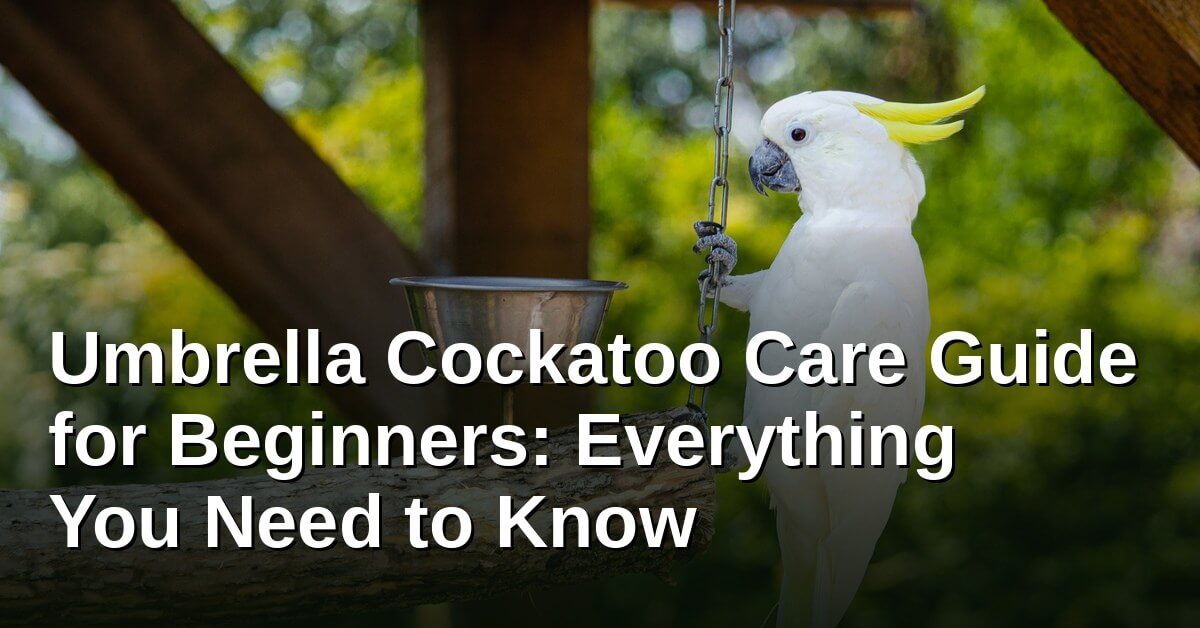
Nobody warns you about the screaming. They show you the photos — that brilliant white bird, crest fanned out, hanging upside down from someone’s finger like it invented joy — and you think: I need one of those. What the photos don’t capture is the 3 AM contact call that carries through two walls, or the morning your bird decides to redecorate the furniture with its beak. This umbrella cockatoo care guide for beginners exists to give you the full picture before you make a decision that could last 60 years — and then show you exactly how to give this remarkable bird the life it deserves.
QUICK STATS AT A GLANCE
- Lifespan: 50–70 Years
- Adult Size: 18–20 inches
- Adult Weight: 500–700 g
- USA Price 2026: $1,000–$3,000
- Daily Time Needed: 3–4 Hours
- Noise Level: Very High
01 — Species Overview: What You’re Actually Getting
The Umbrella Cockatoo (Cacatua alba) comes from a handful of islands in North Maluku, Indonesia — Halmahera, Bacan, Ternate, Tidore, Kasiruta, and Mandioli. In the wild, these birds live in lowland rainforest and mangroves, usually below 900 meters elevation. They eat seeds, fruit, insects, and roots, spending their days moving through the canopy in pairs or small flocks.
In captivity, however, they take all that energy — the foraging, the social contact, the constant stimulation of a forest — and focus it entirely on you. That’s what makes them extraordinary. It’s also what makes them one of the most demanding birds a person can keep.
The name itself comes from that crest. At rest, it lies flat against the head. When excited, alarmed, or just showing off, it fans up into a perfect arc of white feathers — umbrella-shaped, unmistakable. Males have very dark brown to black irises, while females tend toward reddish-brown. The difference is subtle and shouldn’t be used alone to sex a bird; a DNA test is the only reliable method.
Complete Quick-Reference Table

02 — Personality & Temperament — The “Velcro Bird” Explained
Every bird person eventually calls an Umbrella Cockatoo a “velcro bird.” The name sticks because the behavior is real. These birds don’t just enjoy your company — they require it at a physiological level. In a 2016 study published in Animal Cognition, Umbrella Cockatoos displayed measurable stress responses — elevated cortisol, repetitive movements — when separated from bonded companions for as little as 30 minutes. That’s not clinginess. That’s biology.
In practice, your bird will follow you room to room, call loudly when you leave its sight, press against you for contact preening, and generally act as though you are the most important thing in the world. On good days, this is exactly as wonderful as it sounds. On days when you need two hours of uninterrupted work time, however, it is genuinely difficult.
💡 What Experienced Owners Know: The most common reason Umbrella Cockatoos end up in rescue is not cruelty — it’s an owner who underestimated the emotional demand. Many birds develop severe feather-plucking or self-mutilation within the first year when placed in homes that can’t provide consistent daily contact. Research before adopting, then commit completely.
Reading Your Bird’s Body Language
Cockatoos communicate clearly through their crest. Learning to read it is one of the most practical skills a beginner can develop — it prevents bites, builds trust, and tells you exactly what your bird needs at any moment.
03 — Cage Size & Setup — Getting This Wrong Is Expensive
An Umbrella Cockatoo kept in a cage that’s too small will develop behavioral problems. Not might — will. These are large, physically active birds that spread their wings to 24 inches. A cage that doesn’t allow full wing extension forces chronic physical restriction, which compounds stress that already exists from confinement. By the time the feather-plucking starts, the pattern is often difficult to reverse.
Buy the largest cage your space permits. Use the dimensions below as a hard floor, not a target.
Cage Dimensions
What Goes Inside the Cage
⚠️ Never Place the Cage Here: Kitchen: Non-stick cookware (PTFE/Teflon) releases odorless fumes at high heat that kill birds in minutes. A cockatoo anywhere near a kitchen — even an adjacent room with airflow — is at risk. Also avoid: direct window sunlight without shade (heat stroke), rooms where the bird is isolated from family activity all day, and near air conditioning vents.

04 — Diet & Nutrition — The #1 Way Cockatoos Die Young
More Umbrella Cockatoos die prematurely from diet-related illness than from any other cause. The culprit is almost always a seed-heavy diet — sold in colorful bags, eaten enthusiastically by the bird, and completely inadequate as a primary food source. Seeds are roughly 40–60% fat. Over 3–5 years, a seed diet drives fatty liver disease, vitamin A deficiency, and atherosclerosis. These conditions develop quietly and then present as emergencies.
As a result, the transition from seeds to pellets takes patience. In fact, many birds resist it for weeks. Don’t give up. The long-term difference in health outcomes is not subtle — it’s the difference between a bird that lives to 60 and one that dies at 15.
Daily Diet Breakdown
🚫 Foods That Can Kill Your Cockatoo: Avocado — the compound persin causes fatal cardiac failure, often within hours. Chocolate — theobromine is toxic at any amount. Onion & Garlic — destroy red blood cells. Caffeine — cardiac arrhythmia, potentially fatal. Fruit pits & apple seeds — contain cyanide compounds. Alcohol — toxic at any dose. Raw beans — hemagglutinin toxin, destroyed only by cooking. Rhubarb — oxalic acid causes kidney failure. Heavily salted human food — their kidneys cannot process sodium the way ours can.
Water and Humidity
Since Umbrella Cockatoos originate from tropical Indonesia, they are naturally accustomed to high humidity. In dry homes — especially in winter with forced-air heating — their skin and feathers suffer noticeably. For this reason, change water at least twice daily and aim for a room humidity level of 45–55%. Many cockatoo owners mist their bird lightly with warm water 3–4 times a week, or provide a shower perch once weekly. Most birds love it, and it dramatically improves feather condition over time.
05 — The Noise Reality — An Honest Assessment Before You Commit
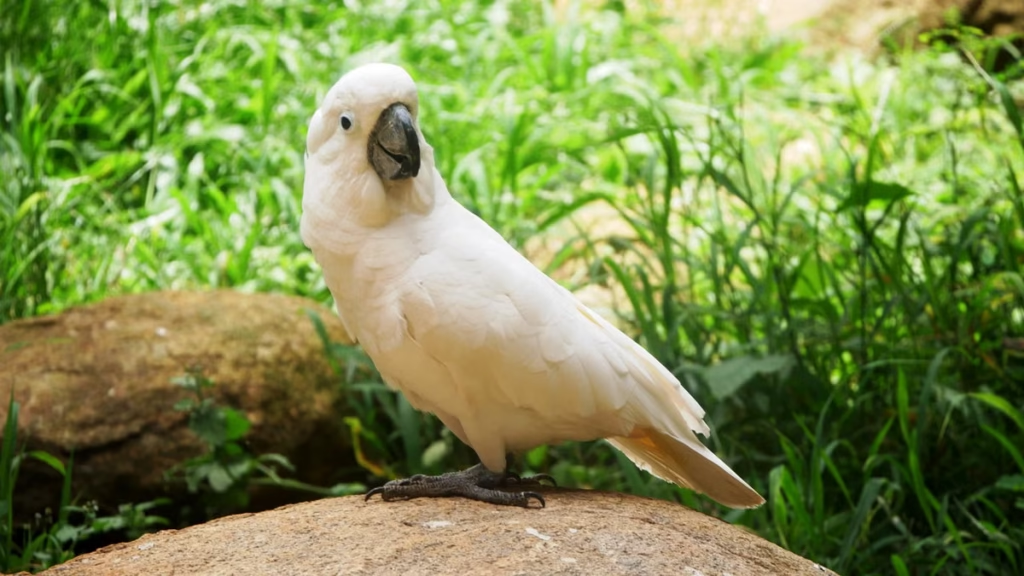
This section exists because most care guides skip it or soften it. They shouldn’t. Umbrella Cockatoos are among the loudest birds kept as pets. Their contact calls — the screams used to locate flock members in the wild — can reach 135 decibels. That’s louder than a lawnmower and approaching chainsaw territory. In a house, that sound carries through walls and floors.
Specifically, there are two predictable scream windows every day: dawn and dusk. These are instinctive and cannot be fully trained away — they are part of the bird’s biological rhythm. However, you can reduce excessive screaming triggered by boredom or attention-seeking through consistent training and enrichment. You cannot, though, eliminate the contact calls entirely.
Noise Level Comparison by Species
- Cockatiel — Low
- African Grey — Moderate
- Macaw — High
- Umbrella Cockatoo — Very High
- Moluccan Cockatoo — Extreme
📍 Who Should NOT Own an Umbrella Cockatoo: Apartment dwellers in buildings with shared walls. Anyone who works from home and needs quiet for calls or concentration. Households where noise causes significant stress or conflict. Families with newborns or young children who sleep lightly. People who travel frequently for work — even a few days a week is too much absence for this species.
If you’re in any of those categories and still want a large, intelligent parrot, an African Grey is worth considering instead — they are significantly quieter while matching cockatoos in intelligence. You can read the African Grey Parrot Complete Care Guide on Wild Birds USA to compare both species directly before deciding.
06 — Training & Bonding — Building Real Trust From Day One
Umbrella Cockatoos learn fast. That’s the good news. However, the other side of it is they learn bad habits just as quickly as good ones. A bird that discovers screaming gets your attention will scream reliably. A bird that figures out biting ends an unwanted interaction will bite. As a result, the patterns you establish in the first six months of ownership tend to last years.
Positive reinforcement is the only training method that works long-term with this species. Punishment — raised voice, cage rattling, water spraying — doesn’t teach a cockatoo what you want. Instead, it teaches them that you’re unpredictable and potentially dangerous. A cockatoo that fears you is one that bites, screams, and plucks. Trust, once broken, takes months to rebuild.
The Five-Step Training Framework
⏱ Session Length Matters: Keep training sessions to 5–10 minutes, twice a day. Cockatoos are emotionally sensitive — longer sessions create frustration on both sides. End every session on a success, even if that means stepping back to something the bird already knows. Ending on a win builds the positive association you need for the next session.
07 — Health & Common Conditions — What to Watch and When to Act
Birds evolved as prey animals, which means they are extremely good at hiding illness. A sick cockatoo in the wild is a cockatoo that gets eaten. Because of this evolutionary instinct, by the time your bird shows obvious symptoms — sitting on the cage floor, eyes half-closed, feathers puffed — the condition is often well-advanced. Therefore, weekly weight monitoring (a digital kitchen scale works fine) catches problems weeks before visible symptoms appear. A healthy adult Umbrella Cockatoo weighs 500–700 grams. A drop of more than 10% from the bird’s established baseline warrants an immediate vet call.
⚠️ Avian Vet vs. General Vet — This Distinction Saves Lives: A general small-animal vet who “sees birds occasionally” is not equipped for avian medicine. Exotic bird medicine is a separate specialization. Blood panels, diagnostic tools, drug dosing, and treatment protocols differ significantly from mammals. Ask specifically for a vet with board certification in avian medicine — not one who simply lists birds among the species they see. Establish that relationship before you bring your bird home, not during an emergency.
Common Health Conditions to Monitor
Annual Veterinary Care Checklist
For this reason, every Umbrella Cockatoo needs a yearly exam even when it appears completely healthy. This should include:
- Physical examination covering beak, nails, and eyes
- Complete blood panel (CBC + chemistry)
- Choanal swab for bacterial and fungal culture
- Fecal gram stain
- Weight documented against the prior year
- Psittacosis titer (recommended by some vets annually)
For this reason, every Umbrella Cockatoo needs a yearly exam even when it appears completely healthy. This should include: physical examination covering beak, nails, and eyes; a complete blood panel (CBC + chemistry); choanal swab for bacterial and fungal culture; fecal gram stain; and weight documented against the prior year. In addition, some vets recommend a psittacosis titer annually. The VCA Animal Hospitals network provides detailed dietary and health guidelines reviewed by board-certified avian veterinarians at VCA Animal Hospitals — Cockatoos Feeding Guide.
08 — What Does an Umbrella Cockatoo Actually Cost? (Full Breakdown)
The purchase price is the smallest number in the 60-year total. In fact, most first-time owners don’t realize this until they’re already in. Below is an honest cost estimate for Year 1 and ongoing annual costs — based on 2026 US prices.
Year 1 Startup Costs vs. Ongoing Annual Expenses
📌 On Adoption vs. Purchase: Parrot rescues across the US have Umbrella Cockatoos available at any given time — most surrendered not through mistreatment but through life changes the original owner didn’t anticipate. Adoption fees typically run $200–$600. An adult rescue cockatoo is not a lesser bird. Many are deeply bonded and absolutely ready for a committed home. The adjustment period requires more patience upfront — but the relationship you build is just as strong.
09 — Is an Umbrella Cockatoo Right for You?
I’m not going to tell you everyone should have one. That’s not true, and telling you otherwise would be doing a disservice to both you and the bird.
The Daily Reality of Ownership
Umbrella Cockatoos need 3–4 hours of real daily interaction — not hours where you’re in the same room on your phone, but actual engagement: training, conversation, play. A stable daily routine matters enormously, because disruption causes visible distress. Moreover, these birds live 50–70 years and will remember every kindness and every failure. Expect them to destroy things with enthusiasm. Screaming at dawn is not something your sleep schedule can override. The bond, however, runs both directions — your bird will feel it just as intensely when you leave for work each morning, and studies have measured that stress response directly.
What You Get in Return
Over time, your bird will learn your voice. It will greet you at the cage door when you come home, and as the relationship deepens, it will figure out your name and use it. Given enough time, it will sometimes — not always, but sometimes — say exactly what the situation calls for. As a result, the relationship that builds over years with one of these birds is unlike any other in aviculture.
If you have the time, the stability, the home environment, and the genuine commitment this bird requires — the Umbrella Cockatoo is one of the most rewarding animals you can share your life with. If you’re not certain, give it another year. The right moment to get one is when you’re completely ready, not when the impulse is loudest.
10 — Frequently Asked Questions
How long do Umbrella Cockatoos live in captivity?
With competent daily care, 50 to 70 years is the realistic range. Some documented individuals have exceeded 80 years. The key word is “care” — a bird on a seed diet without regular vet visits may develop fatal organ disease within 10–15 years. The lifespan potential is there; reaching it requires sustained commitment to diet, health, and mental wellbeing.
Are Umbrella Cockatoos good for beginners?
Honest answer: they’re challenging even for experienced bird owners. If you’re new to parrots, start with a smaller species — a cockatiel or a conure — to develop your understanding of bird behavior, body language, and care routines. After two or more years with a smaller parrot, the transition to a cockatoo goes significantly better. Going straight to a cockatoo as a first bird is possible but sets up both owner and bird for a harder road.
Do Umbrella Cockatoos talk?
Some do, many don’t — and the ones that talk generally don’t match an African Grey in vocabulary or clarity. Umbrella Cockatoos are not primarily talkers; they’re primarily emotional, physical companions. If you want a parrot for its talking ability, an African Grey or an Amazon parrot is a better fit. If you want a bird that will bond to you completely and make your home feel alive, the cockatoo delivers that in a way few other animals can.
What is the minimum cage size for an Umbrella Cockatoo?
The hard minimum is 36 × 36 × 48 inches (width × depth × height). Below that, the bird cannot extend its wings fully, which causes chronic physical restriction and compounds psychological stress. But minimum should never be the goal. Buy the largest cage your space and budget allow. A bird spending 10–12 hours a day in an enclosure benefits enormously from extra room.
How many hours a day does an Umbrella Cockatoo need outside its cage?
At minimum, 3–4 hours of supervised out-of-cage time daily. This isn’t passive time with the bird sitting on a perch while you watch TV — it’s active engagement: training, play, conversation, or simply being physically present with the bird in the same activity. Cockatoos kept in cages for the majority of every day without meaningful interaction develop feather-destructive behavior and chronic screaming that are genuinely difficult to reverse.
Can Umbrella Cockatoos live with other birds?
With careful introduction, yes. Cockatoos can coexist with other large parrots in the same household, though they should have separate cages and supervised interactions until compatibility is established. Never house a cockatoo with significantly smaller birds — the size and beak strength difference is dangerous even during play. Cockatoos raised together from young ages generally do best.
How do I stop my Umbrella Cockatoo from screaming?
First, understand that some screaming — at dawn, at dusk, when alarmed — is normal and non-negotiable. For screaming triggered by boredom or attention-seeking: never go to the cage during an episode. Wait for 3 seconds of quiet, then go reward it. The bird learns silence gets your attention, screaming doesn’t. Increase foraging toys, enrichment, and training sessions. Predictable daily interaction reduces demand-screaming significantly.
What’s the difference between an Umbrella Cockatoo and a Moluccan Cockatoo?
The Moluccan (Salmon-crested Cockatoo) is larger, salmon-pink instead of white, and generally considered even more emotionally intense and louder than the Umbrella. For most beginners wanting a large white cockatoo, the Umbrella is the more manageable choice. Both species have extremely high social needs and are not suited to owners who can’t provide 3–4 hours of daily engagement.
Follow Wild Birds USA — We’re Everywhere You Are
Every single day we post exotic bird videos, funny parrot moments, and honest care guides that no one else covers the way we do. If you’ve ever laughed at a cockatoo throwing a tantrum, facepalmed at a macaw outsmarting its owner, or just needed a two-minute break that involves a bird doing something ridiculous — you’re in the right place.
Pick your platform below and hit follow. We post daily. You won’t regret it.
🌿 wildbirdsusa.net — Exotic Bird Care, Done Right.